The weight of intellectual stagnation: How reliance on AI can hinder genuine learning and critical thinking in students. Image (and typos) generated by Nano Banana.
Source
The New York Times
Summary
Anastasia Berg, a philosophy professor at the University of California, Irvine, contends that even minimal reliance on AI tools threatens students’ cognitive development and linguistic competence. Drawing on her experience of widespread AI use in a moral philosophy course, Berg argues that generative AI erodes the foundational processes of reading, reasoning, and self-expression that underpin higher learning and democratic citizenship. While past technologies reshaped cognition, she claims AI uniquely undermines the human capacity for thought itself by outsourcing linguistic effort. Berg calls for renewed emphasis on tech-free learning environments to protect students’ intellectual autonomy and critical literacy.
Key Points
Over half of Berg’s students used AI to complete philosophy exams.
AI shortcuts inhibit linguistic and conceptual growth central to thinking.
Even “harmless” uses, like summarising, weaken cognitive engagement.
Cognitive decline could threaten democratic participation and self-rule.
Universities should create tech-free spaces to rebuild reading and writing skills.
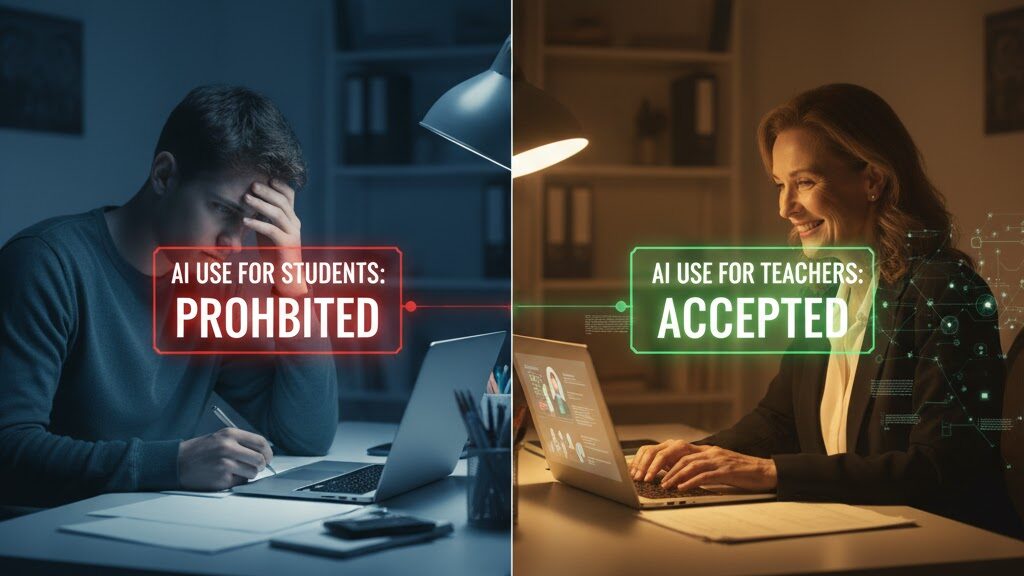
The double standard: Exploring why AI use might be acceptable for educators yet detrimental for students’ learning and development. Image (and typos) generated by Nano Banana.
Source
Edutopia
Summary
History and journalism teacher David Cutler argues that while generative AI can meaningfully enhance teachers’ feedback and efficiency, students should not use it unsupervised. Teachers possess the critical judgment to evaluate AI outputs, but students risk bypassing essential cognitive processes and genuine understanding. Cutler likens premature AI use to handing a calculator to someone who hasn’t learned basic arithmetic. He instead promotes structured, transparent use—AI for non-assessed learning or teacher moderation—while continuing to teach critical thinking and writing through in-class work. His stance reflects both ethical caution and pragmatic optimism about AI’s potential to support, not supplant, human learning.
Key Points
Teachers can use AI to improve feedback, fairness, and grading efficiency.
Students lack the maturity and foundational skills for unsupervised AI use.
In-class writing fosters integrity, ownership, and authentic reasoning.
Transparent teacher use models responsible AI practice.
Slow, deliberate adoption best protects student learning and trust.
Department of Education and Youth & Oide Technology in Education, October 2025
Summary
This national guidance document provides Irish schools with a framework for the safe, ethical, and effective use of artificial intelligence (AI), particularly generative AI (GenAI), in teaching, learning, and school leadership. It aims to support informed decision-making, enhance digital competence, and align AI use with Ireland’s Digital Strategy for Schools to 2027. The guidance recognises AI’s potential to support learning design, assessment, and communication while emphasising human oversight, teacher professionalism, and data protection.
It presents a balanced view of benefits and risks—AI can personalise learning and streamline administration but also raises issues of bias, misinformation, data privacy, and environmental impact. The report introduces a 4P framework—Purpose, Planning, Policies, and Practice—to guide schools in integrating AI responsibly. Teachers are encouraged to use GenAI as a creative aid, not a substitute, and to embed AI literacy in curricula. The document stresses the need for ethical awareness, alignment with GDPR and the EU AI Act (2024), and continuous policy updates as technology evolves.
Key Points
AI should support, not replace, human-led teaching and learning.
Responsible use requires human oversight, verification, and ethical reflection.
AI literacy for teachers, students, and leaders is central to safe adoption.
Compliance with GDPR and the EU AI Act ensures privacy and transparency.
GenAI tools must be age-appropriate and used within consent frameworks.
Bias, misinformation, and “hallucinations” demand critical human review.
The 4P Approach (Purpose, Planning, Policies, Practice) structures school-level implementation.
Environmental and wellbeing impacts must be considered in AI use.
Collaboration between the Department, Oide, and schools underpins future updates.
Guidance will be continuously revised to reflect evolving practice and research.
Conclusion
The guidance frames AI as a powerful but high-responsibility tool in education. By centring ethics, human agency, and data protection, schools can harness AI’s potential while safeguarding learners’ wellbeing, trust, and equity. Its iterative, values-led approach ensures Ireland’s education system remains adaptive, inclusive, and future-ready.
by Jonathan Sansom – Director of Digital Strategy, Hills Road Sixth Form College, Cambridge
Estimated reading time: 5 minutes
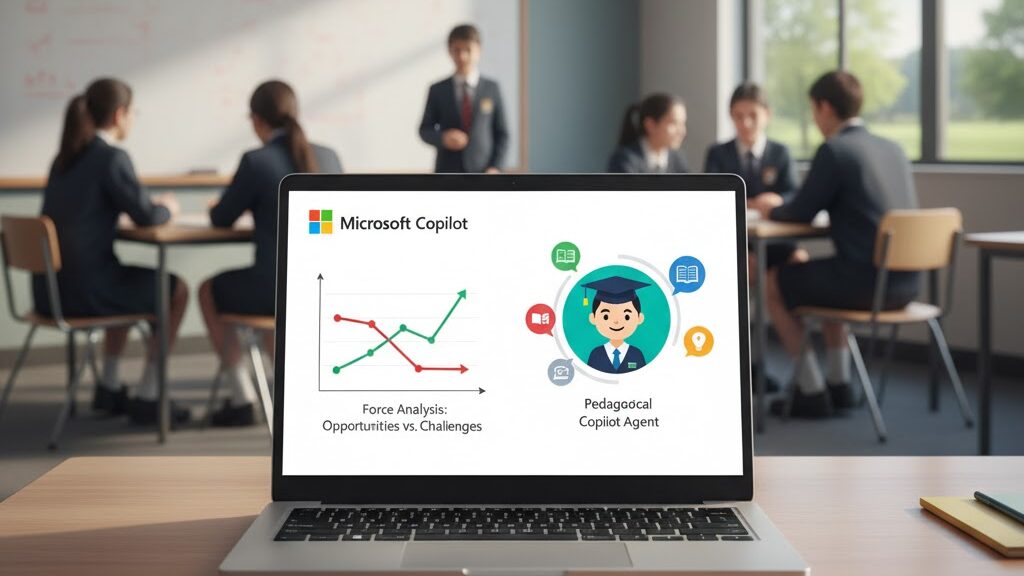
Bridging the gap: This image illustrates how Microsoft Copilot can be leveraged in secondary education, moving from a “force analysis” of opportunities and challenges to the implementation of “pedagogical copilot agents” that assist both students and educators. Image (and typos) generated by Nano Banana.
At Hills Road, we’ve been living in the strange middle ground of generative AI adoption. If you charted its trajectory, it wouldn’t look like a neat curve or even the familiar ‘hype cycle’. It’s more like a tangled ball of wool: multiple forces pulling in competing directions.
The Forces at Play
Our recent work with Copilot Agents has made this more obvious. If we attempt a force analysis, the drivers for GenAI adoption are strong:
The need to equip students and staff with future-ready skills.
Policy and regulatory expectations, from DfE and Ofsted, to show assurance around AI integration.
National AI strategies that frame this as an essential area for investment.
The promise of personalised learning and workload reduction.
A pervasive cultural hype, blending existential narratives with a relentless ‘AI sales’ culture.
But there are also significant restraints:
Ongoing academic integrity concerns.
GDPR and data privacy ambiguity.
Patchy CPD and teacher digital confidence.
Digital equity and access challenges.
The energy cost of AI at scale.
Polarisation of educator opinion, and staff change fatigue.
The result is persistent dissonance. AI is neither fully embraced nor rejected; instead, we are all negotiating what it might mean in our own settings.
Educator-Led AI Design
One way we’ve tried to respond is through educator-led design. Our philosophy is simple: we shouldn’t just adopt GenAI; we must adapt it to fit our educational context.
That thinking first surfaced in experiments on Poe.com, where we created an Extended Project Qualification (EPQ) Virtual Mentor. It was popular, but it lived outside institutional control – not enterprise and not GDPR-secure.
So in 2025 we have moved everything in-house. Using Microsoft Copilot Studio, we created 36 curriculum-specific agents, one for each A Level subject, deployed directly inside Teams. These agents are connected to our SharePoint course resources, ensuring students and staff interact with AI in a trusted, institutionally managed environment.
Built-in Pedagogical Skills
Rather than thinking of these agents as simply ‘question answering machines’, we’ve tried to embed pedagogical skills that mirror what good teaching looks like. Each agent is structured around:
Explaining through metaphor and analogy – helping students access complex ideas in simple, relatable ways.
Prompting reflection – asking students to think aloud, reconsider, or connect their ideas.
Stretching higher-order thinking – moving beyond recall into analysis, synthesis, and evaluation.
Encouraging subject language use – reinforcing terminology in context.
Providing scaffolded progression – introducing concepts step by step, only deepening complexity as students respond.
Supporting responsible AI use – modelling ethical engagement and critical AI literacy.
These skills give the agents an educational texture. For example, if a sociology student asks: “What does patriarchy mean, but in normal terms?”, the agent won’t produce a dense definition. It will begin with a metaphor from everyday life, check understanding through a follow-up question, and then carefully layer in disciplinary concepts. The process is dialogic and recursive, echoing the scaffolding teachers already use in classrooms.
The Case for Copilot
We’re well aware that Microsoft Copilot Studio wasn’t designed as a pedagogical platform. It comes from the world of Power Automate, not the classroom. In many ways we’re “hijacking” it for our purposes. But it works.
The technical model is efficient: one Copilot Studio authoring licence, no full Copilot licences required, and all interactions handled through Teams chat. Data stays in tenancy, governed by our 365 permissions. It’s simple, secure, and scalable.
And crucially, it has allowed us to position AI as a learning partner, not a replacement for teaching. Our mantra remains: pedagogy first, technology second.
Lessons Learned So Far
From our pilots, a few lessons stand out:
Moving to an in-tenancy model was essential for trust.
Pedagogy must remain the driver – we want meaningful learning conversations, not shortcuts to answers.
Expectations must be realistic. Copilot Studio has clear limitations, especially in STEM contexts where dialogue is weaker.
AI integration is as much about culture, training, and mindset as it is about the underlying technology.
Looking Ahead
As we head into 2025–26, we’re expanding staff training, refining agent ‘skills’, and building metrics to assess impact. We know this is a long-haul project – five years at least – but it feels like the right direction.
The GenAI systems that students and teachers are often using in college were in the main designed mainly by engineers, developers, and commercial actors. What’s missing is the educator’s voice. Our work is about inserting that voice: shaping AI not just as a tool for efficiency, but as an ally for reflection, questioning, and deeper thinking.
The challenge is to keep students out of what I’ve called the ‘Cognitive Valley’, that place where understanding is lost because thinking has been short-circuited. Good pedagogical AI can help us avoid that.
We’re not there yet. Some results are excellent, others uneven. But the work is underway, and the potential is undeniable. The task now is to make GenAI fit our context, not the other way around.
Jonathan Sansom
Director of Digital Strategy, Hills Road Sixth Form College, Cambridge
Passionate about education, digital strategy in education, social and political perspectives on the purpose of learning, cultural change, wellbeing, group dynamics, – and the mysteries of creativity…
While AI offers efficiency in creating lesson plans, a new report suggests that these automated curricula often fall short in fostering student inspiration and promoting essential critical thinking skills. This visual highlights the gap between AI-generated structures and the nuanced needs of engaging pedagogy. Image (and typos) generated by Nano Banana.
Source
The Conversation
Summary
Torrey Trust reports that AI-generated lesson plans, though convenient, fail to promote higher-order thinking and inclusivity in the classroom. In a study analysing 311 AI-created civics lesson plans from ChatGPT, Gemini, and Copilot, 90 per cent of activities were found to encourage only basic recall and comprehension rather than critical or creative thinking. Using frameworks such as Bloom’s taxonomy and Banks’ multicultural integration model, the researchers found that only 6 per cent of plans included diverse perspectives or representation of marginalised groups. The study warns that while AI tools can save teachers time, they risk reproducing formulaic, one-size-fits-all instruction. Teachers are encouraged to use AI for inspiration—not automation—and to embed context, creativity, and cultural depth into their own designs.
Key Points
311 AI-generated civics lesson plans were analysed using Bloom’s taxonomy and Banks’ model.
90 per cent of activities promoted only lower-order thinking skills such as memorisation and recall.
Only 6 per cent included multicultural or diverse perspectives.
AI tools produce generic, context-free lesson plans not tailored to real classrooms.
Educators should use AI as a support tool, prompting it with detailed, critical instructions.