How AI Is Rewriting the Future of Humanities Education


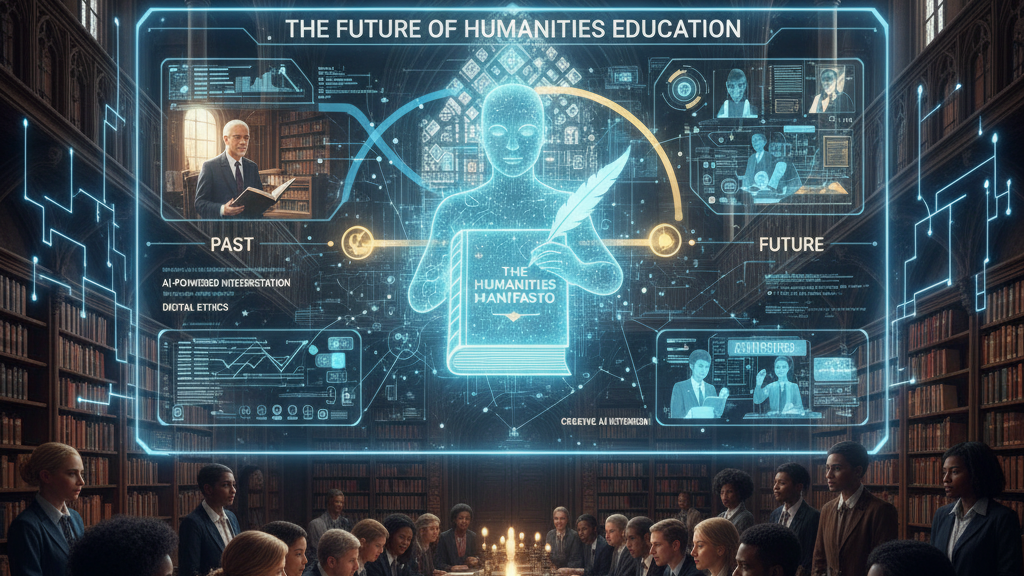
In a grand, ornate university library, a group of diverse students and professors are seated around a long, candlelit wooden table, engaged in a discussion. Above them, a large holographic display titled "THE FUTURE OF HUMANITIES EDUCATION" shows a central figure holding "THE HUMANITIES MANIFESTO" with a quill, flanked by "PAST" and "FUTURE" panels detailing AI-powered interpretation, digital ethics, and evolving roles of AI in humanities. Image (and typos) generated by Nano Banana.
Artificial intelligence is not merely influencing but actively “rewriting” the trajectory of humanities education, prompting a re-evaluation of its foundational principles and methodologies. This image captures a moment of deep academic reflection, visualizing how AI is introducing new tools for interpretation, posing ethical challenges, and ultimately shaping a dynamic new future for the study of human culture and thought. Image (and typos) generated by Nano Banana.

Source

Forbes

Summary

Mary Hemphill argues that while AI is rapidly changing technical and STEM fields, its impact on the humanities may be even more profound. She sees AI not just as a tool but a collaborator—helping students explore new interpretations, generate creative prompts, and push boundaries in writing, philosophy, or cultural critique. But this is double-edged: overreliance risks hollowing out the labour of thinking deeply, undermining the craft faculty value. Hemphill suggests humanities courses must adapt via “AI-native” pedagogy: teaching prompt literacy, interrogative reading, and critical layering. The goal: use AI to elevate human thinking, not replace it.

Key Points

  • Humanities may shift from sourcing facts to exploring deeper interpretation, guided by AI-assisted exploration.
  • Students should be taught prompt literacy—how to interrogate AI outputs, not accept them.
  • “AI-native” pedagogy: adaptation of assignments to expect AI use, layered with critical human engagement.
  • Overreliance on AI can weaken students’ capacity for independent thinking and textual craftsmanship.
  • Humanities faculty must lead design of AI integration that preserves the values of the discipline.

Keywords

URL

https://www.forbes.com/sites/maryhemphill/2025/10/01/how-ai-is-rewriting-the-future-of-humanities-education/

Summary generated by ChatGPT 5


In the Age of AI, Are Universities Doomed?


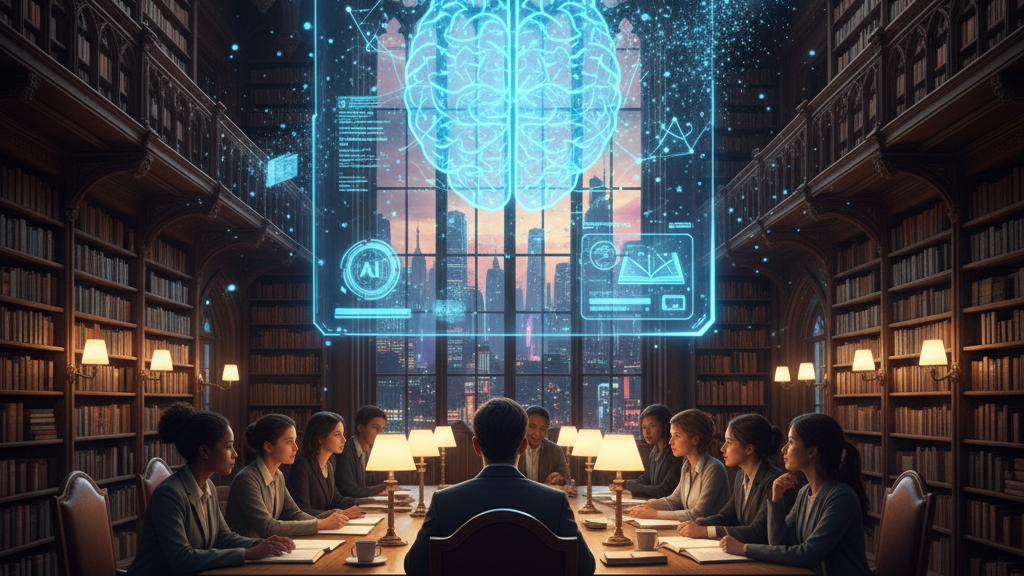
A group of academic figures and students are seated around a grand, traditional university library table, looking towards a glowing, holographic projection of a human brain with interconnected digital pathways, overlaid with various data points and "AI" labels. The brain appears against a backdrop of a city skyline at dusk. Image (and typos) generated by Nano Banana.
The rapid advancement of Artificial Intelligence prompts a critical question: What is the future of higher education? This image explores the intersection of classic academic settings and cutting-edge AI, contemplating whether universities are on the brink of obsolescence or transformation in this new technological era. Image (and typos) generated by Nano Banana.

Source

The Walrus

Summary

Robert Gibbs reflects on how universities must adapt in an era where AI and digital tools erode their traditional role as repositories of knowledge. With information universally accessible, the value of higher education lies less in storing facts and more in fostering judgement, interpretation, and critical inquiry. Drawing on experiences at the University of Toronto’s Jackman Humanities Institute, Gibbs argues the humanities’ long tradition of commentary, reflection, and editing can guide universities in cultivating discernment and slow, thoughtful learning. In the face of rapid information flows and AI-driven content, universities must champion practices that value reflection, contextual reading, and intellectual judgement over efficiency.

Key Points

  • Universities can no longer justify themselves as mere repositories of information, since knowledge is now widely accessible.
  • The mission should shift to developing interpretation, critique, and judgement as central student skills.
  • Humanities traditions of commentary, redaction, and reflection offer models for navigating digital and AI contexts.
  • Libraries and collaborative digital humanities projects show how to combine old scholarly methods with new technology.
  • In an era of speed and distraction, universities should foster slower, deeper reading and writing to cultivate discernment.

Keywords

URL

https://thewalrus.ca/universities-in-the-age-of-ai/

Summary generated by ChatGPT 5


Academics ‘marking students down’ when they suspect AI use


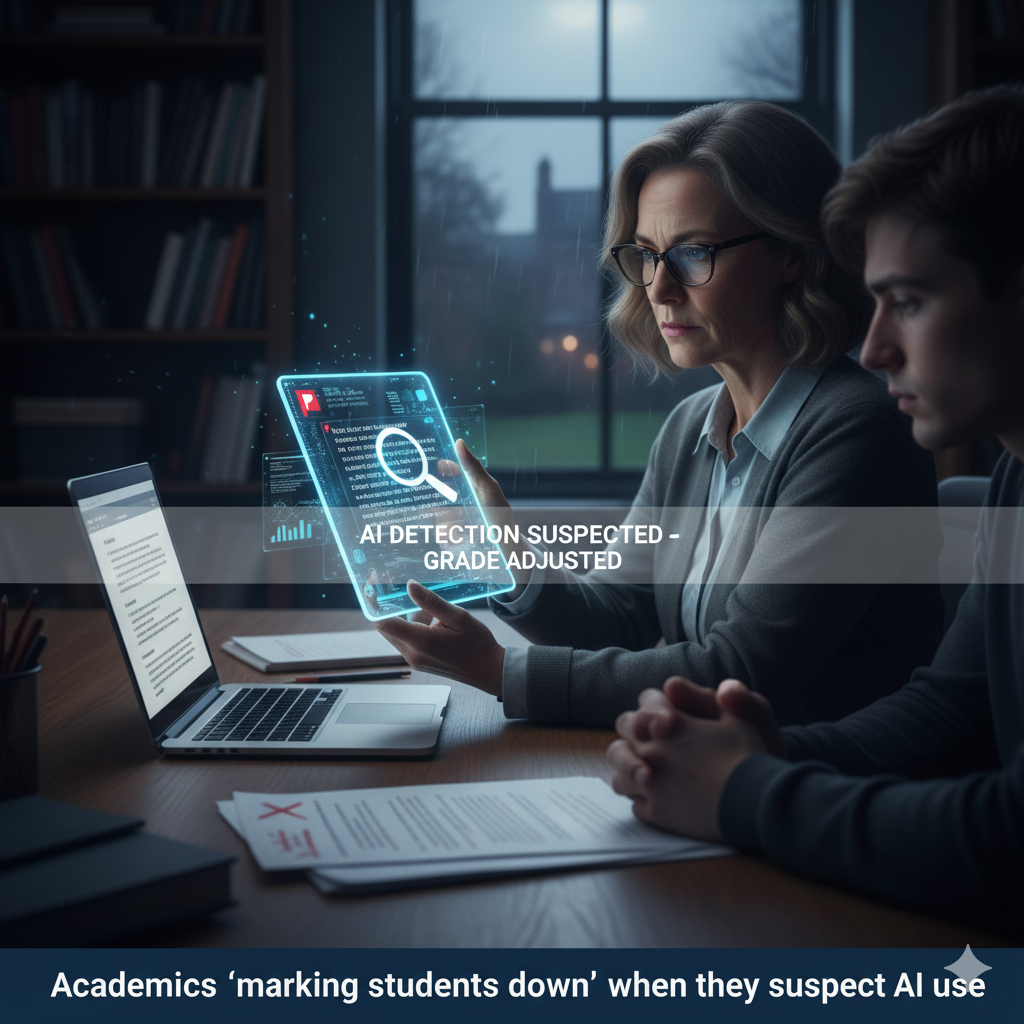
A concerned academic, wearing glasses, sits across from a student, both looking at a transparent tablet displaying 'AI detection suspected - Grade Adjusted' with code and charts. A laptop with an essay is open on the left, and a document with a large red 'X' is on the table, symbolizing suspicion of AI use in academic work. Generated by Nano Banana.
The rise of AI in education presents new challenges for assessment. This image visualizes the tension and scrutiny faced by students as academics grapple with suspected AI use in assignments, leading to difficult conversations and potential grade adjustments. Image generated by Nano Banana.

Source

Times Higher Education

Summary

A recent study of academics in China’s Greater Bay Area reveals that some lecturers are reducing student marks if they suspect AI use, even when the students have declared using it or when institutional policy allows such use. The research, involving 33 academics, highlights that ambiguity around what constitutes legitimate AI use and norms emphasising originality and independence, leads to inconsistent grading. Particularly in the humanities, suspicion of AI can lead to harsher penalties. The lack of explicit expectations communicated to students exacerbates the issue, risking distrust and undermining the credibility of academic grading unless clearer standards are established.

Key Points

  • Academics are sometimes deducting marks based on suspicion of AI use, despite declared or permitted use.
  • The study involved 33 academics, many of whom report tension between policies that permit AI and traditional values of originality and independence.
  • Humanities lecturers are more likely to penalise AI-use suspicion than those in other disciplines.
  • Many institutions lack clear policies; expectations about AI use are often implicit, not explicitly communicated to students.
  • Without clarity, there is a risk of unfair marking, loss of trust between students and staff, and damage to the credibility of academic certifications.

Keywords

URL

https://www.timeshighereducation.com/news/academics-marking-students-down-when-they-suspect-ai-use

Summary generated by ChatGPT 5


AI Defeats the Purpose of a Humanities Education


In a grand, traditional university library, a massive, monolithic black AI construct with glowing blue circuit patterns and red text displaying "HUMANITIES INTEGRITY: 0%" is violently crashing into a long wooden conference table, scattering books and ancient busts. A group of somber-faced academics in robes stands around, observing the destruction with concern. Image (and typos) generated by Nano Banana.
This image powerfully visualises the concern that AI’s capabilities might fundamentally undermine the core purpose of a humanities education. The crashing digital monolith symbolises AI’s disruptive force, threatening to erode the value of human critical thought, interpretation, and creativity that humanities disciplines aim to cultivate. Image (and typos) generated by Nano Banana.

Source

The Harvard Crimson

Summary

The authors argue that generative AI tools fundamentally conflict with what a humanities education aims to do: teach students how to think, read, write, and argue as humans do, rather than delegating those tasks to machines. They claim AI can polish writing but misses the point of learning through struggle, critique, and revision. The piece calls for banning generative AI in humanities courses, saying that even mild uses still sidestep essential intellectual growth. Imperfect, difficult writing is better for learning than polished AI‑assisted work.

Key Points

  • AI polishing undermines the learning process of struggle and critique.
  • Imperfect essays without AI are more educational.
  • Inconsistent policies across faculty cause confusion.
  • Humanities should preserve authentic human expression and critical thinking.
  • Banning AI helps preserve rigor and humanistic values.

Keywords

URL

https://www.thecrimson.com/article/2025/9/9/chiocco-farrell-harvard-ai/

Summary generated by ChatGPT 5