We Asked Teachers About Their Experiences With AI in the Classroom — Here’s What They Said


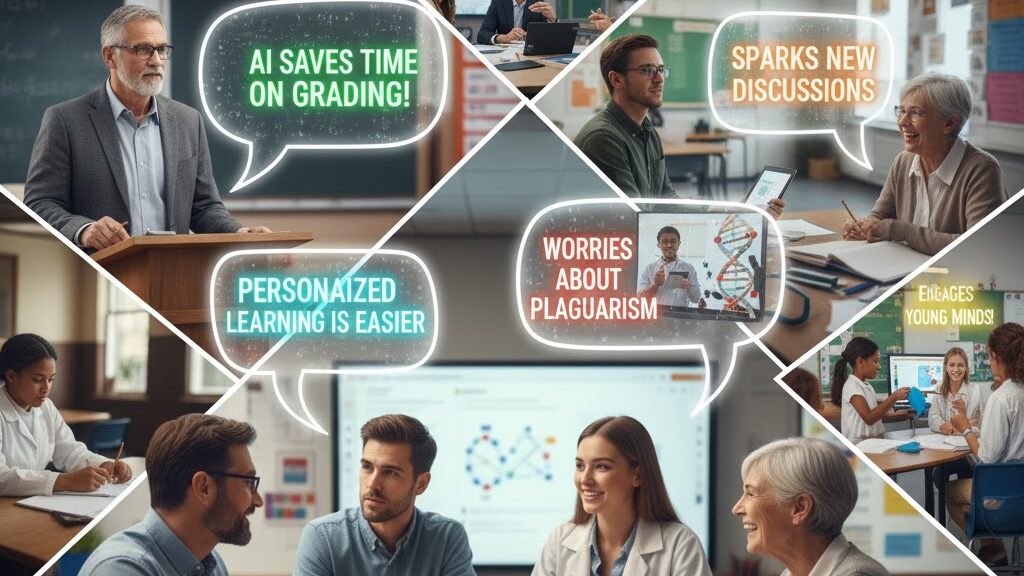
A digital illustration showing a diverse group of teachers sitting around a conference table in a modern classroom, each holding a speech bubble or screen displaying various short, contrasting statements about AI, such as "HELPFUL TOOL," "CHEAT DETECTOR," and "TIME SINK." Image (and typos) generated by Nano Banana.
Diverse perspectives on the digital frontier: Capturing the wide range of experiences and opinions shared by educators as they navigate the benefits and challenges of integrating AI into their classrooms. Image (and typos) generated by Nano Banana.

Source

The Conversation

Summary

Researcher Nadia Delanoy interviewed ten Canadian teachers to explore how generative AI is reshaping K–12 classrooms. The teachers, spanning grades 5–12 across multiple provinces, described mounting pressures to adapt amid ethical uncertainty and emotional strain. Common concerns included the fragility of traditional assessment, inequitable access to AI tools, and rising workloads compounded by inadequate policy support. Many expressed fear that AI could erode the artistry and relational nature of teaching, turning it into a compliance exercise. While acknowledging AI’s potential to enhance workflow, teachers emphasised the need for slower, teacher-led, and ethically grounded implementation that centres humanity and professional judgment.

Key Points

  • Teachers report anxiety over authenticity and fairness in assessment.
  • Equity gaps widen as some students have greater AI access than others.
  • Educators feel policies treat them as implementers, not professionals.
  • AI integration adds to burnout, threatening teacher autonomy.
  • Responsible policy must involve teachers, ethics, and slower adoption.

Keywords

URL

https://theconversation.com/we-asked-teachers-about-their-experiences-with-ai-in-the-classroom-heres-what-they-said-265241

Summary generated by ChatGPT 5


How AI Is Challenging the Credibility of Some Online Courses


A digital illustration of a diploma or certificate with a prominent "CERTIFIED" seal, but the document is visibly fraying and breaking apart into digital code and pixels. A small, glowing AI chatbot icon hovers near the broken area, symbolizing the erosion of credibility. Image (and typos) generated by Nano Banana.
Questioning the digital degree: AI-generated work is forcing educators to reassess the integrity and perceived value of completion certificates for online courses. Image (and typos) generated by Nano Banana.

Source

The Conversation

Summary

Mohammed Estaiteyeh argues that generative AI has exposed fundamental weaknesses in asynchronous online learning, where instructors cannot observe students’ thinking or verify authorship. Traditional assessments—discussion boards, reflective posts, essays, and multimedia assignments—are now easily replaced or augmented by AI tools capable of producing personalised, citation-matched work indistinguishable from human output. Detection tools and remote proctoring offer little protection and raise serious equity and ethical issues. Estaiteyeh warns that without systemic redesign, institutions risk issuing credentials that no longer guarantee genuine learning. He advocates integrating oral exams, experiential learning with external verification, and programme-level redesign to maintain authenticity and uphold academic integrity in the AI era.

Key Points

  • Asynchronous online courses face the highest risk of undetectable AI substitution.
  • Discussion boards, reflections, essays, and even citations can be convincingly AI-generated.
  • AI detectors and remote proctoring are unreliable, inequitable, and ethically problematic.
  • Oral exams and experiential assessments offer partial safeguards but require major redesign.
  • Institutions must invest in structural change or risk turning asynchronous programmes into “credential mills.”

Keywords

URL

https://theconversation.com/how-ai-is-challenging-the-credibility-of-some-online-courses-264851

Summary generated by ChatGPT 5


This Professor Let Half His Class Use AI. Here’s What Happened


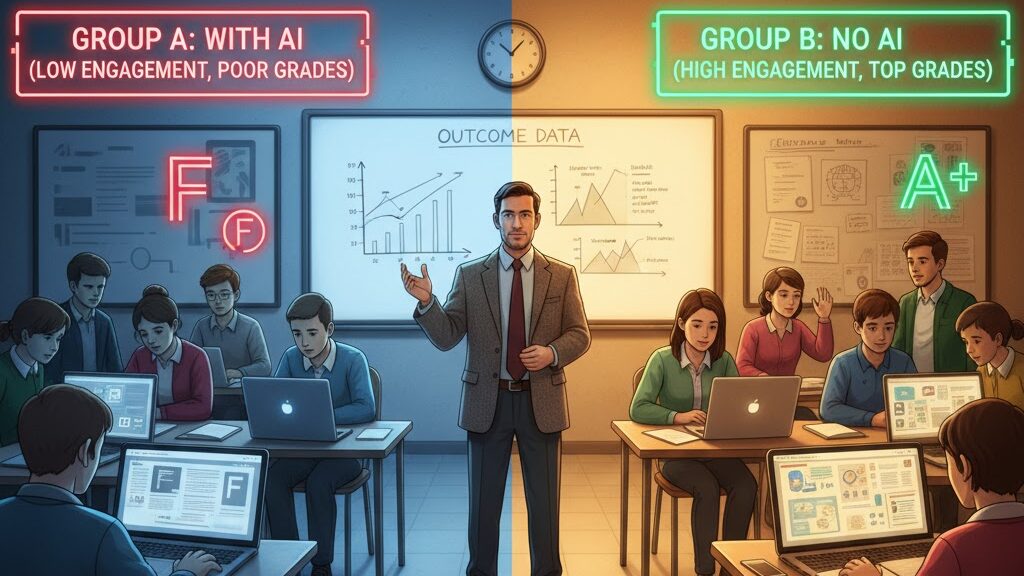
A split classroom scene with a professor in the middle, presenting data. The left side, labeled "GROUP A: WITH AI," shows disengaged students with "F" grades. The right side, labeled "GROUP B: NO AI," shows engaged students with "A+" grades, depicting contrasting outcomes of AI use in a classroom experiment. Image (and typos) generated by Nano Banana.
An academic experiment unfolds: Visualizing the stark differences in engagement and performance between students who used AI and those who did not, as observed by one professor. Image (and typos) generated by Nano Banana.

Source

Gizmodo

Summary

A study by University of Massachusetts Amherst professor Christian Rojas compared two sections of the same advanced economics course—one permitted structured AI use, the other did not. The results revealed that allowing AI under clear guidelines improved student engagement, confidence, and reflective learning but did not affect exam performance. Students with AI access reported greater efficiency and satisfaction with course design while developing stronger habits of self-correction and critical evaluation of AI outputs. Rojas concludes that carefully scaffolded AI integration can enrich learning experiences without fostering dependency or academic shortcuts, though larger studies are needed.

Key Points

  • Structured AI use increased engagement and confidence but not exam scores.
  • Students used AI for longer, more focused sessions and reflective learning.
  • Positive perceptions grew regarding efficiency and instructor quality.
  • AI integration encouraged editing, critical thinking, and ownership of ideas.
  • Researchers stress that broader trials are required to validate results.

Keywords

URL

https://gizmodo.com/this-professor-let-half-his-class-use-ai-heres-what-happened-2000678960

Summary generated by ChatGPT 5


AI: Are we empowering students – or outsourcing the skills we aim to cultivate?


A stark split image contrasting two outcomes of AI in education, divided by a jagged white lightning bolt. The left side shows a diverse group of three enthusiastic students working collaboratively on laptops, with one student raising their hands in excitement. Above them, a vibrant, glowing display of keywords like "CRITICAL THINKING," "CREATIVITY," and "COLLABORATION" emanates, surrounded by data and positive learning metrics. The right side shows a lone, somewhat disengaged male student working on a laptop, with a large, menacing robotic hand hovering above him. The robot hand has glowing red lights and is connected to a screen filled with complex, auto-generated data, symbolizing the automation of tasks and potential loss of human skills. Image (and typos) generated by Nano Banana.
The rise of AI in education presents a crucial dichotomy: are we using it to truly empower students and cultivate essential skills, or are we inadvertently outsourcing those very abilities to algorithms? This image visually explores the two potential paths for AI’s integration into learning, urging a thoughtful approach to its implementation. Image (and typos) generated by Nano Banana.

Source

The Irish Times

Summary

Jean Noonan reflects on the dual role of artificial intelligence in higher education—its capacity to empower learning and its risk of eroding fundamental human skills. As AI becomes embedded in teaching, research, and assessment, universities must balance innovation with integrity. AI literacy, she argues, extends beyond technical skills to include ethics, empathy, and critical reasoning. While AI enhances accessibility and personalised learning, over-reliance may weaken originality and authorship. Noonan calls for assessment redesigns that integrate AI responsibly, enabling students to learn with AI rather than be replaced by it. Collaboration between academia, industry, and policymakers is essential to ensure education cultivates judgment, creativity, and moral awareness. Echoing Orwell’s warning in 1984, she concludes that AI should enhance, not diminish, the intellectual and linguistic richness that defines human learning.

Key Points

  • AI literacy must combine technical understanding with ethics, empathy, and reflection.
  • Universities are rapidly adopting AI but risk outsourcing creativity and independent thought.
  • Over-reliance on AI tools can blur authorship and weaken critical engagement.
  • Assessment design should promote ethical AI use and active, independent learning.
  • Collaboration between universities and industry can align innovation with responsible practice.
  • Education must ensure AI empowers rather than replaces essential human skills.

Keywords

URL

https://www.irishtimes.com/ireland/education/2025/10/29/ai-are-we-empowering-students-or-outsourcing-the-skills-we-aim-to-cultivate/

Summary generated by ChatGPT 5


AI and the Future of Universities


Source

Higher Education Policy Institute (HEPI), October 2025

Summary

This collection of essays explores how artificial intelligence—particularly generative AI (GenAI)—is reshaping the university sector across teaching, research, and administration. Contributors, including Dame Wendy Hall, Vinton Cerf, Rose Luckin, and others, argue that AI represents a profound structural shift rather than a passing technological wave. The report emphasises that universities must respond strategically, ethically, and holistically: developing AI literacy among staff and students, redesigning assessment, and embedding responsible innovation into governance and institutional strategy.

AI is portrayed as both a disruptive and creative force. It automates administrative processes, accelerates research, and transforms strategy-making, while simultaneously challenging ideas of authorship, assessment, and academic integrity. Luckin and others call for universities to foster uniquely human capacities—critical thinking, creativity, emotional intelligence, and metacognition—so that AI augments rather than replaces human intellect. Across the essays, there is strong consensus that AI literacy, ethical governance, and institutional agility are vital if universities are to remain credible and relevant in the AI era.

Key Points

  • AI literacy is now essential for all staff and students.
  • GenAI challenges traditional assessment and integrity systems.
  • Universities must act quickly but ethically in AI integration.
  • Professional services can achieve major efficiency gains through AI.
  • AI enables real-time strategy analysis and forecasting.
  • AI literacy must extend to leadership and governance structures.
  • Human intelligence—creativity, criticality, empathy—remains central.
  • Ethical frameworks and transparency are essential for trust.
  • Data maturity and infrastructure underpin successful adoption.
  • Collaboration across disciplines and sectors will shape sustainable change.

Conclusion

The report concludes that AI will redefine the university’s purpose, requiring institutions to shift from reactive adaptation to active leadership in shaping the AI future. The challenge is not simply to use AI but to ensure it strengthens human intelligence, academic integrity, and social purpose in higher education.

Keywords

URL

https://www.hepi.ac.uk/reports/right-here-right-now-new-report-on-how-ai-is-transforming-higher-education/

Summary generated by ChatGPT 5