Report Reveals Potential of AI to Help UK Higher Education Sector Assess Its Research More Efficiently and Fairly


A stylized visual showing a network of research papers and data graphs being analyzed and sorted by a glowing, benevolent AI interface (represented by a digital hand) over the map of the United Kingdom, symbolizing efficiency and impartial assessment in academia. Image (and typos) generated by Nano Banana.
Streamlining academia: A new report illuminates how artificial intelligence can be leveraged to introduce greater efficiency and fairness into the complex process of assessing research within the UK’s higher education sector. Image (and typos) generated by Nano Banana.

Source

University of Bristol

Summary

This report highlights how UK universities are beginning to integrate generative AI into research assessment processes, marking a significant shift in institutional workflows. Early pilot programmes suggest that AI can assist in evaluating research outputs, managing reviewer assignments and streamlining administrative tasks associated with national research exercises. The potential benefits include increased consistency across assessments, reduced administrative burden and enhanced scalability for institutions with extensive research portfolios. Despite these advantages, the report underscores the importance of strong governance structures, transparent methodological frameworks and ongoing human oversight to ensure fairness, academic integrity and alignment with sector norms. The emerging consensus is that AI should serve as an augmenting tool rather than a replacement for expert judgement. Institutions are encouraged to take a measured approach that balances innovation with ethical responsibility while exploring long-term strategies for responsible adoption and sector-wide coordination. This marks a shift from viewing AI as a hypothetical tool for research assessment to recognising it as an active component of evolving academic practice.

Key Points

  • GenAI already used in UK HE for research assessment.
  • Potential efficiency gains in processing large volumes of research.
  • Increased standardisation of evaluation.
  • Governance and oversight essential.
  • Recommends controlled scaling across sector.

Keywords

URL

https://www.bristol.ac.uk/news/2025/november/report-reveals-potential-of-ai-to-help-assess-research-more-efficiently-.html

Summary generated by ChatGPT 5.1


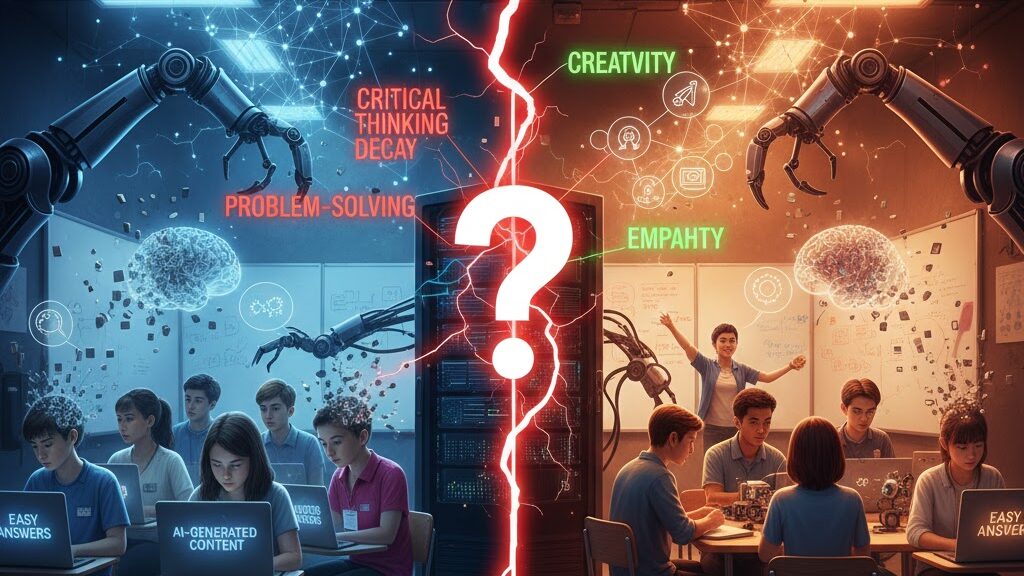
How AI Adoption May Erode Key Skills US Students Need in an Automated World


A highly conceptual visual of a digital circuit board with key areas representing skills like "Critical Thinking," "Problem Solving," and "Originality" fading and becoming obscured by an overwhelming cloud of generic, high-speed AI data. Image (and typos) generated by Nano Banana.
The automation paradox: Experts warn that while AI drives efficiency, its widespread adoption in education may inadvertently erode the crucial cognitive and creative skills US students need to thrive in a future dominated by technology. Image (and typos) generated by Nano Banana.

Source

Times of India (Education International Desk)

Summary

This article explores concerns that widespread adoption of AI tools in education may undermine essential skills that students require for long-term success in an increasingly automated world. Educators and analysts interviewed argue that easy access to generative AI for writing, problem solving and research may weaken students’ capacity for critical thinking, creativity and independent judgement. They note that while AI can accelerate tasks, it may also reduce opportunities for deep learning and cognitive struggle, both of which are crucial for intellectual development. The article raises concerns that students who rely heavily on AI may experience diminished confidence in producing original work and solving complex problems without technological support. Experts recommend curriculum renewal that blends responsible AI literacy with explicit instruction in foundational skills, ensuring that students can use AI effectively without sacrificing their broader intellectual growth. The discussion reflects a recurring theme in the global AI-in-education debate: the need to preserve human expertise and cognitive resilience in an era of pervasive automation. The article calls for educators, policymakers and institutions to strike a balance between embracing AI and safeguarding human capabilities.

Key Points

  • Widespread AI use may weaken foundational cognitive skills
  • Risks include reduced independent thinking and reduced confidence
  • Educators call for curriculum redesign with balanced AI integration
  • Highlights need for responsible AI literacy
  • Addresses long-term workforce preparation concerns

Keywords

URL

https://timesofindia.indiatimes.com/education/news/how-ai-adoption-may-erode-key-skills-us-students-need-in-an-automated-world/articleshow/125672541.cms

Summary generated by ChatGPT 5.1


Outsourced Thinking? Experts Consider AI’s Impact on Our Brains


A stylized, conceptual image showing a human head in profile with glowing digital lines extending from the brain area towards a floating, interconnected mesh of AI circuitry, symbolizing the outsourcing of thought processes. A question mark hangs over the point of connection. Image (and typos) generated by Nano Banana.
The cognitive shift: Experts are weighing the potential impact of AI reliance—is it a tool for enhancement, or are we outsourcing the very processes that keep our brains sharp? Image (and typos) generated by Nano Banana.

Source

RTÉ Prime Time

Summary

RTÉ explores emerging concerns about how widespread AI use may alter human cognition. With almost 800 million ChatGPT users globally and Ireland among the world’s heaviest users, scientists warn that convenience may carry hidden cognitive costs. An MIT study using brain-imaging found reduced neural activity when participants relied on ChatGPT, suggesting diminished critical evaluation. Irish neuroscientist Paul Dockree cautions that outsourcing tasks like writing and problem-solving could erode core cognitive skills, similar to over-dependency on GPS. Others draw parallels with aviation, where automation has weakened pilots’ manual skills. While some users praise AI’s benefits, experts warn of a potential “two-tier society” of empowered critical thinkers and those who grow dependent on automated reasoning.

Key Points

  • AI adoption is extremely rapid; Ireland has one of the highest global usage rates.
  • MIT research indicates reduced brain activity when using ChatGPT for problem-solving.
  • Cognitive scientists warn of long-term skill decline if AI replaces active thinking.
  • Automation parallels in aviation show how skills can erode without practice.
  • Public reactions are mixed, reflecting broader uncertainty about AI’s cognitive impact.

Keywords

URL

https://www.rte.ie/news/primetime/2025/1111/1543356-outsourced-thinking-experts-consider-ais-impact-on-our-brains/

Summary generated by ChatGPT 5


‘Urgent Need’ for More AI Literacy in Higher Education, Report Says


An aerial, wide shot of a large, circular university lecture hall filled with many students seated at desks, all looking towards a prominent stage and screen at the front. A powerful spotlight shines onto the empty stage. Above the students and emanating from the screen, a dense network of glowing digital lines, icons, and data points fills the air, representing AI and digital information. Below the central spotlight, floating holographic icons labeled "AI KNOWLEDGE" and "DIGITAL SKILLS" are prominently displayed, emphasizing the core concepts. Image (and typos) generated by Nano Banana.
A recent report highlights the critical need for increased AI literacy across higher education institutions. As technology rapidly advances, universities face an urgent challenge to equip students with the essential knowledge and digital skills required for an AI-driven future. Image (and typos) generated by Nano Banana.

Source

Research Professional News

Summary

A new report from the Higher Education Policy Institute warns that British universities must urgently improve AI literacy among both staff and students to stay relevant and equitable in an era of rapid digital transformation. Co-authored by Professor Wendy Hall and Giles Carden of the University of Southampton, the report argues that universities can no longer afford to simply “acknowledge AI’s presence” and must adopt structured strategies for skills development, teaching innovation, and research support. It highlights growing digital divides across gender, income, and subject disciplines. Contributions include a chapter written by ChatGPT itself, advocating AI training within doctoral and staff development programmes, and cautioning against uneven capability across institutions. The report also predicts that AI adoption could lead to job reductions in professional services as universities seek financial efficiencies.

Key Points

  • The Higher Education Policy Institute calls for systemic AI literacy across the UK university sector.
  • Experts stress active engagement and structured upskilling, not passive awareness.
  • Digital divides linked to gender, wealth, and discipline risk deepening inequality.
  • ChatGPT’s own chapter recommends integrating AI training into research and doctoral curricula.
  • Financial pressures may drive automation and staff cuts in professional services.

Keywords

URL

https://www.researchprofessionalnews.com/rr-news-uk-universities-2025-10-urgent-need-for-more-ai-literacy-in-higher-education-report-says/

Summary generated by ChatGPT 5


How to Teach Critical Thinking When AI Does the Thinking


In a modern classroom overlooking a city skyline, a female teacher engages with a small group of students around a table. A glowing holographic maze labeled "CRITICAL THINKING" emanates from the tabletop, surrounded by various interactive data displays. In the background, other students work on laptops, and a large screen at the front displays "CRITICAL THINKING IN THE AGE OF AI: NAVIGATING THE ALGORITHMIC LANDSCAPE." Image (and typos) generated by Nano Banana.
As artificial intelligence increasingly automates cognitive tasks, educators face the crucial challenge of teaching critical thinking when AI can “do the thinking” for students. This image illustrates a forward-thinking classroom where a teacher guides students through complex, interactive simulations designed to hone their critical thinking skills, transforming AI from a potential crutch into a tool for deeper intellectual engagement and navigating an algorithmic world. Image (and typos) generated by Nano Banana.

Source

Psychology Today

Summary

Timothy Cook explores how the growing use of generative AI is eroding critical thinking and accountability in both education and professional contexts. Citing Deloitte’s $291,000 error-filled AI-generated report, he warns that overreliance on AI leads to “cognitive outsourcing,” where users stop questioning information and lose ownership of their ideas. Educators, he argues, mirror this problem by automating grading and teaching materials while penalising students for doing the same. Cook proposes a “dialogic” approach—using AI as a thinking partner through questioning, critique, and reflection—to restore analytical engagement and model responsible use in classrooms and workplaces alike.

Key Points

  • Deloitte’s AI-generated report highlights the risks of uncritical reliance on ChatGPT.
  • Many educators automate teaching tasks while discouraging students from AI use.
  • Frequent AI users show weakened brain connectivity and reduced ownership of ideas.
  • Dialogic prompting—interrogating AI outputs—fosters deeper reasoning and creativity.
  • Transparent, guided AI use should replace institutional hypocrisy and cognitive outsourcing.

Keywords

URL

https://www.psychologytoday.com/us/blog/the-algorithmic-mind/202510/how-to-teach-critical-thinking-when-ai-does-the-thinking

Summary generated by ChatGPT 5