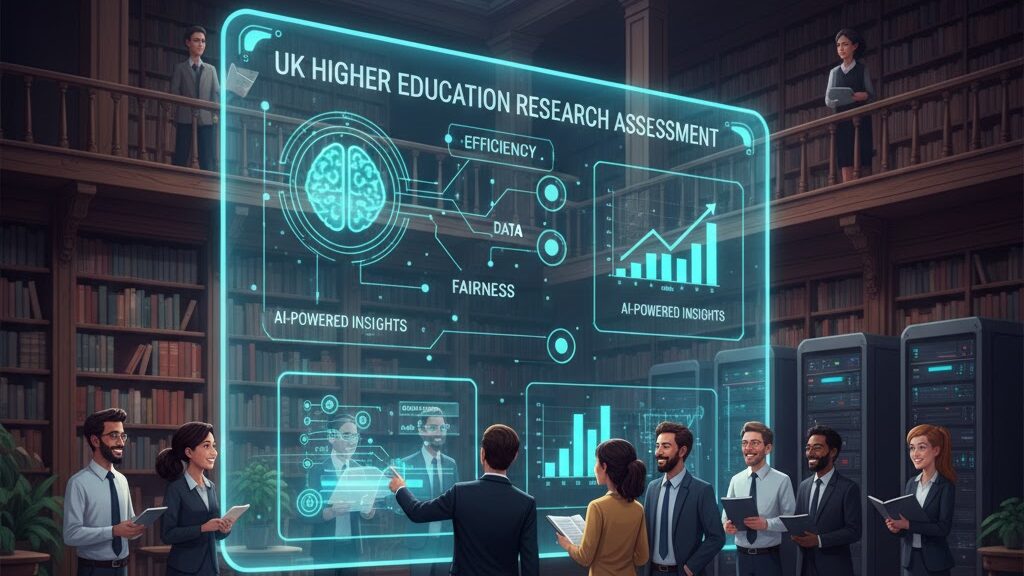
Report Reveals Potential of AI to Help UK Higher Education Sector Assess Its Research More Efficiently and Fairly


A stylized visual showing a network of research papers and data graphs being analyzed and sorted by a glowing, benevolent AI interface (represented by a digital hand) over the map of the United Kingdom, symbolizing efficiency and impartial assessment in academia. Image (and typos) generated by Nano Banana.
Streamlining academia: A new report illuminates how artificial intelligence can be leveraged to introduce greater efficiency and fairness into the complex process of assessing research within the UK’s higher education sector. Image (and typos) generated by Nano Banana.

Source

University of Bristol

Summary

This report highlights how UK universities are beginning to integrate generative AI into research assessment processes, marking a significant shift in institutional workflows. Early pilot programmes suggest that AI can assist in evaluating research outputs, managing reviewer assignments and streamlining administrative tasks associated with national research exercises. The potential benefits include increased consistency across assessments, reduced administrative burden and enhanced scalability for institutions with extensive research portfolios. Despite these advantages, the report underscores the importance of strong governance structures, transparent methodological frameworks and ongoing human oversight to ensure fairness, academic integrity and alignment with sector norms. The emerging consensus is that AI should serve as an augmenting tool rather than a replacement for expert judgement. Institutions are encouraged to take a measured approach that balances innovation with ethical responsibility while exploring long-term strategies for responsible adoption and sector-wide coordination. This marks a shift from viewing AI as a hypothetical tool for research assessment to recognising it as an active component of evolving academic practice.

Key Points

  • GenAI already used in UK HE for research assessment.
  • Potential efficiency gains in processing large volumes of research.
  • Increased standardisation of evaluation.
  • Governance and oversight essential.
  • Recommends controlled scaling across sector.

Keywords

URL

https://www.bristol.ac.uk/news/2025/november/report-reveals-potential-of-ai-to-help-assess-research-more-efficiently-.html

Summary generated by ChatGPT 5.1


UWA and Oxford Partner for Generative AI in Higher Education


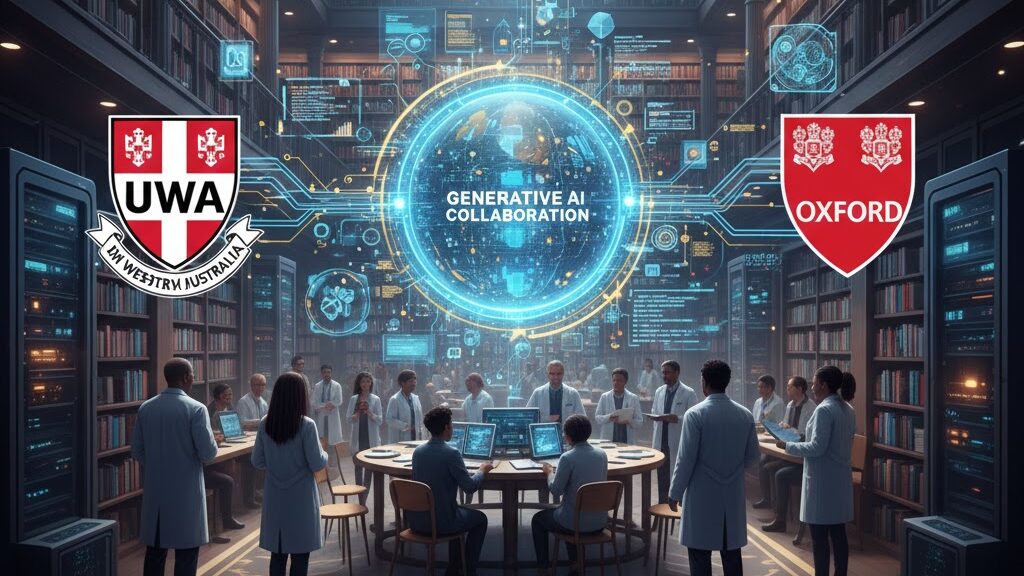
A digital illustration merging the architectural styles of the University of Western Australia (UWA) and the University of Oxford. A traditional university shield or crest is split in two, with one half featuring a classic coat of arms and the other half displaying generative AI code and glowing digital patterns, symbolizing their partnership in advanced education. Image (and typos) generated by Nano Banana.
Global collaboration in the age of AI: UWA and Oxford University join forces to pioneer the integration and study of generative artificial intelligence within the landscape of higher education. Image (and typos) generated by Nano Banana.

Source

University of Western Australia

Summary

The University of Western Australia and the University of Oxford announced a formal partnership that positions generative AI as a strategic driver in the future of higher education. The collaboration focuses on advancing responsible AI research, developing governance models and integrating generative AI into teaching and learning in ways that uphold academic integrity and inclusivity. Both institutions highlight that the rapid acceleration of AI requires coordinated international responses that balance innovation with ethical safeguards. The partnership will explore curriculum transformation, staff development and AI-informed pedagogical frameworks intended to support both student learning and broader institutional capability building. By aligning two globally significant universities, the initiative signals a trend toward cross-border cooperation designed to shape sector-wide AI standards. It also indicates growing recognition that AI adoption in higher education must be underpinned by shared values, transparent methodologies and research-based evidence. This collaboration aims to become a blueprint for how universities can jointly shape the future of AI-enabled education while ensuring that human expertise remains central.

Key Points

  • Major partnership between UWA and Oxford to advance responsible AI
  • Focus on governance, research and curriculum innovation
  • Reflects global shift toward collaboration on AI strategy
  • Emphasises ethical frameworks for AI adoption in higher education
  • Positions AI as core to long-term institutional development

Keywords

URL

https://www.uwa.edu.au/news/article/2025/november/uwa-and-oxford-partner-for-generative-ai-in-higher-ed

Summary generated by ChatGPT 5.1


AI and the Future of Universities


Source

Higher Education Policy Institute (HEPI), October 2025

Summary

This collection of essays explores how artificial intelligence—particularly generative AI (GenAI)—is reshaping the university sector across teaching, research, and administration. Contributors, including Dame Wendy Hall, Vinton Cerf, Rose Luckin, and others, argue that AI represents a profound structural shift rather than a passing technological wave. The report emphasises that universities must respond strategically, ethically, and holistically: developing AI literacy among staff and students, redesigning assessment, and embedding responsible innovation into governance and institutional strategy.

AI is portrayed as both a disruptive and creative force. It automates administrative processes, accelerates research, and transforms strategy-making, while simultaneously challenging ideas of authorship, assessment, and academic integrity. Luckin and others call for universities to foster uniquely human capacities—critical thinking, creativity, emotional intelligence, and metacognition—so that AI augments rather than replaces human intellect. Across the essays, there is strong consensus that AI literacy, ethical governance, and institutional agility are vital if universities are to remain credible and relevant in the AI era.

Key Points

  • AI literacy is now essential for all staff and students.
  • GenAI challenges traditional assessment and integrity systems.
  • Universities must act quickly but ethically in AI integration.
  • Professional services can achieve major efficiency gains through AI.
  • AI enables real-time strategy analysis and forecasting.
  • AI literacy must extend to leadership and governance structures.
  • Human intelligence—creativity, criticality, empathy—remains central.
  • Ethical frameworks and transparency are essential for trust.
  • Data maturity and infrastructure underpin successful adoption.
  • Collaboration across disciplines and sectors will shape sustainable change.

Conclusion

The report concludes that AI will redefine the university’s purpose, requiring institutions to shift from reactive adaptation to active leadership in shaping the AI future. The challenge is not simply to use AI but to ensure it strengthens human intelligence, academic integrity, and social purpose in higher education.

Keywords

URL

https://www.hepi.ac.uk/reports/right-here-right-now-new-report-on-how-ai-is-transforming-higher-education/

Summary generated by ChatGPT 5


Why Higher Ed’s AI Rush Could Put Corporate Interests Over Public Service and Independence


In a grand, traditional university meeting room with stained-glass windows, a group of academic leaders in robes and corporate figures in suits are gathered around a long table. Above them, a large holographic display illustrates a stark contrast: "PUBLIC SERVICE & INDEPENDENCE" on the left (glowing blue) versus "CORPORATE AI DOMINATION" on the right (glowing red), with glowing digital pathways showing the potential flow of influence from academic values towards corporate control, symbolized by locked icons and data clouds. Image (and typos) generated by Nano Banana.
The rapid embrace of AI in higher education, often driven by external pressures and vast resources, raises critical concerns that corporate interests could overshadow the foundational values of public service and academic independence. This image visually depicts the tension between these two forces, suggesting that universities risk compromising their core mission if the “AI rush” prioritises commercial gains over their commitment to unbiased research, equitable access, and intellectual autonomy. Image (and typos) generated by Nano Banana.

Source

The Conversation

Summary

Chris Wegemer warns that universities’ accelerating embrace of AI through corporate partnerships may erode academic independence and their public service mission. High-profile collaborations—such as those between Nvidia and the University of Florida, Microsoft and Princeton, and OpenAI with the California State University system—illustrate a growing trend toward “corporatisation.” Wegemer argues that financial pressures, prestige-seeking, and the decline in enrolment are driving institutions to adopt market-driven governance, aligning higher education with private-sector priorities. Without transparent oversight and faculty involvement, he cautions, universities risk sacrificing democratic values and intellectual freedom for commercial gain.

Key Points

  • Universities are partnering with tech giants to build AI infrastructure and credentials.
  • These partnerships deepen higher education’s dependence on corporate capital.
  • Market and prestige pressures are displacing public-interest research priorities.
  • Faculty governance and academic freedom are being sidelined in AI decision-making.
  • The author urges renewed focus on transparency, democracy, and public accountability.

Keywords

URL

https://theconversation.com/why-higher-eds-ai-rush-could-put-corporate-interests-over-public-service-and-independence-260902

Summary generated by ChatGPT 5


Today’s AI hype has echoes of a devastating technology boom and bust 100 years ago


A split image contrasting two eras. On the left, a sepia-toned scene from 100 years ago shows a crowd enthusiastically gathered around industrial machinery and towering power lines, with a banner proclaiming "THE FUTURE OF EVERYTHING!" On the right, a vibrant, futuristic cityscape glows under a digital sky, where a diverse crowd looks up at a holographic brain symbol and text announcing "AI REVOLUTION! UNLIMITED POTENTIAL!". In the foreground, people interact with digital news showing "AI CRASHES" and "TECH LAYOFFS." Image (and typos) generated by Nano Banana.
The intense fervor surrounding today’s AI technology mirrors the intense hype and subsequent devastating bust of a technological revolution a century ago. This side-by-side comparison starkly portrays the recurring cycle of technological innovation and speculation, prompting a cautionary reflection on whether the current AI gold rush could face a similar fate to past booms and busts. Image (and typos) generated by Nano Banana.

Source

The Conversation

Summary

Cameron Shackell draws parallels between today’s AI boom and the electrification craze of the 1920s. Just as electricity fuelled massive innovation, speculation and eventual collapse, AI is showing similar patterns of overinvestment, market concentration and loose regulation. The 1929 stock market crash revealed the dangers of unregulated “high-tech” exuberance, leading to reforms that transformed electricity into stable infrastructure. Shackell warns that AI could follow the same path—booming unsustainably before a painful correction—unless governments implement thoughtful regulation. The question, he suggests, is whether we can integrate AI safely into daily life before a comparable bust forces reform.

Key Points

  • The 1920s electricity boom mirrors today’s AI surge in hype and speculation.
  • Both technologies reshaped industries and drove market concentration.
  • Lack of oversight in the 1920s helped trigger the Great Depression.
  • AI’s rapid expansion faces similarly weak global regulation.
  • The author urges proactive governance to avoid another tech-driven collapse.

Keywords

URL

https://theconversation.com/todays-ai-hype-has-echoes-of-a-devastating-technology-boom-and-bust-100-years-ago-265492

Summary generated by ChatGPT 5