We Asked Teachers About Their Experiences With AI in the Classroom — Here’s What They Said


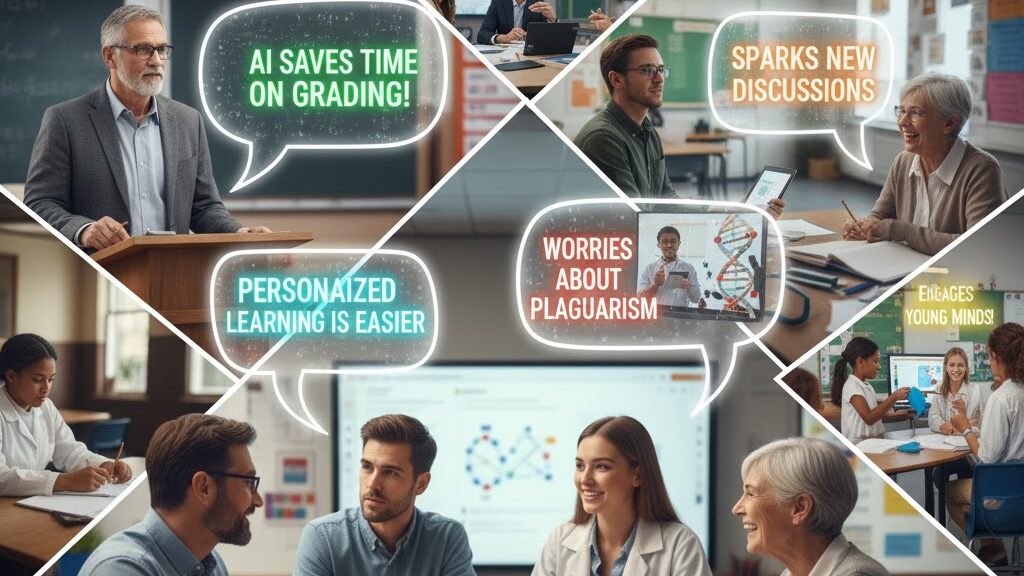
A digital illustration showing a diverse group of teachers sitting around a conference table in a modern classroom, each holding a speech bubble or screen displaying various short, contrasting statements about AI, such as "HELPFUL TOOL," "CHEAT DETECTOR," and "TIME SINK." Image (and typos) generated by Nano Banana.
Diverse perspectives on the digital frontier: Capturing the wide range of experiences and opinions shared by educators as they navigate the benefits and challenges of integrating AI into their classrooms. Image (and typos) generated by Nano Banana.

Source

The Conversation

Summary

Researcher Nadia Delanoy interviewed ten Canadian teachers to explore how generative AI is reshaping K–12 classrooms. The teachers, spanning grades 5–12 across multiple provinces, described mounting pressures to adapt amid ethical uncertainty and emotional strain. Common concerns included the fragility of traditional assessment, inequitable access to AI tools, and rising workloads compounded by inadequate policy support. Many expressed fear that AI could erode the artistry and relational nature of teaching, turning it into a compliance exercise. While acknowledging AI’s potential to enhance workflow, teachers emphasised the need for slower, teacher-led, and ethically grounded implementation that centres humanity and professional judgment.

Key Points

  • Teachers report anxiety over authenticity and fairness in assessment.
  • Equity gaps widen as some students have greater AI access than others.
  • Educators feel policies treat them as implementers, not professionals.
  • AI integration adds to burnout, threatening teacher autonomy.
  • Responsible policy must involve teachers, ethics, and slower adoption.

Keywords

URL

https://theconversation.com/we-asked-teachers-about-their-experiences-with-ai-in-the-classroom-heres-what-they-said-265241

Summary generated by ChatGPT 5


Student Success Leaders Worry About Affordability, AI and Diversity


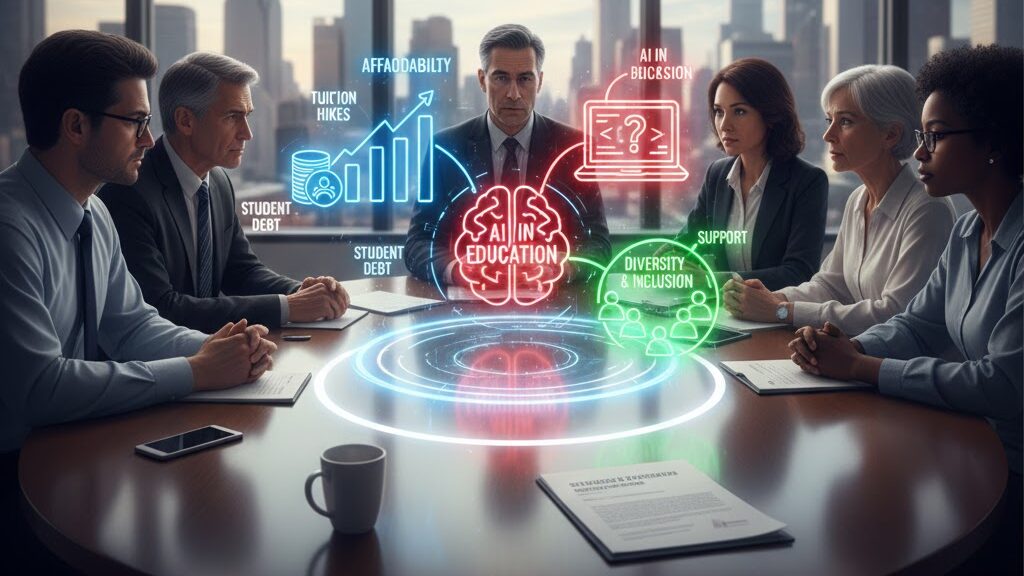
A composite visual showing three distinct, stylized icons representing major challenges: A padlock with dollar signs (Affordability), a swirling digital vortex or chatbot logo (AI), and a group of varied silhouettes (Diversity). All three are converging on a single, glowing student figure, symbolizing the multiple pressures on student success leaders. Image (and typos) generated by Nano Banana.
Triple threat to student success: Leaders in higher education are currently grappling with the complex and intertwined challenges of making college affordable, integrating AI responsibly, and ensuring robust diversity and inclusion across their institutions. Image (and typos) generated by Nano Banana.

Source

Inside Higher Ed

Summary

This article examines the concerns expressed by student-success leaders across U.S. higher education institutions, reflecting a convergence of affordability challenges, diversity commitments and the accelerating influence of generative AI. While administrators generally maintain confidence in institutional missions, they report increasing difficulty in evaluating authentic student engagement and learning outcomes due to widespread AI use. AI-assisted work can obscure students’ actual competencies, making early intervention and personalised support more complex. Leaders warn that inequitable access to advanced AI tools and differences in digital literacy may widen existing gaps for underrepresented groups. These concerns extend beyond teaching and assessment policies to broader institutional planning, prompting calls for staff training, student guidance frameworks and integrated AI governance strategies. The article suggests that institutions must adopt more holistic responses that acknowledge AI’s influence on retention, equity, affordability and long-term student success. AI is no longer a marginal pedagogical issue but an influential variable in strategic decision-making.

Key Points

  • AI seen as major pressure alongside affordability and DEI.
  • AI affects measurement of engagement and outcomes.
  • Risks of widening equity gaps.
  • Need for proactive policy.
  • AI now strategic issue, not just pedagogical.

Keywords

URL

https://www.insidehighered.com/news/students/academics/2025/11/06/student-success-leaders-worry-about-affordability-ai-dei

Summary generated by ChatGPT 5.1


NSW public school students to get access to state-of-the-art generative AI app


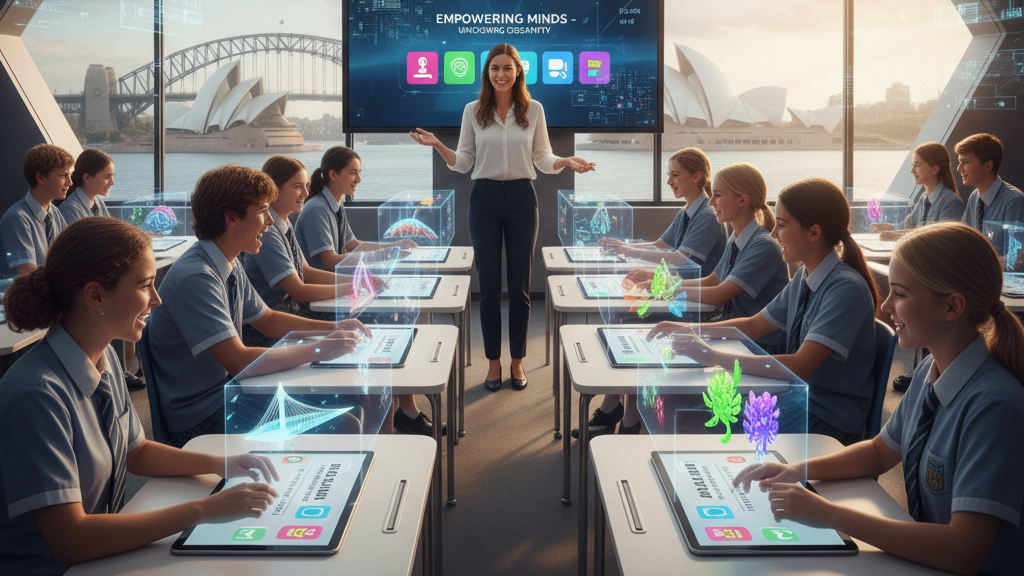
A diverse group of cheerful public school students in a modern classroom is excitedly gathered around a teacher. The teacher holds a large, glowing tablet displaying a generative AI interface with a 'CREATE' icon. In the background, a large screen shows a variety of AI-generated content (images, text, music notes), and the Sydney skyline is visible through a large window. The scene symbolises public school students gaining access to advanced AI technology. Generated by Nano Banana.
In a significant step forward for public education, students in New South Wales are set to gain access to a state-of-the-art generative AI app. This image envisions a future classroom where students and teachers collaborate using powerful AI tools, highlighting a new era of learning and creativity in Australian schools. Image (and typos) generated by Nano Banana.

Source

CyberDaily.au

Summary

The New South Wales government in Australia is rolling out a generative AI app across public schools to support students in areas like writing, problem solving, and research. The aim is to help with learning and reduce educational inequality—particularly for those with fewer resources. Officials emphasise that the app will supplement—not replace—teaching, with controls in place to prevent outright cheating. Teachers will receive training on appropriate use, and the pilot includes oversight and evaluation to monitor impacts, equity, and risk.

Key Points

  • NSW public schools will gain access to a generative AI app intended as a learning support tool, not a replacement for instruction.
  • The rollout aims to reduce disparity: assist students who may lack advanced tutors, help with writing, research, structuring work.
  • Safeguards include teacher training, monitoring, and policies to restrict misuse or overreliance.
  • The government will pilot the programme to evaluate outcomes: learning improvements, equity effects, and unintended harms.
  • The introduction reflects a shift from resisting AI to integrating it thoughtfully at the school level.

Keywords

URL

https://www.cyberdaily.au/government/12672-nsw-public-school-students-to-get-access-to-state-of-the-art-generative-ai-app

Summary generated by ChatGPT 5


‘It’s going to be a life skill’: educators discuss the impact of AI on university education


In a modern, sunlit conference room with a city view, a diverse group of seven educators in business attire are gathered around a sleek table. They are looking at a central holographic display that reads 'AI FLUENCY: A LIFE SKILL FOR 21ST CENTURY' and shows icons related to AI and learning. The scene depicts a discussion among professionals about the transformative impact of AI on university education. Generated by Nano Banana.
As AI reshapes industries and daily life, educators are converging to discuss its profound impact on university education, recognising AI fluency not merely as a technical skill but as an essential ‘life skill’ for the 21st century. This image captures a pivotal conversation among academic leaders focused on integrating AI into curricula to prepare students for the future. Image generated by Nano Banana.

Source

The Guardian

Summary

Educators argue that generative AI is swiftly moving from a novelty to a necessary skill, and universities must catch up. Students are often more advanced in AI usage than academic institutions, which are playing catch‑up with policy, curriculum adaptation, and support services. The piece emphasises that being able to use AI tools (and understand their limits) should be as fundamental as reading and writing. Universities are urged to incorporate AI literacy broadly—across disciplines—ensure equitable access, and ensure that teaching still reinforces enduring human skills like critical thinking, creativity, and communication.

Key Points

  • AI proficiency is becoming a life skill; many students already use AI tools, often more adeptly than institutions can respond.
  • Important for students to evaluate what AI can and can’t do, not just how to use it.
  • Universities should show leadership: clear AI strategy, support across all courses.
  • Equity matters: ensuring all students have access and skills to use AI.
  • Human skills (creativity, communication, thinking) retain their value even as AI tools become common.

Keywords

URL

https://www.theguardian.com/education/2025/sep/13/its-going-to-be-a-life-skill-educators-discuss-the-impact-of-ai-on-university-education

Summary generated by ChatGPT 5


Social media is teaching children how to use AI. How can teachers keep up?


A split image contrasting two scenes. On the left, three young children are engrossed in tablets and smartphones, surrounded by vibrant social media interfaces featuring AI-related content and hashtags like "#AIforkids." On the right, a teacher stands in a traditional classroom looking somewhat perplexed at a whiteboard with "AI?" written on it, while students sit at desks, symbolizing the challenge for educators to keep pace with children's informal AI learning. Image (and typos) generated by Nano Banana.
While children are rapidly learning about AI through pervasive social media platforms, educators face the challenge of integrating this knowledge into formal learning environments. This image highlights the growing disconnect between how children are acquiring AI literacy informally and the efforts teachers must make to bridge this gap and keep classroom instruction relevant and engaging. Image (and typos) generated by Nano Banana.

Source

The Conversation

Summary

Students are learning to use AI mainly through TikTok, Discord, and peer networks, while teachers rely on informal exchanges and LinkedIn. This creates quick but uneven knowledge transfer that often skips deeper issues such as bias, equity, and ethics. A Canadian pilot project showed that structured teacher education transforms enthusiasm into critical AI literacy, giving educators both vocabulary and judgment to integrate AI responsibly. The article stresses that without institutional clarity and professional development, AI adoption risks reinforcing inequity and mistrust.

Key Points

  • Informal learning (TikTok, Discord, staff rooms) drives AI uptake but lacks critical depth.
  • Teacher candidates benefit from structured AI education, gaining language and tools to discuss ethics and bias.
  • Institutional AI policies are fragmented, leaving instructors without support and creating confusion.
  • Equity and bias are central concerns; multilingual learners may be disadvantaged by uncritical AI use.
  • Embedding AI literacy in teacher education and learning communities is critical to move from casual adoption to critical engagement.

Keywords

URL

https://theconversation.com/social-media-is-teaching-children-how-to-use-ai-how-can-teachers-keep-up-264727

Summary generated by ChatGPT 5