Guidance on Artificial Intelligence in Schools


Source

Department of Education and Youth & Oide Technology in Education, October 2025

Summary

This national guidance document provides Irish schools with a framework for the safe, ethical, and effective use of artificial intelligence (AI), particularly generative AI (GenAI), in teaching, learning, and school leadership. It aims to support informed decision-making, enhance digital competence, and align AI use with Ireland’s Digital Strategy for Schools to 2027. The guidance recognises AI’s potential to support learning design, assessment, and communication while emphasising human oversight, teacher professionalism, and data protection.

It presents a balanced view of benefits and risks—AI can personalise learning and streamline administration but also raises issues of bias, misinformation, data privacy, and environmental impact. The report introduces a 4P framework—Purpose, Planning, Policies, and Practice—to guide schools in integrating AI responsibly. Teachers are encouraged to use GenAI as a creative aid, not a substitute, and to embed AI literacy in curricula. The document stresses the need for ethical awareness, alignment with GDPR and the EU AI Act (2024), and continuous policy updates as technology evolves.

Key Points

  • AI should support, not replace, human-led teaching and learning.
  • Responsible use requires human oversight, verification, and ethical reflection.
  • AI literacy for teachers, students, and leaders is central to safe adoption.
  • Compliance with GDPR and the EU AI Act ensures privacy and transparency.
  • GenAI tools must be age-appropriate and used within consent frameworks.
  • Bias, misinformation, and “hallucinations” demand critical human review.
  • The 4P Approach (Purpose, Planning, Policies, Practice) structures school-level implementation.
  • Environmental and wellbeing impacts must be considered in AI use.
  • Collaboration between the Department, Oide, and schools underpins future updates.
  • Guidance will be continuously revised to reflect evolving practice and research.

Conclusion

The guidance frames AI as a powerful but high-responsibility tool in education. By centring ethics, human agency, and data protection, schools can harness AI’s potential while safeguarding learners’ wellbeing, trust, and equity. Its iterative, values-led approach ensures Ireland’s education system remains adaptive, inclusive, and future-ready.

Keywords

URL

https://assets.gov.ie/static/documents/dee23cad/Guidance_on_Artificial_Intelligence_in_Schools_25.pdf

Summary generated by ChatGPT 5


The Future Learner: (Digital) Education Reimagined for 2040


Source

European Digital Education Hub (EDEH), European Commission, 2025

Summary

This foresight report explores four plausible futures for digital education in 2040, emphasising how generative and intelligent technologies could redefine learning, teaching, and human connection. Developed by the EDEH “Future Learner” squad, the study uses scenario planning to imagine how trends such as the rise of generative AI (GenAI), virtual assistance, lifelong learning, and responsible technology use might shape the education landscape. The report identifies 16 major drivers of change, highlighting GenAI’s central role in personalising learning, automating administration, and transforming the balance between human and machine intelligence.

In the most optimistic scenario – Empowered Learning – AI-powered personal assistants, immersive technologies, and data-driven systems make education highly adaptive, equitable, and learner-centred. In contrast, the Constrained Education scenario imagines over-regulated, energy-limited systems where AI use is tightly controlled, while The End of Human Knowledge portrays an AI-saturated collapse where truth, trust, and human expertise dissolve. The final Transformative Vision outlines a balanced, ethical future in which AI enhances – not replaces – human intelligence, fostering empathy, sustainability, and lifelong learning. Across all futures, the report calls for human oversight, explainability, and shared responsibility to ensure that AI in education remains ethical, inclusive, and transparent.

Key Points

  • Generative AI and intelligent systems are central to all future learning scenarios.
  • AI personal assistants, XR, and data analytics drive personalised, lifelong education.
  • Responsible use and ethical frameworks are essential to maintain human agency.
  • Overreliance on AI risks misinformation, cognitive overload, and social fragmentation.
  • Sustainability and carbon-neutral AI systems are core to educational innovation.
  • Data privacy and explainability remain critical for trust in AI-driven learning.
  • Equity and inclusion depend on access to AI-enhanced tools and digital literacy.
  • The line between human and artificial authorship will blur without strong governance.
  • Teachers evolve into mentors and facilitators supported by AI co-workers.
  • The most resilient future balances technology with human values and social purpose.

Conclusion

The Future Learner envisions 2040 as a pivotal point for digital education, where the success or failure of AI integration depends on ethical design, equitable access, and sustained human oversight. Generative AI can create unprecedented opportunities for personalisation and engagement, but only if education systems preserve their human essence – empathy, creativity, and community – amid the accelerating digital transformation.

Keywords

URL

https://ec.europa.eu/newsroom/eacea_oep/items/903368/en

Summary generated by ChatGPT 5


Generative AI might end up being worthless – and that could be a good thing


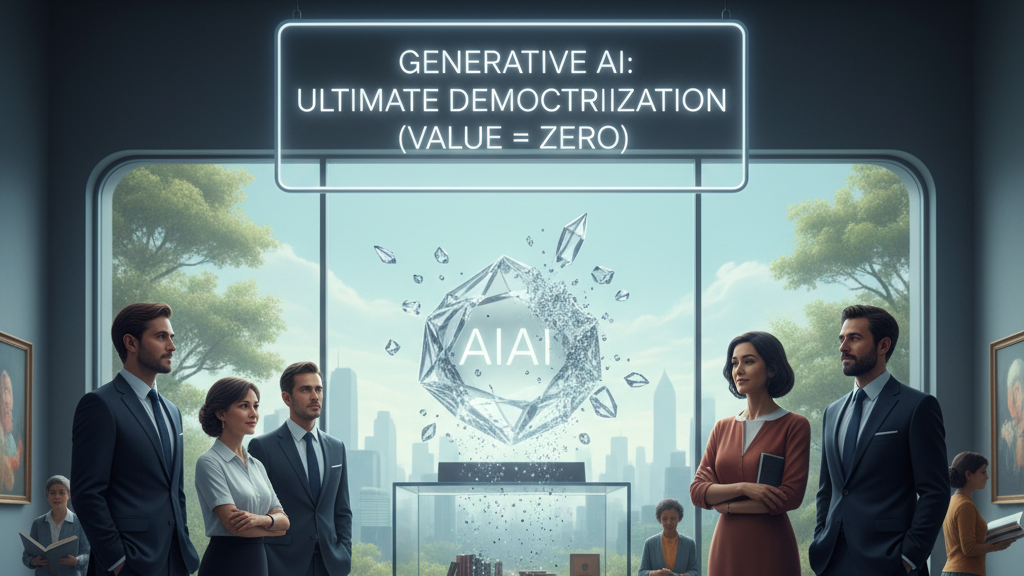
A large, glowing, glass orb of generative AI data is shattering and dissipating into a pile of worthless dust. The ground is dry and cracked, and behind the orb, a single, small, green sprout is beginning to grow, symbolizing a return to human creativity. The scene visually represents the idea that the potential 'worthlessness' of AI could be a good thing. Generated by Nano Banana.
While the value of generative AI is a subject of intense debate, some argue that its potential to become ‘worthless’ could be a positive outcome. This image captures the idea that if AI’s allure fades, it could clear the way for a resurgence of human-led creativity, critical thinking, and innovation, ultimately leading to a more meaningful and authentic creative landscape. Image (and typos) generated by Nano Banana.

Source

The Conversation

Summary

The article argues that the current hype around generative AI (GenAI) may oversell its value: it may eventually prove “worthless” in terms of sustainable returns, which wouldn’t necessarily be bad. Because GenAI is costly to operate and its productivity gains so far modest, many companies could fail to monetise it. Such a collapse might temper hype, reduce wasteful spending, and force society to focus on deeper uses of AI (ethics, reliability, human-centred value) rather than chasing illusions. The author sees a scenario where AI becomes a modest tool rather than the transformative juggernaut many expect.

Key Points

  • GenAI’s operational costs are high and monetisation is uncertain, so many ventures may fail.
  • Overhyping AI risks creating bubble dynamics—lots of investment chasing little real value.
  • A “worthless” AI future may force more careful, grounded development rather than blind expansion.
  • It could shift attention to AI’s limits, ethics, robustness, and human oversight.
  • The collapse of unrealistic expectations might be healthier than unchecked hype.

Keywords

URL

https://www.theconversation.com/generative-ai-might-end-up-being-worthless-and-that-could-be-a-good-thing-266046

Summary generated by ChatGPT 5


AI-Generated “Workslop” Is Destroying Productivity


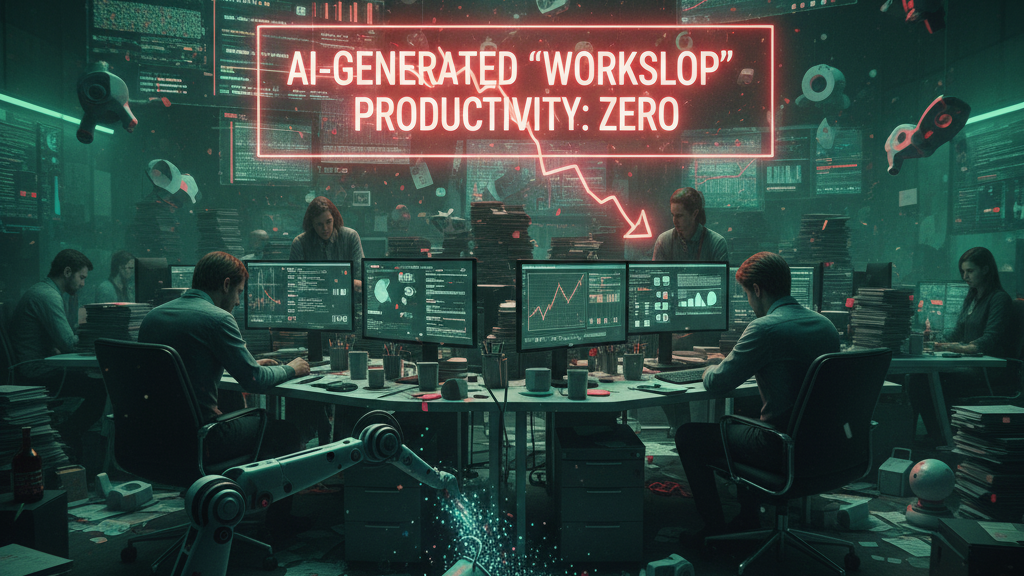
A chaotic office or data center environment filled with people at desks, surrounded by numerous screens displaying complex, overwhelming data and downward-trending graphs. A glowing red holographic display overhead reads 'AI-GENERATED 'WORKSLOP' PRODUCTIVTY: ZERO', with a prominent downward arrow. On the floor, papers are strewn everywhere, and a robotic arm appears to be spilling sparkling digital 'waste.' The scene visually represents how poorly managed AI outputs can destroy productivity. Generated by Nano Banana.
While AI promises efficiency, its unmanaged or poorly implemented output can lead to ‘workslop,’ a deluge of low-quality or irrelevant content that ironically destroys productivity. This image vividly portrays a chaotic scenario where AI-generated clutter overwhelms human workers, underscoring the critical need for careful integration and oversight to truly leverage AI’s benefits without drowning in its drawbacks. Image (and typos) generated by Nano Banana.

Source

Harvard Business Review

Summary

The article introduces “workslop” — AI-generated content (emails, memos, reports) that looks polished but lacks substance — and argues it undermines productivity. As organisations push employees to adopt AI tools, many are producing superficial, low-value outputs that require downstream repair or rewriting by others. The study suggests that while AI adoption has surged, few companies experience measurable productivity gains. The hidden cost of workslop is that the burden shifts to recipients, who must clarify, fix, or discard shallow AI outputs. For AI to add real value, its use must be paired with human review, prompt skill, and metrics focussed on outcomes rather than volume.

Key Points

  • “Workslop” is AI content that appears polished but fails to meaningfully advance a task.
  • Many organisations see limited return on their AI investments: activity without impact.
  • The cost of superficial AI output is borne by others, who must rework or reject it.
  • To counter workslop: review AI outputs, set expectations for quality, teach prompt & editing skills.
  • Value metrics should prioritise outcomes (impact, clarity) over sheer output volume.

Keywords

URL

https://hbr.org/2025/09/ai-generated-workslop-is-destroying-productivity

Summary generated by ChatGPT 5