Source
European Digital Education Hub (EDEH), European Commission, 2025
Summary
This foresight report explores four plausible futures for digital education in 2040, emphasising how generative and intelligent technologies could redefine learning, teaching, and human connection. Developed by the EDEH “Future Learner” squad, the study uses scenario planning to imagine how trends such as the rise of generative AI (GenAI), virtual assistance, lifelong learning, and responsible technology use might shape the education landscape. The report identifies 16 major drivers of change, highlighting GenAI’s central role in personalising learning, automating administration, and transforming the balance between human and machine intelligence.
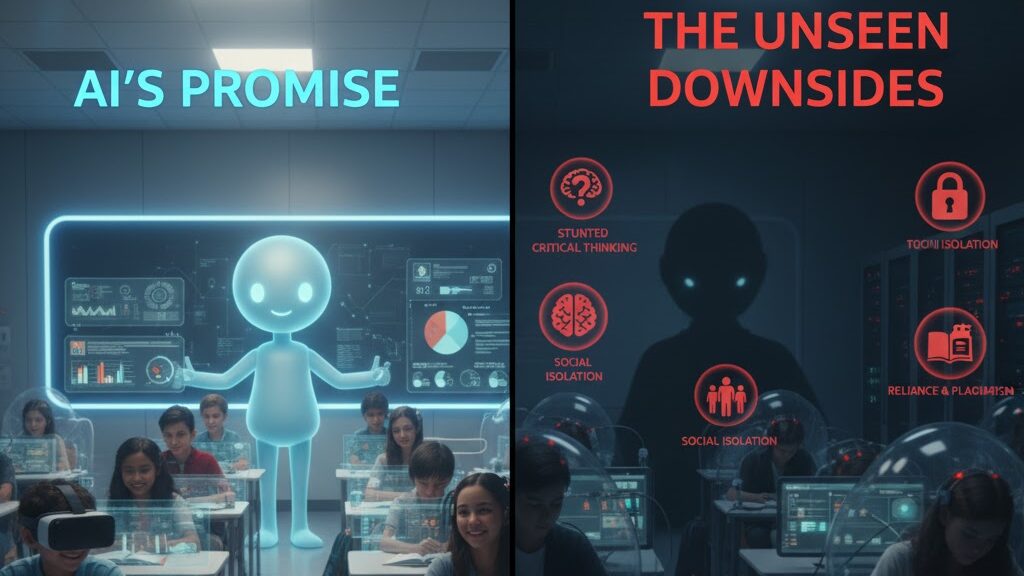
In the most optimistic scenario – Empowered Learning – AI-powered personal assistants, immersive technologies, and data-driven systems make education highly adaptive, equitable, and learner-centred. In contrast, the Constrained Education scenario imagines over-regulated, energy-limited systems where AI use is tightly controlled, while The End of Human Knowledge portrays an AI-saturated collapse where truth, trust, and human expertise dissolve. The final Transformative Vision outlines a balanced, ethical future in which AI enhances – not replaces – human intelligence, fostering empathy, sustainability, and lifelong learning. Across all futures, the report calls for human oversight, explainability, and shared responsibility to ensure that AI in education remains ethical, inclusive, and transparent.
Key Points
- Generative AI and intelligent systems are central to all future learning scenarios.
- AI personal assistants, XR, and data analytics drive personalised, lifelong education.
- Responsible use and ethical frameworks are essential to maintain human agency.
- Overreliance on AI risks misinformation, cognitive overload, and social fragmentation.
- Sustainability and carbon-neutral AI systems are core to educational innovation.
- Data privacy and explainability remain critical for trust in AI-driven learning.
- Equity and inclusion depend on access to AI-enhanced tools and digital literacy.
- The line between human and artificial authorship will blur without strong governance.
- Teachers evolve into mentors and facilitators supported by AI co-workers.
- The most resilient future balances technology with human values and social purpose.
Conclusion
The Future Learner envisions 2040 as a pivotal point for digital education, where the success or failure of AI integration depends on ethical design, equitable access, and sustained human oversight. Generative AI can create unprecedented opportunities for personalisation and engagement, but only if education systems preserve their human essence – empathy, creativity, and community – amid the accelerating digital transformation.
Keywords
URL
https://ec.europa.eu/newsroom/eacea_oep/items/903368/en
Summary generated by ChatGPT 5