The Lecturers Learning to Spot AI Misconduct


Four serious and focused lecturers/academics (two men, two women) are gathered around a table in a dimly lit, high-tech setting. They are looking at a large, glowing blue holographic screen that displays complex text, code, and highlights, with the prominent title "AI MISCONDUCT DETECTION." The screen shows an example of potentially AI-generated text with highlighted sections. Two individuals are actively pointing at the screen, while others are taking notes on laptops and paper. Surrounding the main screen are smaller holographic icons representing documents and a magnifying glass, symbolizing investigation and analysis. Image (and typos) generated by Nano Banana.
As AI tools become more sophisticated, the challenge of maintaining academic integrity intensifies. This image depicts lecturers undergoing specialised training to hone their skills in identifying AI-generated misconduct, ensuring fairness and originality in student work. Image (and typos) generated by Nano Banana.

Source

BBC News

Summary

Academics at De Montfort University (DMU) in Leicester are receiving specialist training to identify when students misuse artificial intelligence in coursework. The initiative, led by Dr Abiodun Egbetokun and supported by the university’s new AI policy, seeks to balance ethical AI use with maintaining academic integrity. Lecturers are being taught to spot linguistic “markers” of AI generation, such as repetitive phrasing or Americanised language, though experts acknowledge that detection is becoming increasingly difficult. DMU encourages students to use AI tools to support critical thinking and research, but presenting AI-generated work as one’s own constitutes misconduct. Staff also highlight the flaws of AI detection software, which has produced false positives, prompting calls for education over punishment. Students, meanwhile, recognise both the value and ethical boundaries of AI in their studies and future professions.

Key Points

  • DMU lecturers are being trained to recognise signs of AI misuse in student work.
  • The university’s policy allows ethical AI use for learning support but bans misrepresentation.
  • Detection focuses on linguistic patterns rather than unreliable software tools.
  • Staff warn that false accusations can harm students as much as confirmed misconduct.
  • Educators stress fostering AI literacy and integrity rather than “catching out” students.
  • Students value AI for translation, study support, and clinical applications but accept clear ethical limits.

Keywords

URL

https://www.bbc.com/news/articles/c2kn3gn8vl9o

Summary generated by ChatGPT 5

University wrongly accuses students of using artificial intelligence to cheat


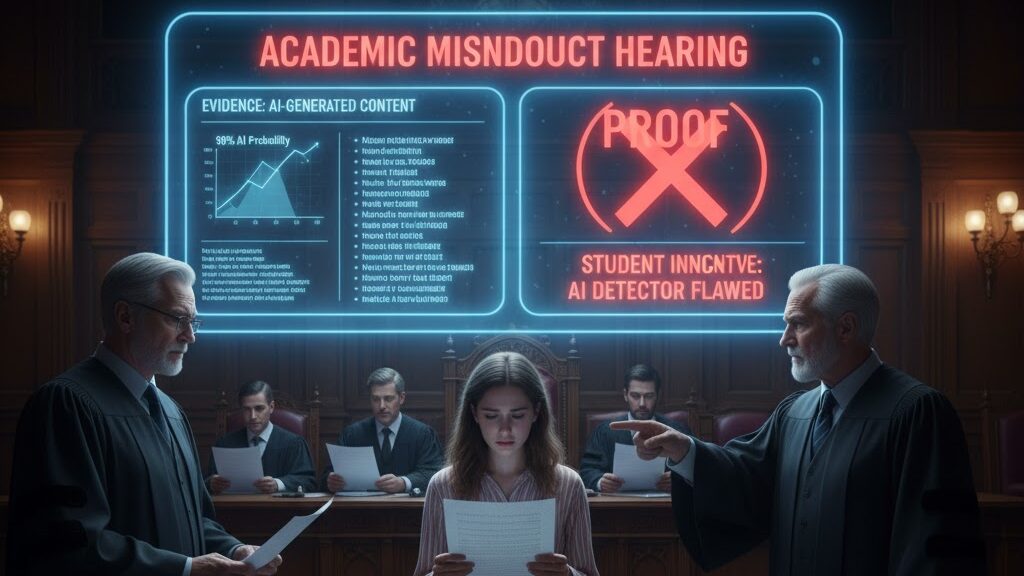
In a solemn academic hearing room, reminiscent of a courtroom, a distressed female student stands before a panel of university officials in robes, holding a document. A large holographic screen above displays "ACADEMIC MISCONDUCT HEARING." On the left, "EVIDENCE: AI-GENERATED CONTENT" shows a graph of AI probability, while on the right, a large red 'X' over "PROOF" is accompanied by text stating "STUDENT INNOCENT: AI DETECTOR FLAWED," highlighting a wrongful accusation. Image (and typos) generated by Nano Banana.
The burgeoning reliance on AI detection software has led to a disturbing trend: universities wrongly accusing students of using artificial intelligence to cheat. This dramatic image captures the devastating moment a student is cleared after an AI detector malfunctioned, highlighting the serious ethical challenges and immense distress caused by flawed technology in academic integrity processes. Image (and typos) generated by Nano Banana.

Source

ABC News (Australia)

Summary

The Australian Catholic University (ACU) has come under fire after wrongly accusing hundreds of students of using AI to cheat on assignments. Internal records showed nearly 6,000 academic misconduct cases in 2024, around 90 % linked to AI use. Many were based solely on Turnitin’s unreliable AI detection tool, later scrapped for inaccuracy. Students said they faced withheld results, job losses and reputational damage while proving their innocence. Academics reported low AI literacy, inconsistent policies and heavy workloads. Experts, including Sydney’s Professor Danny Liu, argue that banning AI is misguided and that universities should instead teach students responsible and transparent use.

Key Points

  • ACU recorded nearly 6,000 misconduct cases, most tied to alleged AI use.
  • Many accusations were based only on Turnitin’s flawed AI detector.
  • Students bore the burden of proof, with long investigation delays.
  • ACU has since abandoned the AI tool and introduced training on ethical AI use.
  • Experts urge universities to move from policing AI to teaching it responsibly.

Keywords

URL

https://www.abc.net.au/news/2025-10-09/artificial-intelligence-cheating-australian-catholic-university/105863524

Summary generated by ChatGPT 5


Admissions Essays Written by AI Are Generic and Easy to Spot


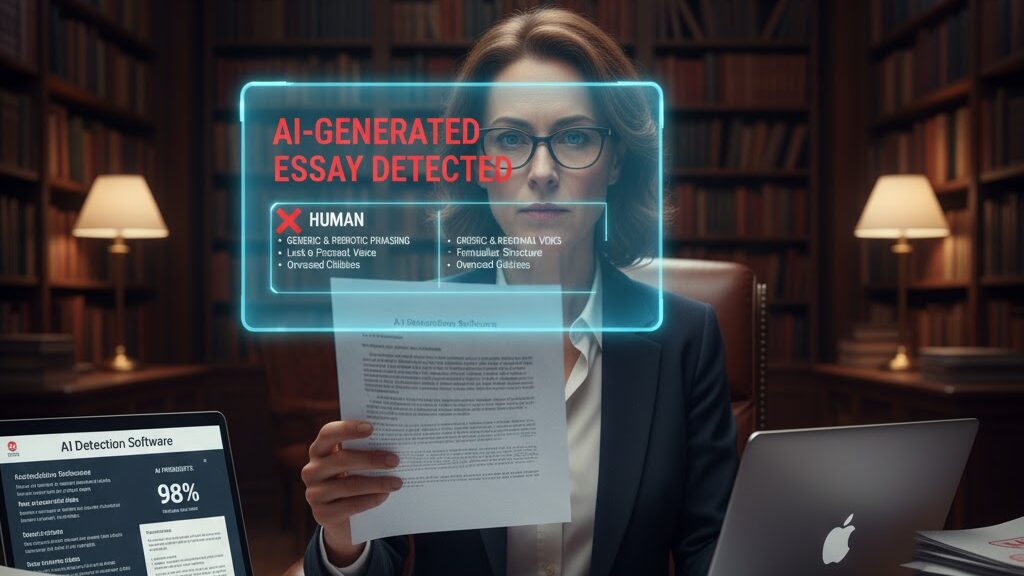
In a grand, wood-paneled library office, a serious female admissions officer in glasses sits at a desk piled with papers and laptops. A prominent holographic alert floats in front of her, reading "AI-GENERATED ESSAY DETECTED" in red. Below it, a comparison lists characteristics of "HUMAN" writing (e.g., unique voice) versus generic AI traits. One laptop screen displays "AI Detection Software" with a high probability score. Image (and typos) generated by Nano Banana.
Despite sophisticated AI capabilities, admissions essays generated by artificial intelligence are often characterised by generic phrasing and a distinct lack of personal voice, making them relatively easy to spot. This image depicts an admissions officer using AI detection software and her own critical judgment to identify an AI-generated essay, underscoring the challenges and tools in maintaining authenticity in student applications. Image (and typos) generated by Nano Banana.

Source

Inside Higher Ed

Summary

Cornell University researchers have found that AI-generated college admission essays are noticeably generic and easily distinguished from human writing. In a study comparing 30,000 human-written essays with AI-generated versions, the latter often failed to convey authentic personal narratives. When researchers added personal details for context, AI tools tended to overemphasise keywords, producing essays that sounded even more mechanical. While the study’s authors note that AI can be helpful for editing and feedback, they warn against using it to produce full drafts. The team also developed a detection model that could identify AI-generated essays with near-perfect accuracy.

Key Points

  • Cornell researchers compared AI and human-written college admission essays.
  • AI-generated essays lacked authenticity and were easily recognised.
  • Adding personal traits often made AI writing sound more artificial.
  • AI can provide useful feedback for weaker writers but not full essays.
  • A detection model identified AI-written essays with high accuracy.

Keywords

URL

https://www.insidehighered.com/news/quick-takes/2025/10/06/admissions-essays-written-ai-are-generic-and-easy-spot

Summary generated by ChatGPT 5


You Can Detect AI Writing With These Tips


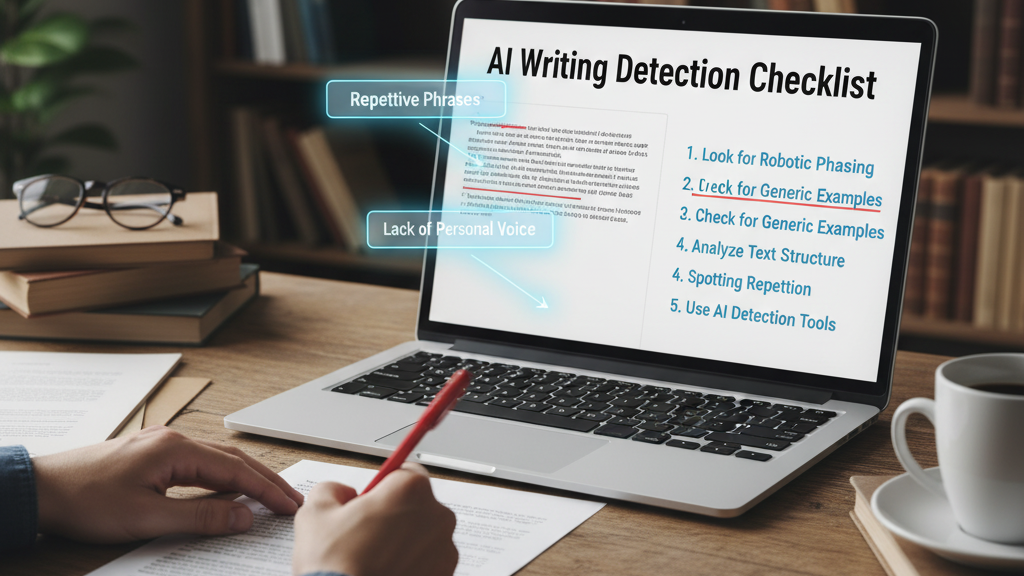
A person's hands are shown at a wooden desk, writing on a paper with a red pen. In front of them, a laptop displays an "AI Writing Detection Checklist" with tips like "Look for Robotic Phrasing," "Check for Generic Examples," and "Analyze Text Structure." Highlighted on the screen are examples of "Repetitive Phrases" and "Lack of Personal Voice," indicating common AI writing tells. A stack of books and a coffee cup are also on the desk. Image (and typos) generated by Nano Banana.
With the proliferation of AI-generated content, discerning human writing from machine-generated text has become an essential skill. This image presents practical tips and a checklist to help identify AI writing, focusing on common tells such as repetitive phrases, generic examples, and a lack of personal voice, empowering readers and educators to critically evaluate written material. Image (and typos) generated by Nano Banana.

Source

CNET

Summary

CNET offers a practical guide for spotting AI-generated writing. It highlights typical cues: prompts embedded openly in the text, overly generic or ambiguous language, unnatural transitions, repetition, and lack of depth or specificity. The article suggests that when a piece echoes the original assignment prompt too directly, that’s a red flag. While no single cue is definitive, combining several tells (tone flatness, formulaic structure, prompt residue) increases confidence that AI was involved. The aim isn’t accusation but raising readers’ critical sensitivity toward AI authorship.

Key Points

  • AI text often includes remnants of the assignment prompt verbatim.
  • It tends to use generic, vague, or ambivalent phrasing more often than human writers.
  • Repetitive patterns, smooth transitions, and “flat” tone are common signals.
  • Contextual depth, original insight, nuance, and emotional detail are often muted.
  • Use a cluster of clues rather than relying on one signal to infer AI writing.

Keywords

URL

https://www.cnet.com/tech/services-and-software/use-these-simple-tips-to-detect-ai-writing/

Summary generated by ChatGPT 5


AI in the classroom is hard to detect — time to bring back oral tests


In a modern classroom or meeting room, students are seated around a table, some with laptops. Two individuals are engaged in an oral discussion, facing each other. Behind them, a large screen displays lines of code that appear to be pixelating and disappearing, symbolizing the difficulty in detecting AI. Image (and typos) generated by Nano Banana.
As the stealth of AI-generated content in written assignments increases, educators are exploring alternative assessment methods. This image highlights a return to oral examinations, where direct interaction can provide a more accurate measure of a student’s understanding and original thought, bypassing the challenges of AI detection software. Image (and typos) generated by Nano Banana.

Source

The Conversation

Summary

Because AI-written texts are relatively easy to present convincingly, detecting AI use in student work is becoming increasingly difficult. The article argues that oral assessments (discussions, interrogations, viva voce) expose a student’s reasoning in ways AI can’t mimic. Voice, hesitation, follow-up questioning and depth of thought are far harder for AI to fake in real time. The authors suggest reintroducing or strengthening oral exams and conversational assessments as a countermeasure to maintain academic integrity and ensure authentic student understanding.

Key Points

  • AI tools produce polished text, but they fail when asked to defend their reasoning under questioning.
  • Oral tests can force students to show understanding, not just output.
  • Real-time dialogue gives instructors more confidence about authenticity than text alone.
  • Reintroduction of oral assessment may help bridge the integrity gap in AI-era classrooms.
  • The method isn’t perfect, but it is a practical and historically grounded safeguard.

Keywords

URL

https://theconversation.com/ai-in-the-classroom-is-hard-to-detect-time-to-bring-back-oral-tests-265955

Summary generated by ChatGPT 5