We Asked Teachers About Their Experiences With AI in the Classroom — Here’s What They Said


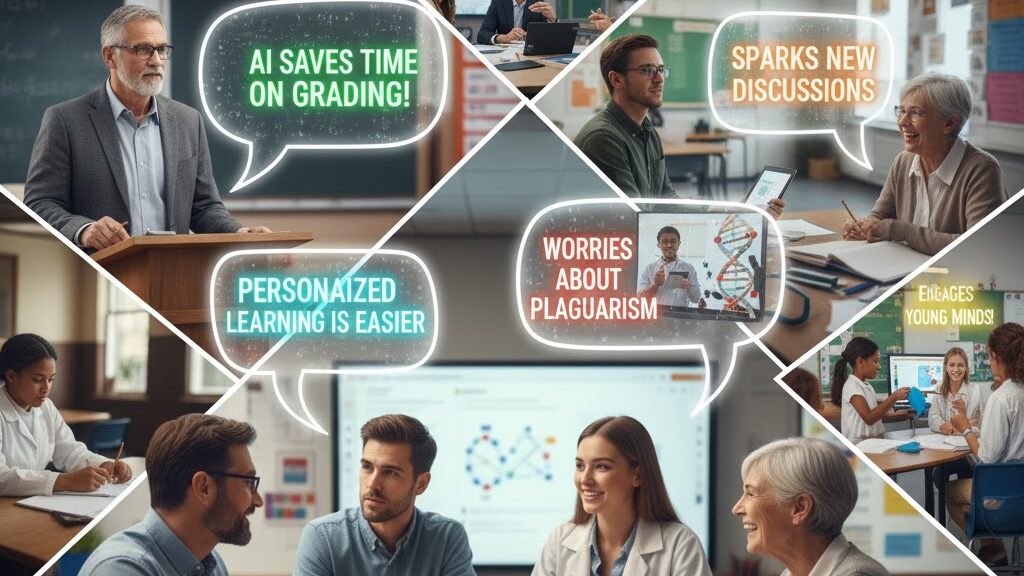
A digital illustration showing a diverse group of teachers sitting around a conference table in a modern classroom, each holding a speech bubble or screen displaying various short, contrasting statements about AI, such as "HELPFUL TOOL," "CHEAT DETECTOR," and "TIME SINK." Image (and typos) generated by Nano Banana.
Diverse perspectives on the digital frontier: Capturing the wide range of experiences and opinions shared by educators as they navigate the benefits and challenges of integrating AI into their classrooms. Image (and typos) generated by Nano Banana.

Source

The Conversation

Summary

Researcher Nadia Delanoy interviewed ten Canadian teachers to explore how generative AI is reshaping K–12 classrooms. The teachers, spanning grades 5–12 across multiple provinces, described mounting pressures to adapt amid ethical uncertainty and emotional strain. Common concerns included the fragility of traditional assessment, inequitable access to AI tools, and rising workloads compounded by inadequate policy support. Many expressed fear that AI could erode the artistry and relational nature of teaching, turning it into a compliance exercise. While acknowledging AI’s potential to enhance workflow, teachers emphasised the need for slower, teacher-led, and ethically grounded implementation that centres humanity and professional judgment.

Key Points

  • Teachers report anxiety over authenticity and fairness in assessment.
  • Equity gaps widen as some students have greater AI access than others.
  • Educators feel policies treat them as implementers, not professionals.
  • AI integration adds to burnout, threatening teacher autonomy.
  • Responsible policy must involve teachers, ethics, and slower adoption.

Keywords

URL

https://theconversation.com/we-asked-teachers-about-their-experiences-with-ai-in-the-classroom-heres-what-they-said-265241

Summary generated by ChatGPT 5


Their Professors Caught Them Cheating. They Used A.I. to Apologize.


A distressed university student in a dimly lit room is staring intently at a laptop screen, which displays an AI chat interface generating a formal apology letter to their professor for a late submission. Image (and typos) generated by Nano Banana.
The irony of a digital dilemma: Students caught using AI to cheat are now turning to the same technology to craft their apologies. Image (and typos) generated by Nano Banana.

Source

The New York Times

Summary

At the University of Illinois Urbana–Champaign, over 100 students in an introductory data science course were caught using artificial intelligence both to cheat on attendance and to generate apology emails after being discovered. Professors Karle Flanagan and Wade Fagen-Ulmschneider identified the misuse through digital tracking tools and later used the incident to discuss academic integrity with their class. The identical AI-written apologies became a viral example of AI misuse in education. While the university confirmed no disciplinary action would be taken, the case underscores the lack of clear institutional policy on AI use and the growing tension between student temptation and ethical academic practice.

Key Points

  • Over 100 Illinois students used AI to fake attendance and write identical apologies.
  • Professors exposed the incident publicly to promote lessons on academic integrity.
  • No formal sanctions were applied as the syllabus lacked explicit AI-use rules.
  • The case reflects universities’ struggle to define ethical AI boundaries.
  • Highlights the normalisation and risks of generative AI in student behaviour.

Keywords

URL

https://www.nytimes.com/2025/10/29/us/university-illinois-students-cheating-ai.html

Summary generated by ChatGPT 5


AI: Are we empowering students – or outsourcing the skills we aim to cultivate?


A stark split image contrasting two outcomes of AI in education, divided by a jagged white lightning bolt. The left side shows a diverse group of three enthusiastic students working collaboratively on laptops, with one student raising their hands in excitement. Above them, a vibrant, glowing display of keywords like "CRITICAL THINKING," "CREATIVITY," and "COLLABORATION" emanates, surrounded by data and positive learning metrics. The right side shows a lone, somewhat disengaged male student working on a laptop, with a large, menacing robotic hand hovering above him. The robot hand has glowing red lights and is connected to a screen filled with complex, auto-generated data, symbolizing the automation of tasks and potential loss of human skills. Image (and typos) generated by Nano Banana.
The rise of AI in education presents a crucial dichotomy: are we using it to truly empower students and cultivate essential skills, or are we inadvertently outsourcing those very abilities to algorithms? This image visually explores the two potential paths for AI’s integration into learning, urging a thoughtful approach to its implementation. Image (and typos) generated by Nano Banana.

Source

The Irish Times

Summary

Jean Noonan reflects on the dual role of artificial intelligence in higher education—its capacity to empower learning and its risk of eroding fundamental human skills. As AI becomes embedded in teaching, research, and assessment, universities must balance innovation with integrity. AI literacy, she argues, extends beyond technical skills to include ethics, empathy, and critical reasoning. While AI enhances accessibility and personalised learning, over-reliance may weaken originality and authorship. Noonan calls for assessment redesigns that integrate AI responsibly, enabling students to learn with AI rather than be replaced by it. Collaboration between academia, industry, and policymakers is essential to ensure education cultivates judgment, creativity, and moral awareness. Echoing Orwell’s warning in 1984, she concludes that AI should enhance, not diminish, the intellectual and linguistic richness that defines human learning.

Key Points

  • AI literacy must combine technical understanding with ethics, empathy, and reflection.
  • Universities are rapidly adopting AI but risk outsourcing creativity and independent thought.
  • Over-reliance on AI tools can blur authorship and weaken critical engagement.
  • Assessment design should promote ethical AI use and active, independent learning.
  • Collaboration between universities and industry can align innovation with responsible practice.
  • Education must ensure AI empowers rather than replaces essential human skills.

Keywords

URL

https://www.irishtimes.com/ireland/education/2025/10/29/ai-are-we-empowering-students-or-outsourcing-the-skills-we-aim-to-cultivate/

Summary generated by ChatGPT 5


Guidance on Artificial Intelligence in Schools


Source

Department of Education and Youth & Oide Technology in Education, October 2025

Summary

This national guidance document provides Irish schools with a framework for the safe, ethical, and effective use of artificial intelligence (AI), particularly generative AI (GenAI), in teaching, learning, and school leadership. It aims to support informed decision-making, enhance digital competence, and align AI use with Ireland’s Digital Strategy for Schools to 2027. The guidance recognises AI’s potential to support learning design, assessment, and communication while emphasising human oversight, teacher professionalism, and data protection.

It presents a balanced view of benefits and risks—AI can personalise learning and streamline administration but also raises issues of bias, misinformation, data privacy, and environmental impact. The report introduces a 4P framework—Purpose, Planning, Policies, and Practice—to guide schools in integrating AI responsibly. Teachers are encouraged to use GenAI as a creative aid, not a substitute, and to embed AI literacy in curricula. The document stresses the need for ethical awareness, alignment with GDPR and the EU AI Act (2024), and continuous policy updates as technology evolves.

Key Points

  • AI should support, not replace, human-led teaching and learning.
  • Responsible use requires human oversight, verification, and ethical reflection.
  • AI literacy for teachers, students, and leaders is central to safe adoption.
  • Compliance with GDPR and the EU AI Act ensures privacy and transparency.
  • GenAI tools must be age-appropriate and used within consent frameworks.
  • Bias, misinformation, and “hallucinations” demand critical human review.
  • The 4P Approach (Purpose, Planning, Policies, Practice) structures school-level implementation.
  • Environmental and wellbeing impacts must be considered in AI use.
  • Collaboration between the Department, Oide, and schools underpins future updates.
  • Guidance will be continuously revised to reflect evolving practice and research.

Conclusion

The guidance frames AI as a powerful but high-responsibility tool in education. By centring ethics, human agency, and data protection, schools can harness AI’s potential while safeguarding learners’ wellbeing, trust, and equity. Its iterative, values-led approach ensures Ireland’s education system remains adaptive, inclusive, and future-ready.

Keywords

URL

https://assets.gov.ie/static/documents/dee23cad/Guidance_on_Artificial_Intelligence_in_Schools_25.pdf

Summary generated by ChatGPT 5


How Education Can Transform Disruptive AI Advances into Workforce Opportunities


A vibrant and futuristic scene set within a modern, glass-roofed architectural complex that resembles a university campus or innovative workspace. In the foreground, a diverse group of students or young professionals are seated around a large table, interacting with glowing holographic interfaces projected onto the tabletop, showing data and digital connections. In the background, many people are walking, and a humanoid robot is visible. Dominating the scene is a massive, glowing blue upward-trending arrow, composed of interconnected digital lines and data points, symbolizing growth and opportunity. Image (and typos) generated by Nano Banana.
As AI continues to disrupt industries, education holds the key to transforming these advancements into unprecedented workforce opportunities. This image visualizes how strategic educational initiatives can bridge the gap between AI innovation and career readiness, equipping individuals to thrive in an evolving job market. Image (and typos) generated by Nano Banana.

Source

World Economic Forum

Summary

Mallik Tatipamula and Azad Madni argue that education systems must evolve rapidly to prepare workers for the AI-native, autonomous, and ethically aligned economy of the future. While AI is expected to displace 92 million jobs globally, it will also create 170 million new roles requiring AI literacy, ethical judgment, and transdisciplinary thinking. The authors call for a “transdisciplinary systems mindset” in education—integrating physical sciences, life sciences, computation, and engineering—to equip graduates with creative, contextual, and ethical reasoning skills that AI cannot replicate. Future success will depend less on narrow technical expertise and more on the ability to collaborate across disciplines, apply systems thinking, and use AI to augment human potential responsibly.

Key Points

  • AI will both displace and create millions of jobs, demanding rapid educational adaptation.
  • Education must prioritise AI literacy, ethics, and cognitive resilience alongside technical skills.
  • A “net-positive AI framework” should ensure technology benefits society and human cognition.
  • Transdisciplinary curricula combining science, engineering, and ethics are vital for future-ready workers.
  • Physical AI, data fluency, and human-AI collaboration will become core competencies.
  • Universities should promote challenge-driven learning and convergence hubs for innovation.

Keywords

URL

https://www.weforum.org/stories/2025/10/education-disruptive-ai-workforce-opportunities/

Summary generated by ChatGPT 5