By James Hanley, Oliver Harris, Caitlin Walsh, Sam Blanch, Dakota Venn-Keane, Eve Whelan, Luke Kiely, Jake Power, and Alex Rockett Power in collaboration with ChatGPT and Dr Hazel Farrell
Estimated reading time: 7 minutes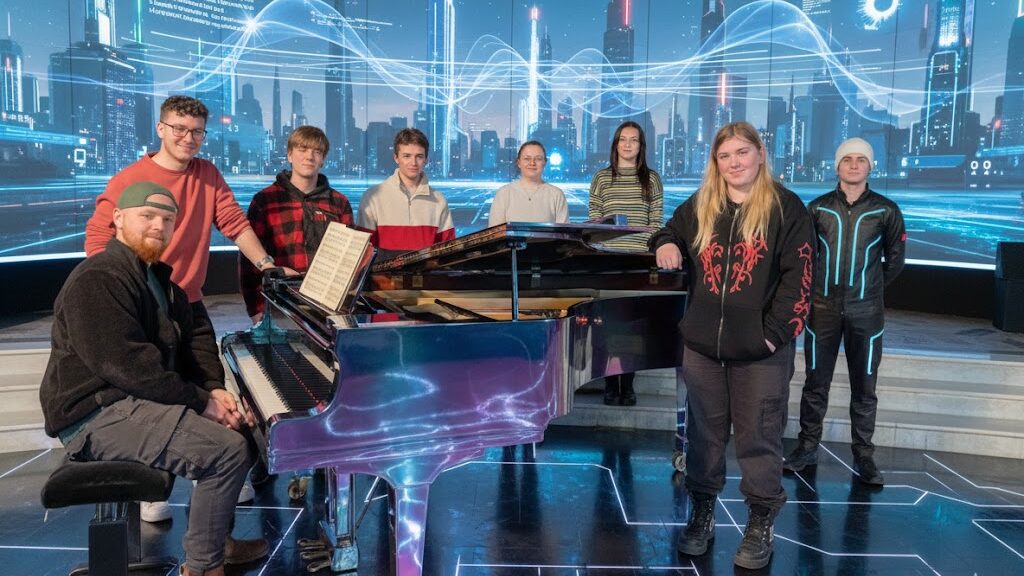
In recognition of how deeply AI is becoming embedded in the educational landscape, a co-created assignment exploring possibilities for music educators was considered timely. As part of the Year 3 Music Pedagogy module at South East Technological University (SETU), students were tasked with designing a learning activity that meaningfully integrated AI into the process. They were asked not only to create a resource but to trial it, evaluate it, and critically reflect on how AI shaped the learning experience. A wide range of free AI tools were used, including ChatGPT, SUNO, Audacity, Napkin, Google Gemini, Notebook LM, and Eleven Labs, and each student focused on a teaching resource that resonated with them, such as interactive tools, infographics, lesson plans, and basic websites.
Across their written and audio reflections, a rich picture emerged: AI is powerful, fallible, inspiring, frustrating, and always dependent on thoughtful human oversight. This blog is based on their reflections which reveal a generation of educators learning not just how to use AI, but why it must be used with care.
Expanding Pedagogical Possibilities
Students consistently highlighted AI’s ability to accelerate creativity and resource development. Several noted that AI made it easier to create visually engaging materials, such as diagrams, colourful flashcards, or child‑friendly graphics. One student reflected, “With just a click of the mouse, anyone can generate their own diagrams and flash cards for learning,” emphasising how AI allowed them to design tools they would otherwise struggle to produce manually.
Others explored AI‑generated musical content. One student used a sight‑reading generator to trial melodic exercises, observing that while the exercises themselves were well‑structured, “the feedback was exceedingly generous.” Another used ChatGPT to build a lesson structure, describing the process as “seamless and streamlined,” though still requiring adjustments to ensure accuracy and alignment with Irish terminology. One reflection explained, “AI can create an instrumental track in a completely different style, but it still needs human balance through EQ, compression, and reverb to make it sound natural.” This demonstrated how AI and hands-on editing can work together to develop both musical and technical skills.
An interactive rhythm game for children was designed by another student who used ChatGPT to progressively refine layout, colour schemes, difficulty levels, and supportive messages such as “Nice timing!” and “Perfect rhythm!” They described an iterative process requiring over 30 versions as the model continuously adapted to new instructions. The result was a working single‑player prototype that demonstrated both the creative potential and technical limits of AI‑assisted design.
The Teacher’s Role Remains Central
Across all reflections, students expressed strong awareness that AI cannot replace fundamental aspects of music teaching. Human judgment, accuracy, musical nuance, and relational connection were seen as irreplaceable. One student wrote that although AI can generate ideas and frameworks, “the underlying educational thinking remained a human responsibility.” Another reflected on voice‑training tools, noting that constant pitch guidance from AI could become “a crutch,” misleading students into believing they were singing correctly even when not. Many recognised that while AI can speed up creative processes, the emotional control, balance, and overall musical feel must still come from human input. One reflection put it simply: “AI gives you the idea, but people give it life.”
There was also a deep recognition of the social dimension of teaching. As one student put it, the “teacher–student relationship bears too much of an impact” to be substituted by automated tools. Many emphasised that confidence‑building, emotional support, and adaptive feedback come from real educators, not algorithms.
Challenges, Risks, and Ethical Considerations
The assignment surfaced several important realisations, including the fact that technical inaccuracies were common. Students identified incorrect musical examples, inconsistent notation, malfunctioning website features, and audio‑mixing problems. One student documented how, over time, the “quality of the site got worse,” illustrating AI’s tendency to forget earlier instructions in long interactions. This reinforced the need for rigorous verification when creating learning materials.
Another reflection noted that not all AI websites perform equally; some produce excellent results, while others generate distorted or incomplete outputs, forcing teachers to try multiple tools before finding one that works. It also reminded educators that even free or simple programs, like basic versions of Audacity, can still teach valuable mixing and editing skills without needing expensive software. A parallel concern was over‑reliance. Students worried that teachers might outsource too much planning to AI or that learners might depend on automated feedback rather than developing critical listening skills. As one reflection warned, “AI can and will become a key tool… the crucial factor is that we as real people know where the line is between a ‘tool’ and a ‘free worker.’”
Equity of access also arose as a barrier. Subscription‑based AI tools required credits or payment, creating challenges for students and highlighting ethical tensions between commercial technologies and educational use. Students demonstrated strong awareness of academic integrity. They distinguished between using AI to support structure and clarity versus allowing AI to generate entire lessons or presentations. One student cautioned that presenting AI‑produced content as one’s own is “blatant plagiarism,” highlighting the need for transparent and ethical practice.
Learning About Pedagogy and Professional Identity
Many students described developing a clearer sense of themselves as educators. They reflected on the complexity of communicating clearly, engaging learners, and designing accessible content. Some discovered gaps in their teaching confidence; others found new enthusiasm for pedagogical design. One wrote, “Teaching and clearly communicating my views was more challenging than I assumed,” acknowledging the shift from student to teacher mindset. Another recognised that while AI could support efficiency, it made them more aware of their responsibility for accuracy and learner experience.
Imagining the Future of AI in Music Education
Students were divided between optimism and caution. Some saw AI becoming a standard part of educational resource creation, enabling personalised practice, interactive learning, and rapid content generation. Others expressed concern about the possibility of AI replacing human instruction if not critically managed. However, all students agreed on one point: AI works best when treated as a supportive tool rather than an autonomous teacher. As one reflection summarised, “It is clear to me that AI is by no means a replacement for musical knowledge or teaching expertise.” Another added, “AI can make the process faster and more creative, but it still needs the human touch to sound right.”

Dr Hazel Farrell
Academic Lead for GenAI, Programme Leader BA (Hons) Music
South East Technological University