Outsourced Thinking? Experts Consider AI’s Impact on Our Brains


A stylized, conceptual image showing a human head in profile with glowing digital lines extending from the brain area towards a floating, interconnected mesh of AI circuitry, symbolizing the outsourcing of thought processes. A question mark hangs over the point of connection. Image (and typos) generated by Nano Banana.
The cognitive shift: Experts are weighing the potential impact of AI reliance—is it a tool for enhancement, or are we outsourcing the very processes that keep our brains sharp? Image (and typos) generated by Nano Banana.

Source

RTÉ Prime Time

Summary

RTÉ explores emerging concerns about how widespread AI use may alter human cognition. With almost 800 million ChatGPT users globally and Ireland among the world’s heaviest users, scientists warn that convenience may carry hidden cognitive costs. An MIT study using brain-imaging found reduced neural activity when participants relied on ChatGPT, suggesting diminished critical evaluation. Irish neuroscientist Paul Dockree cautions that outsourcing tasks like writing and problem-solving could erode core cognitive skills, similar to over-dependency on GPS. Others draw parallels with aviation, where automation has weakened pilots’ manual skills. While some users praise AI’s benefits, experts warn of a potential “two-tier society” of empowered critical thinkers and those who grow dependent on automated reasoning.

Key Points

  • AI adoption is extremely rapid; Ireland has one of the highest global usage rates.
  • MIT research indicates reduced brain activity when using ChatGPT for problem-solving.
  • Cognitive scientists warn of long-term skill decline if AI replaces active thinking.
  • Automation parallels in aviation show how skills can erode without practice.
  • Public reactions are mixed, reflecting broader uncertainty about AI’s cognitive impact.

Keywords

URL

https://www.rte.ie/news/primetime/2025/1111/1543356-outsourced-thinking-experts-consider-ais-impact-on-our-brains/

Summary generated by ChatGPT 5


How Generative AI Could Change How We Think and Speak


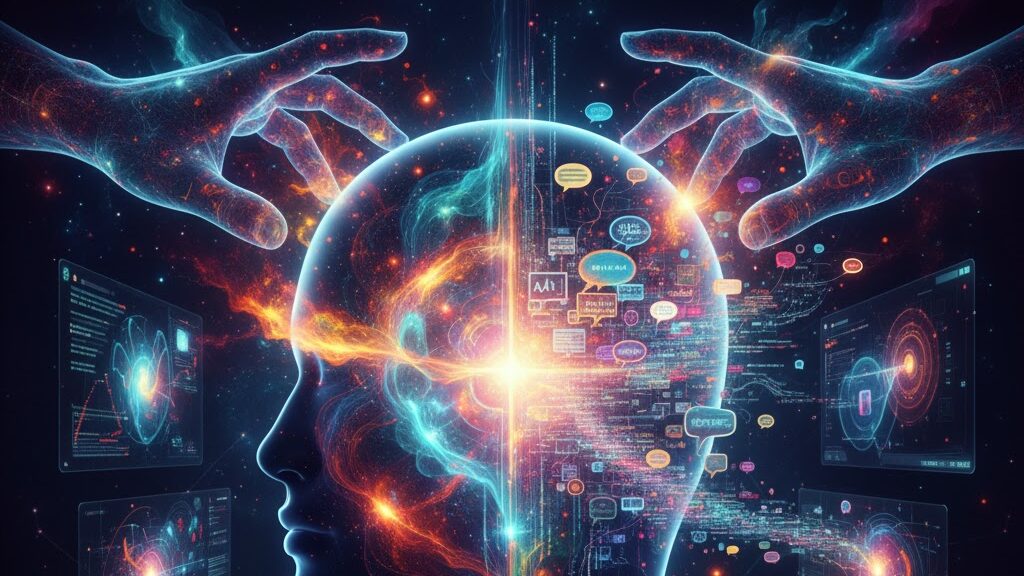
A glowing, ethereal blue silhouette of a human head and shoulders against a dark, starry background. Within the head, vibrant cosmic energy and swirling light converge, symbolizing thought and consciousness. From the head, streams of complex code, abstract data visualizations, and various speech bubbles with different languages and concepts flow outward, representing language and communication. Above the head, two pairs of translucent, glowing hands reach down, seemingly interacting with or guiding the processes. On either side, futuristic holographic interfaces display intricate data and neural networks. Image (and typos) generated by Nano Banana.
Generative AI is not just changing how we create, but how we fundamentally process information and express ourselves. Explore the profound ways this transformative technology could reshape human thought patterns and linguistic communication in the years to come. Image (and typos) generated by Nano Banana.

Source

The Conversation

Summary

Antonio Cerella examines how generative AI may reshape the cognitive and linguistic habits that underpin human thought. Drawing on psychology, neuroscience, and linguistics, he argues that over-reliance on AI tools risks weakening creativity, critical thinking, and language mastery. Just as GPS technology has diminished spatial memory, constant AI-assisted writing and problem-solving could erode our ability to form and express original ideas. Cerella warns that when language becomes pre-packaged through AI systems, the connection between speech and thought deteriorates, fostering a “culture of immediacy” driven by emotion rather than understanding. Yet for those with mature linguistic awareness, AI can still serve as a creative partner—if used reflectively and not as a substitute for thought.

Key Points

  • Overuse of AI may dull critical thinking and creative language use.
  • Psychological research shows that technological reliance can reconfigure the brain.
  • AI-generated language risks weakening the link between thought and expression.
  • The loss of linguistic agency could erode democratic discourse and imagination.
  • Conscious, reflective engagement with language can preserve creativity and autonomy.

Keywords

URL

https://theconversation.com/how-generative-ai-could-change-how-we-think-and-speak-267118

Summary generated by ChatGPT 5