AI technology ‘replacing critical thinking in university lectures’ – student


In a grand, Gothic-style university lecture hall, rows of students are seated, all intently focused on glowing laptops. At the front, a large, cold blue holographic display titled "AI LECTURE AUTOMATION SYSTEM" prominently states: "Critical Thinking: Replaced. Information: Delivered." A small whiteboard in the background sarcastically asks, "AI IS 'HERE,' WHERE'S THE PROF?!" Image (and typos) generated by Nano Banana.
According to a student’s observation, AI technology is alarmingly “replacing critical thinking in university lectures,” transforming the learning environment into one focused solely on information delivery. This dystopian image visualizes a future where traditional human instruction is minimized, and AI automates the lecture process, raising serious questions about the impact on students’ cognitive development and the very essence of higher education. Image (and typos) generated by Nano Banana.

Source

Waikato Times

Summary

A University of Waikato student has voiced concern that widespread use of AI in lectures is eroding students’ ability to think critically. Speaking anonymously, the fourth-year student said many peers now use ChatGPT to generate lecture notes, discussion questions, and ideas—essentially outsourcing thinking itself. While she acknowledged that AI has benefits when used judiciously, she worries it encourages intellectual passivity and dependence. The student warned that such habits could eventually harm employability, as employers increasingly seek graduates with strong analytical and critical-thinking skills.

Key Points

  • Students are using ChatGPT to generate lecture notes and workshop discussion prompts.
  • The student fears this practice undermines the purpose of higher education—to cultivate independent thinking.
  • She admits AI has value when used responsibly but sees overreliance as damaging to learning.
  • The trend risks producing graduates who lack the analytical abilities employers prize most.
  • The concern reflects wider tensions in universities over balancing AI’s benefits and harms.

Keywords

URL

https://www.waikatotimes.co.nz/nz-news/360843243/ai-technology-replacing-critical-thinking-university-lectures-student

Summary generated by ChatGPT 5


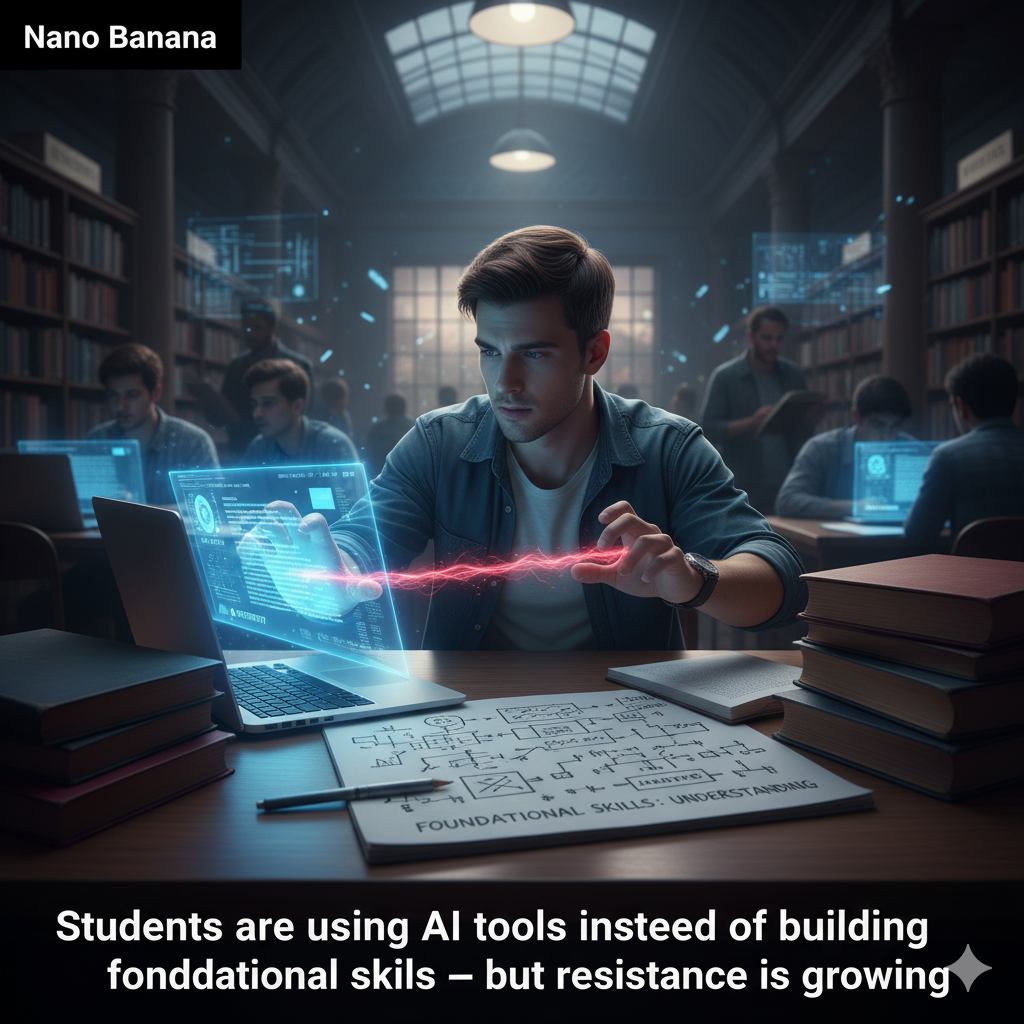
Students are using AI tools instead of building foundational skills – but resistance is growing


In a dimly lit library, a focused male student interacts with a glowing holographic display from his laptop, showing complex data. A red, crackling energy line extends from the display towards his hands. On the desk, an open notebook beneath it is titled 'FOUNDATIONAL SKILLS: UNDERSTANDING' with handwritten equations. Other students are visible in the background, implying a widespread trend. The scene contrasts AI tool usage with fundamental learning. Generated by Nano Banana.
The convenience of AI tools poses a growing dilemma for students: relying on them for quick answers versus engaging in the hard work of building foundational knowledge. While the allure of efficiency is strong, a movement towards prioritising true understanding and essential skills is gaining momentum. Image generated by Nano Banana.

Source

ZDNet

Summary

The rapid uptake of AI in education is fuelling concerns that students are outsourcing critical thinking and failing to build long-term skills. While AI helps with grading, planning, and coding, academics worry about “hollow” assignments that lack depth and originality. Some professors highlight students’ inability to explain code produced with AI, exposing gaps in understanding. In response, a coalition of technology faculty issued an open letter urging universities to resist uncritical adoption, warning of dependence, loss of expertise, and damage to academic freedom. Advocates argue AI should supplement—not replace—foundational skills, with careful vetting and practical use.

Key Points

  • AI is heavily used in classrooms, but risks undermining deep learning and original thought.
  • Examples show students submitting near-identical AI essays or failing to explain AI-written code.
  • Professors call for limits and redesigns to safeguard academic freedom and integrity.
  • Concerns include declining quality of computer science education and over-reliance on prompting tools.
  • Best practice is to adopt AI deliberately, ensuring it serves genuine educational purposes.

Keywords

URL

https://www.zdnet.com/article/students-are-using-ai-tools-instead-of-building-foundational-skills-but-resistance-is-growing/

Summary generated by ChatGPT 5


How AI Impacts Academic Thinking, Writing and Learning


In a grand, traditional university library, a male student is intensely focused on his laptop at a wooden desk with open books. Above him, three distinct, glowing holographic pathways converge on a central brain icon. These pathways are labeled 'THINKING: ANALYSIS & IDEATION' (blue, with gears and question marks), 'WRITING: CREATION & REFINEMENT' (green, with a scroll and feather quill), and 'LEARNING: EXPLORATION & MASTERY' (orange, with a human anatomy model and planets). The image illustrates AI's comprehensive impact on academic processes. Generated by Nano Banana.
AI’s influence stretches across every pillar of academic life, fundamentally reshaping how students engage with thinking, writing, and learning. This image visually articulates the interconnected ways AI tools are transforming cognitive processes, aiding in content creation and refinement, and opening new avenues for exploration and mastery in education. Image generated by Nano Banana.

Source

Psychology Today

Summary

A meta‑analysis of studies from 2022‑2024 shows AI tools improve student performance (grades, engagement, higher‑order thinking) but reduce mental effort. Students use AI more for surface-level content than deep argument, and long‑term retention without AI remains unclear. Educators should design learning that builds verification, scepticism, and critical thinking rather than fostering dependence.

Key Points

  • AI boosts grades and engagement but reduces effort and depth.
  • Students mostly use AI for facts and summaries, less for critical analysis.
  • Few studies assess long‑term retention without AI assistance.
  • Over‑trust in AI risks over‑reliance and copy/paste behaviour.
  • Educators must design tasks that foster verification and reflective use.

Keywords

URL

https://www.psychologytoday.com/us/blog/in-one-lifespan/202509/how-ai-impacts-academic-thinking-writing-and-learning

Summary generated by ChatGPT 5