Outsourced Thinking? Experts Consider AI’s Impact on Our Brains


A stylized, conceptual image showing a human head in profile with glowing digital lines extending from the brain area towards a floating, interconnected mesh of AI circuitry, symbolizing the outsourcing of thought processes. A question mark hangs over the point of connection. Image (and typos) generated by Nano Banana.
The cognitive shift: Experts are weighing the potential impact of AI reliance—is it a tool for enhancement, or are we outsourcing the very processes that keep our brains sharp? Image (and typos) generated by Nano Banana.

Source

RTÉ Prime Time

Summary

RTÉ explores emerging concerns about how widespread AI use may alter human cognition. With almost 800 million ChatGPT users globally and Ireland among the world’s heaviest users, scientists warn that convenience may carry hidden cognitive costs. An MIT study using brain-imaging found reduced neural activity when participants relied on ChatGPT, suggesting diminished critical evaluation. Irish neuroscientist Paul Dockree cautions that outsourcing tasks like writing and problem-solving could erode core cognitive skills, similar to over-dependency on GPS. Others draw parallels with aviation, where automation has weakened pilots’ manual skills. While some users praise AI’s benefits, experts warn of a potential “two-tier society” of empowered critical thinkers and those who grow dependent on automated reasoning.

Key Points

  • AI adoption is extremely rapid; Ireland has one of the highest global usage rates.
  • MIT research indicates reduced brain activity when using ChatGPT for problem-solving.
  • Cognitive scientists warn of long-term skill decline if AI replaces active thinking.
  • Automation parallels in aviation show how skills can erode without practice.
  • Public reactions are mixed, reflecting broader uncertainty about AI’s cognitive impact.

Keywords

URL

https://www.rte.ie/news/primetime/2025/1111/1543356-outsourced-thinking-experts-consider-ais-impact-on-our-brains/

Summary generated by ChatGPT 5


Students using ChatGPT beware: Real learning takes legwork, study finds


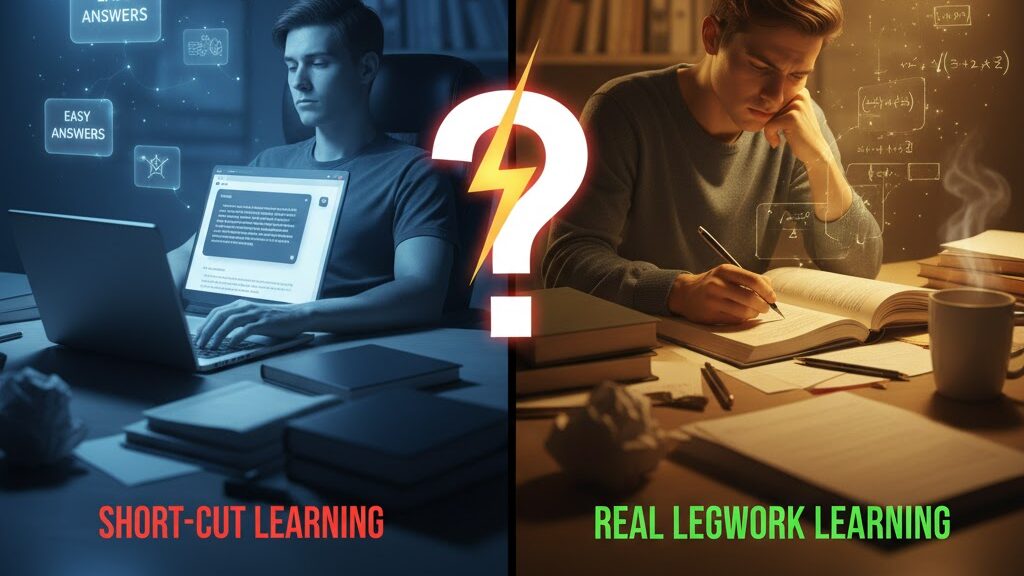
split image illustrating two contrasting study methods. On the left, a student in a blue-lit setting uses a laptop for "SHORT-CUT LEARNING" with "EASY ANSWERS" floating around. On the right, a student in a warm, orange-lit setting is engaged in "REAL LEGWORK LEARNING," writing in a notebook with open books and calculations. A large question mark divides the two scenes. Image (and typos) generated by Nano Banana.
The learning divide: A visual comparison highlights the potential pitfalls of relying on AI for “easy answers” versus the proven benefits of diligent study and engagement, as a new study suggests. Image (and typos) generated by Nano Banana.

Source

The Register

Summary

A new study published in PNAS Nexus finds that people who rely on ChatGPT or similar AI tools for research develop shallower understanding compared with those who gather information manually. Conducted by researchers from the University of Pennsylvania’s Wharton School and New Mexico State University, the study involved over 10,000 participants. Those using AI-generated summaries retained fewer facts, demonstrated less engagement, and produced advice that was shorter, less original, and less trustworthy. The findings reinforce concerns that overreliance on AI can “deskill” learners by replacing active effort with passive consumption. The researchers conclude that AI should support—not replace—critical thinking and independent study.

Key Points

  • Study of 10,000 participants compared AI-assisted and traditional research.
  • AI users showed shallower understanding and less factual recall.
  • AI summaries led to homogenised, less trustworthy responses.
  • Overreliance on AI risks reducing active learning and cognitive engagement.
  • Researchers recommend using AI as a support tool, not a substitute.

Keywords

URL

https://www.theregister.com/2025/11/03/chatgpt_real_understanding/

Summary generated by ChatGPT 5


Teachers Worry AI Will Impede Students’ Critical Thinking Skills. Many Teens Aren’t So Sure


A split image contrasting teachers' concerns about AI with teenagers' perspectives. On the left, a worried female teacher stands in a traditional classroom, gesturing with open hands towards a laptop on a desk. A glowing red 'X' mark covers the words "CRITICAL THINKING" and gears/data on the laptop screen, symbolizing the perceived threat to cognitive skills. On the right, three engaged teenagers (two boys, one girl) are working collaboratively on laptops in a bright, modern setting. Glowing keywords like "PROBLEM-SOLVING," "INNOVATION," and "CREATIVITY" emanate from their screens, representing AI's perceived benefits. A large question mark is placed in the middle top of the image. Image (and typos) generated by Nano Banana.
A clear divide emerges in the debate over AI’s impact on critical thinking: while many teachers express concern that AI will hinder students’ cognitive development, a significant number of teenagers remain unconvinced, often viewing AI as a tool that can enhance their problem-solving abilities. This image visualises the contrasting viewpoints on this crucial educational challenge. Image (and typos) generated by Nano Banana.

Source

Education Week

Summary

Alyson Klein reports on the growing divide between teachers and students over how artificial intelligence is affecting critical thinking. While educators fear that AI tools like ChatGPT are eroding students’ ability to reason independently, many teens argue that AI can actually enhance their thinking when used responsibly. Teachers cite declining originality and over-reliance on AI-generated answers, expressing concern that students are losing confidence in forming their own arguments. Students, however, describe AI as a useful study companion—helping clarify concepts, model strong writing, and guide brainstorming. Experts suggest that the key issue is not whether AI harms or helps, but how schools teach students to engage with it critically. Educators who integrate AI into lessons rather than banning it outright are finding that students can strengthen, rather than surrender, their analytical skills.

Key Points

  • Teachers fear AI use is diminishing critical thinking and originality in student work.
  • Many students view AI as a learning aid that supports understanding and creativity.
  • The divide reflects differing expectations around what “thinking critically” means.
  • Experts recommend structured AI literacy education over prohibition or punishment.
  • Responsible AI use depends on reflection, questioning, and teacher guidance.

Keywords

URL

https://www.edweek.org/technology/teachers-worry-ai-will-impede-students-critical-thinking-skills-many-teens-arent-so-sure/2025/10

Summary generated by ChatGPT 5


AI Chatbots Fail at Accurate News, Major Study Reveals


A distressed young woman sits at a desk in a dim room, holding her head in her hands while looking at a glowing holographic screen. The screen prominently displays a "AI CHATBOT NEWS ACCURACY REPORT" table. The table has columns for "QUERY," "AI CHATBOT RESPONSE" (filled with garbled, incorrect text and large red 'X' marks), and "REALITY/CORRECTION" (showing accurate but simple names/phrases). A prominent red siren icon flashes above the table, symbolizing an alert or warning. Image (and typos) generated by Nano Banana.
A major new study has delivered a sobering revelation: AI chatbots are significantly failing when it comes to reporting accurate news. This image highlights the frustration and concern arising from AI’s inability to provide reliable information, underscoring the critical need for verification and human oversight in news consumption. Image (and typos) generated by Nano Banana.

Source

Deutsche Welle (DW)

Summary

A landmark study by 22 international public broadcasters, including DW, BBC, and NPR, found that leading AI chatbots—ChatGPT, Copilot, Gemini, and Perplexity—misrepresented or distorted news content in 45 per cent of their responses. The investigation, which reviewed 3,000 AI-generated answers, identified widespread issues with sourcing, factual accuracy, and the ability to distinguish fact from opinion. Gemini performed the worst, with 72 per cent of its responses showing significant sourcing errors. Researchers warn that the systematic nature of these inaccuracies poses a threat to public trust and democratic discourse. The European Broadcasting Union (EBU), which coordinated the study, has urged governments to strengthen media integrity laws and called on AI companies to take accountability for how their systems handle journalistic content.

Key Points

  • AI chatbots distorted or misrepresented news 45 per cent of the time.
  • 31 per cent of responses had sourcing issues; 20 per cent contained factual errors.
  • Gemini and Copilot were the least accurate, though all models underperformed.
  • Errors included outdated information, misattributed quotes, and false facts.
  • The EBU and partner broadcasters launched the “Facts In: Facts Out” campaign for AI accountability.
  • Researchers demand independent monitoring and regulatory enforcement on AI-generated news.

Keywords

URL

https://www.dw.com/en/chatbot-ai-artificial-intelligence-chatgpt-google-gemini-news-misinformation-fact-check-copilot-v2/a-74392921

Summary generated by ChatGPT 5


Experts Warn AI Could Reshape Teen Brains


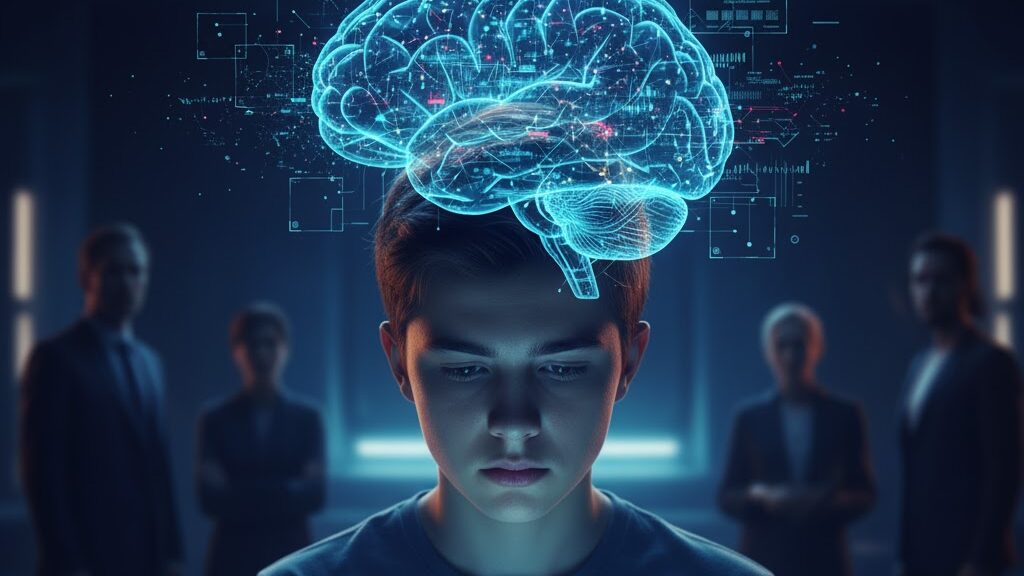
A focused teenage boy looks down at a glowing digital tablet displaying complex data. Above his head, a bright blue, intricate holographic representation of a human brain pulsates with interconnected data points and circuits, symbolizing the impact of technology. In the blurred background, several adult figures in professional attire stand, observing the scene, representing the "experts." Image (and typos) generated by Nano Banana.
As artificial intelligence becomes increasingly integrated into daily life, experts are raising concerns about its potential long-term effects on the developing brains of teenagers. Explore the warnings and discussions surrounding AI’s influence on cognitive development and neural pathways. Image (and typos) generated by Nano Banana.

Source

CNBC

Summary

Ernestine Siu reports growing concern among scientists and regulators that prolonged use of generative AI by children and teenagers could alter brain development and weaken critical thinking skills. A 2025 MIT Media Lab study found that reliance on large language models (LLMs) such as ChatGPT reduced neural connectivity compared with unaided writing tasks, suggesting “cognitive debt” from over-dependence on external support. Researchers warn that early exposure may limit creativity, self-regulation, and critical analysis, while privacy and emotional risks also loom large as children anthropomorphise AI companions. Experts urge limits on generative AI use among young people, stronger parental oversight, and the cultivation of both AI and digital literacy to safeguard cognitive development and wellbeing.

Key Points

  • One in four U.S. teens now use ChatGPT for schoolwork, double the 2023 rate.
  • MIT researchers found reduced brain network activity in users relying on LLMs.
  • Overuse of AI may lead to “cognitive debt” and hinder creativity and ownership of work.
  • Younger users are particularly vulnerable to emotional and privacy risks.
  • Experts recommend age-appropriate AI design, digital literacy training, and parental engagement.

Keywords

URL

https://www.cnbc.com/2025/10/13/experts-warn-ai-llm-chatgpt-gemini-perplexity-claude-grok-copilot-could-reshape-teen-youth-brains.html

Summary generated by ChatGPT 5