Students using ChatGPT beware: Real learning takes legwork, study finds


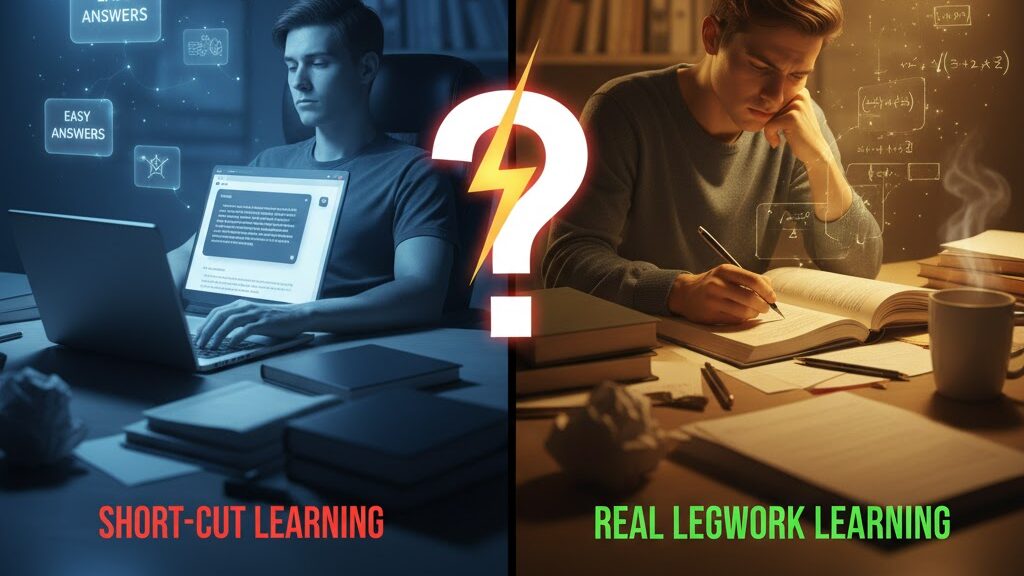
split image illustrating two contrasting study methods. On the left, a student in a blue-lit setting uses a laptop for "SHORT-CUT LEARNING" with "EASY ANSWERS" floating around. On the right, a student in a warm, orange-lit setting is engaged in "REAL LEGWORK LEARNING," writing in a notebook with open books and calculations. A large question mark divides the two scenes. Image (and typos) generated by Nano Banana.
The learning divide: A visual comparison highlights the potential pitfalls of relying on AI for “easy answers” versus the proven benefits of diligent study and engagement, as a new study suggests. Image (and typos) generated by Nano Banana.

Source

The Register

Summary

A new study published in PNAS Nexus finds that people who rely on ChatGPT or similar AI tools for research develop shallower understanding compared with those who gather information manually. Conducted by researchers from the University of Pennsylvania’s Wharton School and New Mexico State University, the study involved over 10,000 participants. Those using AI-generated summaries retained fewer facts, demonstrated less engagement, and produced advice that was shorter, less original, and less trustworthy. The findings reinforce concerns that overreliance on AI can “deskill” learners by replacing active effort with passive consumption. The researchers conclude that AI should support—not replace—critical thinking and independent study.

Key Points

  • Study of 10,000 participants compared AI-assisted and traditional research.
  • AI users showed shallower understanding and less factual recall.
  • AI summaries led to homogenised, less trustworthy responses.
  • Overreliance on AI risks reducing active learning and cognitive engagement.
  • Researchers recommend using AI as a support tool, not a substitute.

Keywords

URL

https://www.theregister.com/2025/11/03/chatgpt_real_understanding/

Summary generated by ChatGPT 5


AI teaching tools not a panacea, but can be a force multiplier


In a modern conference room with a city skyline view, two groups of students and a central female and male instructor are divided by a glowing, split-color light. On the left (red side), the text 'AI: NOT A PANECA' is displayed with error icons. On the right (blue side), 'AI: FORCE MULTIPLIFER' is displayed with growth and brain icons. Light streams intensely between the instructors, symbolizing AI's dual nature. The scene conveys a balanced perspective on AI's role in education. Generated by Nano Banana.
While AI teaching tools are certainly not a ‘panacea’ for all educational challenges, they possess immense potential as a ‘force multiplier,’ significantly enhancing learning experiences. This image visually contrasts AI’s limitations with its power to augment human capabilities, underscoring a nuanced approach to its integration in the classroom. Image (and typos) generated by Nano Banana.

Source

The New Indian Express

Summary

The author argues that while AI teaching tools are gaining attention, their value shows only when paired with thoughtful pedagogy, not when used in isolation. Meta-analyses and classroom studies suggest AI tools (adaptive quizzes, personalised feedback) can enhance student performance and time management—but only in learning environments where human feedback, active engagement, and scaffolding remain central. AI should assist, not replace, the relational, ethical, and mentoring roles of teachers. Without integrating AI into active learning, its benefits are diluted; it risks becoming mere decoration.

Key Points

  • AI tools deliver gains when embedded into active, interactive teaching—not used as standalone replacements.
  • Meta-studies show stronger outcomes when technology is personalised and integrated rather than simply overlaid.
  • Students report improved time management and performance when AI offers real-time feedback and adaptive quizzing.
  • Pedagogical design (feedback loops, scaffolding, mentor oversight) remains essential; AI alone doesn’t do that work.
  • AI cannot replicate human qualities such as creativity, ethics, judgement, and emotional understanding.

Keywords

URL

https://www.newindianexpress.com/opinions/2025/Sep/18/ai-teaching-tools-not-a-panacea-but-can-be-a-force-multiplier

Summary generated by ChatGPT 5