European Digital Education Hub (EDEH), European Commission, 2025
Summary
This foresight report explores four plausible futures for digital education in 2040, emphasising how generative and intelligent technologies could redefine learning, teaching, and human connection. Developed by the EDEH “Future Learner” squad, the study uses scenario planning to imagine how trends such as the rise of generative AI (GenAI), virtual assistance, lifelong learning, and responsible technology use might shape the education landscape. The report identifies 16 major drivers of change, highlighting GenAI’s central role in personalising learning, automating administration, and transforming the balance between human and machine intelligence.
In the most optimistic scenario – Empowered Learning – AI-powered personal assistants, immersive technologies, and data-driven systems make education highly adaptive, equitable, and learner-centred. In contrast, the Constrained Education scenario imagines over-regulated, energy-limited systems where AI use is tightly controlled, while The End of Human Knowledge portrays an AI-saturated collapse where truth, trust, and human expertise dissolve. The final Transformative Vision outlines a balanced, ethical future in which AI enhances – not replaces – human intelligence, fostering empathy, sustainability, and lifelong learning. Across all futures, the report calls for human oversight, explainability, and shared responsibility to ensure that AI in education remains ethical, inclusive, and transparent.
Key Points
Generative AI and intelligent systems are central to all future learning scenarios.
AI personal assistants, XR, and data analytics drive personalised, lifelong education.
Responsible use and ethical frameworks are essential to maintain human agency.
Overreliance on AI risks misinformation, cognitive overload, and social fragmentation.
Sustainability and carbon-neutral AI systems are core to educational innovation.
Data privacy and explainability remain critical for trust in AI-driven learning.
Equity and inclusion depend on access to AI-enhanced tools and digital literacy.
The line between human and artificial authorship will blur without strong governance.
Teachers evolve into mentors and facilitators supported by AI co-workers.
The most resilient future balances technology with human values and social purpose.
Conclusion
The Future Learner envisions 2040 as a pivotal point for digital education, where the success or failure of AI integration depends on ethical design, equitable access, and sustained human oversight. Generative AI can create unprecedented opportunities for personalisation and engagement, but only if education systems preserve their human essence – empathy, creativity, and community – amid the accelerating digital transformation.
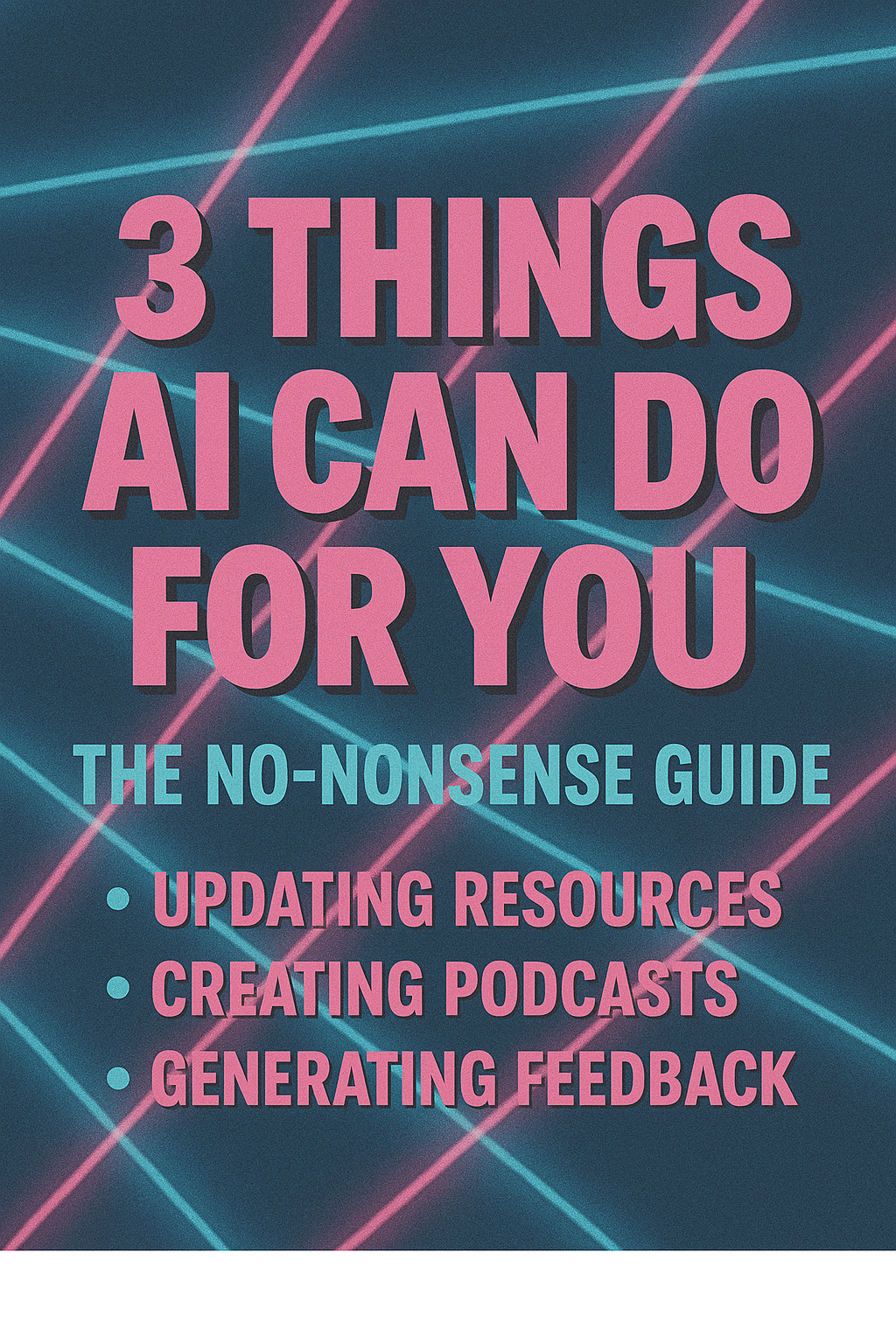
Some people are for it, some people are against it, some people write guidelines about it. What unites most of these ‘factions’ is an almost total inability to use it effectively. Yes, I am talking about AI, the super useful, super intuitive thing that is changing your life by, well, generating some misspelled logos.
This blog post offers something different. Three real things you can do. I will tell you what they are, how to do them, why you should do them, and how much it will cost you. And I am not talking about the things everyone else is talking about.
I know about all this, because ever since ChatGPT launched late 2022, I have been all over it. I have incorporated AI tools into all aspects of my work (even life) and I have built an entire business on the back of it. Here we go then.
Thing Number 1: Updating Your Resources
Academics spend a great deal of time updating things. We update reading lists, handbooks, lecture notes, guides, textbooks, all of the time. Sometimes, we update material in areas we have deep expertise, sometimes we update a handbook in a module that got dumped on us because someone left. Here is how to leverage technology to make this process faster and less painful. You will need a subscription to ChatGPT (£20+VAT, prices as of September 2025) and access to Gemini (via Google Pro subscription, currently free for a year for students and staff or £18.99/month).
Upload the material you wish to update, for example a chapter from a textbook. You select the deep thinking or research option and ask the bot to conduct a review for updates and recommend changes to your uploaded text. Once this is ready, ask it to incorporate the changes into your text, or input them manually as needed. You then take the updated document and run it through the other model, asking it to check for accuracy.
The result is an updated document, which has been updated, verified and often reworded for clarity. Both models offer references and explain their rationale, so you can verify manually and check every step of the process.
Conclusion? You have updated your resource, and it took you one morning, instead of a week
Thing Number 2: Creating Podcasts
Yes, we can lecture, we can offer tutorials, indeed we can upload pdfs on the VLE. But why stop there? Students benefit from multi-modal forms of learning. The surest way to get the message across is to deliver the same information live, via text, audio and video, multiple times.
What has been stopping us doing this effectively? The answer is that most of us are terrible in front of a camera. Yes, students may appreciate a video podcast, but if you look like the hostage in a ransom request video, you are unlikely to hold their attention.
Here is what to do. Use one of the bots you already subscribe to, ChatGPT, or Gemini (as above) or even copilot (via an institutional licence or £19/month) to turn your lecture notes, book chapter or even recordings of live sessions into a podcast script. You can select length, style, and focus to match your intended audience.
You then go to ElevenLabs ($22+VAT/month) and make a clone of your voice. This sounds scary, but it isn’t. Just one tip, do not believe the ‘5 minutes of recording and you’ll fool your mom’ spiel. You need to find quality recordings of your voice that run for a couple of hours for good, reliable results.
Once you have your voice clone, go to HeyGen ($29+VAT/month) and create your video clone. This can be done (at high spec) by either uploading a green screen recording of yourself of about 20’ or by using a new photo-to-video feature (I know this sounds unlikely, but it works very well).
You are now good to go, having cloned yourself in audio and video. You can bring the two together in HeyGen, feed it your pre-prepared scripts and bingo, you can produce unlimited videos where you narrate your lecture scripts looking like a Hollywood star, and no one needs to expect a ransom note.
Thing Number 3: Generating Student Feedback
Most of us are used to generate student feedback on the basis of proformas and templates that combine expectations on learning outcomes with marking grids and assessment criteria.
What students crave (and keep telling us in surveys such as the NSS in the UK), is personalised feedback. Hardly anyone has the time however to personalise templates to student scripts in a way that is deeply meaningful and helpful. We usually copy-paste the proforma, and stick a line extra with an invitation to ‘come and see me if you have questions’.
The bots described above (ChatGPT, Gemini, Copilot etc) do a fantastic job of adapting templates to individualised student scripts. Yes, this requires you uploading a great deal of university resource and the student scripts to the bot, so more on this below.
And Now The Small-Print
First of all, we’ve racked up quite a bill here. You must be thinking, why should I pay for all this out of my own pocket? The answer is you should not, but even if you did, it won’t be that bad. You don’t need to keep paying the subscriptions post the point you need them (all these are PAYG) and most offer free trials or discounts at the beginning of your subscription. You may even get your university to pay for some of it (for example copilot).
Secondly, aren’t there data protection and privacy concerns? Yes there are. All of the above assumes you either own the resources you are uploading, or you have permission to do so. This is a tall order for most institutions that have an unnecessarily guarded view of AI. Some concern is real. For example, I don’t like the latest iteration of Gemini’s terms which forces third party reviewers onto your content if you want full functionality.
Thirdly, won’t a kid in Texas go without a shower, every time you say thank you to ChatGPT? I choose not to care about the latter. The Americans have bigger fish to fry at the moment.
Here you have it therefore, 3 concrete things you can do, as an academic with AI, with costs explained. Bonus feature? You can use all these tools to launch your own school on social media, like I did!
Dr Ioannis Glinavos
Academic Entrepreneur
Dr Ioannis Glinavos is a legal academic and education innovator with a strong focus on the intersection of AI and EdTech. As a pioneer in integrating artificial intelligence tools into higher education, he has developed engaging, student-centred resources—particularly in law—through podcasts, video content, and interactive platforms. His work explores how emerging technologies can enhance learning outcomes and critical thinking, while keeping students engaged in synchronous and asynchronous content.
Research suggests a correlation between a lack of academic confidence in students and an increased likelihood of turning to AI tools for assistance. This image depicts a student utilising an AI interface offering “confidence boost” and “essay assist,” illustrating how AI can become a crutch for those feeling insecure about their abilities in the academic environment. Image (and typos) generated by Nano Banana.
Source
Inside Higher Ed
Summary
A survey by Inside Higher Ed and Generation Lab finds that 85 % of students claim they’ve used generative AI for coursework in the past year. Among the habits observed, students with lower self-perceived academic competence or low confidence are more likely to lean on AI tools, especially when unsure or reluctant to ask peers or instructors for help. The study distinguishes between instrumental help-seeking (clarification, explanations) and executive help-seeking (using AI to complete work). Students who trust AI more are also more likely to use it. The authors argue that universities need clearer AI policies and stronger support structures so that students don’t feel forced into overreliance.
Key Points
85 % of surveyed students reported using generative AI for coursework in the past year.
Students with lower academic confidence or discomfort asking peers tend to rely more on AI.
AI use splits into two modes: instrumental (asking questions, clarifying) vs executive (using the AI to generate or complete work).
Trust in AI correlates with higher usage, even controlling for other variables.
Many students call for clear, standardised institutional policies on AI use to reduce ambiguity.
This collection of essays explores how artificial intelligence—particularly generative AI (GenAI)—is reshaping the university sector across teaching, research, and administration. Contributors, including Dame Wendy Hall, Vinton Cerf, Rose Luckin, and others, argue that AI represents a profound structural shift rather than a passing technological wave. The report emphasises that universities must respond strategically, ethically, and holistically: developing AI literacy among staff and students, redesigning assessment, and embedding responsible innovation into governance and institutional strategy.
AI is portrayed as both a disruptive and creative force. It automates administrative processes, accelerates research, and transforms strategy-making, while simultaneously challenging ideas of authorship, assessment, and academic integrity. Luckin and others call for universities to foster uniquely human capacities—critical thinking, creativity, emotional intelligence, and metacognition—so that AI augments rather than replaces human intellect. Across the essays, there is strong consensus that AI literacy, ethical governance, and institutional agility are vital if universities are to remain credible and relevant in the AI era.
Key Points
GenAI is reshaping all aspects of higher education teaching and learning.
AI literacy must be built into curricula, staff training, and institutional culture.
Faculty should use GenAI to enhance creativity and connection, not replace teaching.
Clear, flexible policies are needed for responsible and ethical AI use.
Institutions must prioritise equity, inclusion, and closing digital divides.
Ongoing professional development in AI is essential for staff and administrators.
Collaboration across institutions and with industry accelerates responsible adoption.
Assessment and pedagogy must evolve to reflect AI’s role in learning.
GenAI governance should balance innovation with accountability and transparency.
Shared toolkits and global practice networks can scale learning and implementation.
Conclusion
The Action Plan positions GenAI as both a challenge and a catalyst for renewal in higher education. Institutions that foster literacy, ethics, and innovation will not only adapt but thrive. Teaching with AI is framed as a collective, values-led enterprise—one that keeps human connection, creativity, and critical thinking at the centre of the learning experience.
by Jim O’Mahony, SFHEA – Munster Technological University
Estimated reading time: 5 minutes
The true test of a professor’s intelligence: finding the lost remote control. Image generated by Nano Banana
I remember as a 7-year-old having to hop off the couch at home to change the TV channel. Shortly afterwards, a futuristic-looking device called a remote control was placed in my hand, and since then I have chosen its wizardry over my own physical ability to operate the TV. Why wouldn’t I? It’s reliable, instant, multifunctional, compliant and most importantly… less effort.
The Seduction of Less Effort
Less effort……….as humans, we’re biologically wired for it. Our bodies will always choose energy saving over energy-consuming, whether that’s a physical instance or a cognitive one. It’s an evolutionary aid to conserve energy.
Now, my life hasn’t been impaired by the introduction of a remote control, but imagine for a minute if that remote control replaced my thinking as a 7-year-old rather than my ability to operate a TV. Sounds fanciful, but in reality, this is exactly the world in which our students are now living in.
Within their grasp is a seductive all-knowing technological advancement called Gen AI, with the ability to replace thinking, reflection, metacognition, creativity, evaluative judgement, interpersonal relationships and other richly valued attributes that make us uniquely human.
Now, don’t get me wrong, I’m a staunch flag bearer for this new age of Gen AI and can see the unlimited potential it holds for enhanced learning. Who knows? Someday, it may even solve Bloom’s 2 sigma problem through its promise of personalised learning?
Guardrails for a New Age
However, I also realise that as the adults in the room, we have a very narrow window to put sufficient guardrails in place for our students around its use, and urgent considered governance is needed from University executives.
Gen AI literacy isn’t the most glamorous term (it may not even be the most appropriate term), but it encapsulates what our priority as educators should be. Learn what these tools are, how they work, what are the limitations, problems, challenges, pitfalls, etc, and how can we use them positively within our professional practice to support rather than replace learning?
Isn’t that what we all strive for? To have the right digital tools matched with the best pedagogical practices so that our students enter the workforce as well-rounded, fully prepared graduates – a workforce by the way, that is rapidly changing, with more than 71% of employers routinely adopting Gen AI 12 months ago (we can only imagine what it is now).
Shouldn’t our teaching practices change then, to reflect the new Gen AI-rich graduate attributes required by employers? Surely, the answer is YES… or is it? There is no easy answer – and perhaps no right answer. Maybe we’ve been presented with a wicked problem – an unsolvable situation where some crusade to resist AI, and others introduce policies to ‘ban the banning’ of AI! Confused anyone?
Rethinking Assessment in a GenAI World
I believe a common-sense approach is best and would have us reimagine our educational programmes with valid, secure and authentic assessments that reward learning both with and without the use of Gen AI.
Achieving this is far from easy, but as a starting point, consider a recent paper from Deakin University, which advocates for structural changes to assessment design along with clearly communicated instructions to students around Gen AI use.
To facilitate a more discursive approach regarding reimagined assessment protocols, some universities are adopting ‘traffic light systems’ such as the AI Assessment scale, which, although not perfect (or the whole solution), at least promotes open and transparent dialogue with students about assessment integrity – and that’s never a bad thing.
The challenge will come from those academics who resist the adoption of Gen AI in education. Whether their reasons relate to privacy, environmental issues, ethics, inherent bias, AGI, autonomous AI or cognitive offloading concerns (all well-intentioned and entirely valid by the way), Higher Ed debates and decision making around this topic in the coming months will be robust and energetic.
Accommodating the fearful or ‘traditionalist educators’ who feel unprepared or unwilling to road-test Gen AI should be a key part of any educational strategy or initiative. Their voices should be heard and their opinions considered – but in return, they also need to understand how Gen AI works.
From Resistance to Fluency
Within each department, faculty, staffroom, T&L department – even among the rows of your students, you will find early adopters and digital champions who are a little further along this dimly lit path to Gen AI enlightenment. Seek them out, have coffee with them, reflect on their wisdom and commit to trialling at least one new Gen AI tool or application each week – here’s a list of 100 to get you started. Slowly build your confidence, take an open course, learn about AI fluency, and benefit from the expertise of others.
I’m not encouraging you to be an AI evangelist, but improving your knowledge and general AI capabilities will make you better able to make more informed decisions for you and your students.
Now, did anyone see where I left the remote control?
Jim O’Mahony
University Professor | Biotechnologist | Teaching & Learning Specialist Munster Technological University
I am a passionate and enthusiastic University lecturer with over 20 years experience of designing, delivering and assessing undergraduate and postgraduate programmes. My primary focus as an academic is to empower students to achieve their full potential through innovative educational strategies and carefully designed curricula. I embrace the strategic and well-intentioned use of digital tools as part of my learning ethos, and I have been an early adopter and enthusiastic advocate of Artificial Intelligence (AI) as an educational tool.