AI and the Future of Universities


Source

Higher Education Policy Institute (HEPI), October 2025

Summary

This collection of essays explores how artificial intelligence—particularly generative AI (GenAI)—is reshaping the university sector across teaching, research, and administration. Contributors, including Dame Wendy Hall, Vinton Cerf, Rose Luckin, and others, argue that AI represents a profound structural shift rather than a passing technological wave. The report emphasises that universities must respond strategically, ethically, and holistically: developing AI literacy among staff and students, redesigning assessment, and embedding responsible innovation into governance and institutional strategy.

AI is portrayed as both a disruptive and creative force. It automates administrative processes, accelerates research, and transforms strategy-making, while simultaneously challenging ideas of authorship, assessment, and academic integrity. Luckin and others call for universities to foster uniquely human capacities—critical thinking, creativity, emotional intelligence, and metacognition—so that AI augments rather than replaces human intellect. Across the essays, there is strong consensus that AI literacy, ethical governance, and institutional agility are vital if universities are to remain credible and relevant in the AI era.

Key Points

  • AI literacy is now essential for all staff and students.
  • GenAI challenges traditional assessment and integrity systems.
  • Universities must act quickly but ethically in AI integration.
  • Professional services can achieve major efficiency gains through AI.
  • AI enables real-time strategy analysis and forecasting.
  • AI literacy must extend to leadership and governance structures.
  • Human intelligence—creativity, criticality, empathy—remains central.
  • Ethical frameworks and transparency are essential for trust.
  • Data maturity and infrastructure underpin successful adoption.
  • Collaboration across disciplines and sectors will shape sustainable change.

Conclusion

The report concludes that AI will redefine the university’s purpose, requiring institutions to shift from reactive adaptation to active leadership in shaping the AI future. The challenge is not simply to use AI but to ensure it strengthens human intelligence, academic integrity, and social purpose in higher education.

Keywords

URL

https://www.hepi.ac.uk/reports/right-here-right-now-new-report-on-how-ai-is-transforming-higher-education/

Summary generated by ChatGPT 5


Professors Share Their Findings and Thoughts on the Use of AI in Research


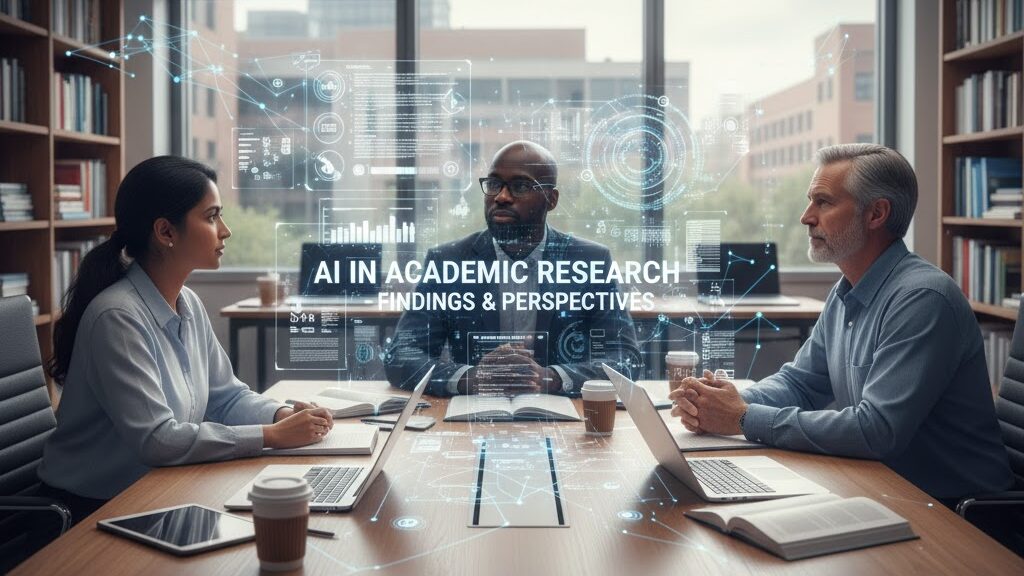
Three professors (one woman, two men) sit around a large polished conference table in a modern office with bookshelves in the background. They are engaged in a discussion, with open laptops, notebooks, and coffee cups in front of them. Overlaying the scene are glowing holographic data visualizations and graphs, with the words "AI IN ACADEMIC RESEARCH: FINDINGS & PERSPECTIVES" digitally projected in the center, representing the intersection of human intellect and artificial intelligence. Image (and typos) generated by Nano Banana.
Dive into the evolving landscape of academic research as leading professors share their insights and discoveries on integrating AI tools. Explore the benefits, challenges, and future implications of artificial intelligence in scholarly pursuits. Image (and typos) generated by Nano Banana.

Source

The Cavalier Daily

Summary

At the University of Virginia, faculty across disciplines are exploring how artificial intelligence can accelerate and reshape academic research. Associate Professor Hudson Golino compares AI’s transformative potential to the introduction of electricity in universities, noting its growing use in data analysis and conceptual exploration. Economist Anton Korinek, recently named among Time’s 100 most influential in AI, evaluates where AI adds value—from text synthesis and coding to ideation—while cautioning that tasks like mathematical modelling still require human oversight. Professors Mona Sloane and Renee Cummings stress ethical transparency, inclusivity, and the need for disclosure when using AI in research, arguing that equity and critical reflection must remain at the heart of innovation.

Key Points

  • AI is increasingly used at the University of Virginia for research and analysis across disciplines.
  • Golino highlights AI’s role in improving efficiency but calls for deeper institutional understanding.
  • Korinek finds AI most effective for writing, coding, and text synthesis, less so for abstract modelling.
  • Sloane and Cummings advocate transparency, ethical use, and inclusion in AI-assisted research.
  • Faculty urge a balance between efficiency, equity, and accountability in AI’s integration into academia.

Keywords

URL

https://www.cavalierdaily.com/article/2025/10/professors-share-their-findings-and-thoughts-on-the-use-of-ai-in-research

Summary generated by ChatGPT 5


The Future Learner: (Digital) Education Reimagined for 2040


Source

European Digital Education Hub (EDEH), European Commission, 2025

Summary

This foresight report explores four plausible futures for digital education in 2040, emphasising how generative and intelligent technologies could redefine learning, teaching, and human connection. Developed by the EDEH “Future Learner” squad, the study uses scenario planning to imagine how trends such as the rise of generative AI (GenAI), virtual assistance, lifelong learning, and responsible technology use might shape the education landscape. The report identifies 16 major drivers of change, highlighting GenAI’s central role in personalising learning, automating administration, and transforming the balance between human and machine intelligence.

In the most optimistic scenario – Empowered Learning – AI-powered personal assistants, immersive technologies, and data-driven systems make education highly adaptive, equitable, and learner-centred. In contrast, the Constrained Education scenario imagines over-regulated, energy-limited systems where AI use is tightly controlled, while The End of Human Knowledge portrays an AI-saturated collapse where truth, trust, and human expertise dissolve. The final Transformative Vision outlines a balanced, ethical future in which AI enhances – not replaces – human intelligence, fostering empathy, sustainability, and lifelong learning. Across all futures, the report calls for human oversight, explainability, and shared responsibility to ensure that AI in education remains ethical, inclusive, and transparent.

Key Points

  • Generative AI and intelligent systems are central to all future learning scenarios.
  • AI personal assistants, XR, and data analytics drive personalised, lifelong education.
  • Responsible use and ethical frameworks are essential to maintain human agency.
  • Overreliance on AI risks misinformation, cognitive overload, and social fragmentation.
  • Sustainability and carbon-neutral AI systems are core to educational innovation.
  • Data privacy and explainability remain critical for trust in AI-driven learning.
  • Equity and inclusion depend on access to AI-enhanced tools and digital literacy.
  • The line between human and artificial authorship will blur without strong governance.
  • Teachers evolve into mentors and facilitators supported by AI co-workers.
  • The most resilient future balances technology with human values and social purpose.

Conclusion

The Future Learner envisions 2040 as a pivotal point for digital education, where the success or failure of AI integration depends on ethical design, equitable access, and sustained human oversight. Generative AI can create unprecedented opportunities for personalisation and engagement, but only if education systems preserve their human essence – empathy, creativity, and community – amid the accelerating digital transformation.

Keywords

URL

https://ec.europa.eu/newsroom/eacea_oep/items/903368/en

Summary generated by ChatGPT 5


Smarter Classrooms, Real Results: How AI is Rewriting the Rules of Education


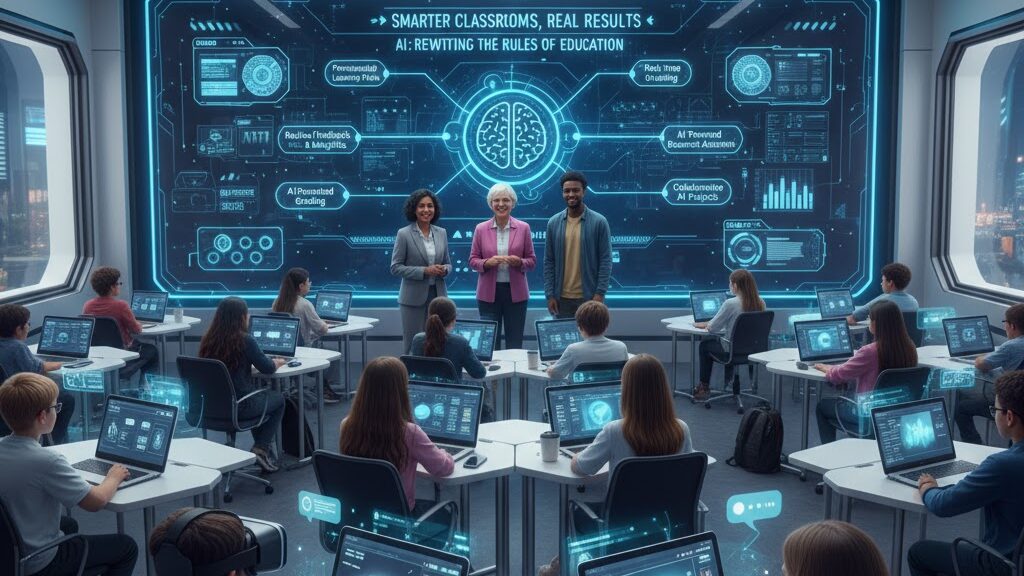
In a sleek, futuristic classroom filled with students using laptops and holographic interfaces, three educators (two female, one male) stand at the front, presenting to the class. A large, interactive screen prominently displays "SMARTER CLASSROOMS, REAL RESULTS: AI IS REWRITING THE RULES OF EDUCATION," featuring a central glowing brain icon surrounded by various AI applications like personalized learning paths, automated grading, and AI-powered assessment. Image (and typos) generated by Nano Banana.
Artificial intelligence is fundamentally “rewriting the rules of education,” ushering in an era of smarter classrooms and demonstrating tangible improvements in learning outcomes. This image envisions a dynamic, technologically advanced educational environment where AI tools enhance every aspect of teaching and learning, from personalised instruction and automated feedback to collaborative projects, ultimately delivering real and measurable results for students. Image (and typos) generated by Nano Banana.

Source

WTOP News

Summary

Will Vitka reports that artificial intelligence is transforming classrooms by saving teachers time, improving accessibility, and offering real-time personalised learning. University of Maryland professor Charles Harry describes AI as a “huge net positive” when used thoughtfully, helping educators create complex, adaptive assignments and enabling students to learn coding and data analysis more quickly. AI tools are also levelling the field for learners with disabilities and multilingual needs. However, privacy, ethical use, and over-reliance remain major concerns. Surveys show one in four teachers believe AI causes more harm than good, underscoring the need for balance between innovation and integrity.

Key Points

  • AI personalises learning and provides real-time academic feedback for students.
  • Educators using AI save up to six hours per week on administrative tasks.
  • Accessibility improves through tools like translation and voice-to-text.
  • Ethical concerns persist around cheating and student data privacy.
  • The global AI-in-education market could reach $90 billion by 2032.

Keywords

URL

https://wtop.com/education/2025/10/smarter-classrooms-real-results-how-ai-is-rewriting-the-rules-of-education/

Summary generated by ChatGPT 5


ChatGPT can hallucinate: College dean in Dubai urges students to verify data


In a modern, high-tech lecture hall with a striking view of the Dubai skyline at night, a female college dean stands at a podium, gesturing emphatically towards a large holographic screen. The screen prominently displays the ChatGPT logo surrounded by numerous warning signs and error messages such as "ERROR: FACTUAL INACCURACY" and "DATA HALLUCINATION DETECTED," with a bold command at the bottom: "VERIFY YOUR DATA!". Students in traditional Middle Eastern attire are seated, working on laptops. Image (and typos) generated by Nano Banana.
Following concerns over ChatGPT’s tendency to “hallucinate” or generate factually incorrect information, a college dean in Dubai is issuing a crucial directive to students: always verify data provided by AI. This image powerfully visualises the critical importance of scrutinising AI-generated content, emphasising that while AI can be a powerful tool, human verification remains indispensable for academic integrity and accurate knowledge acquisition. Image (and typos) generated by Nano Banana.

Source

Gulf News

Summary

Dr Wafaa Al Johani, Dean of Batterjee Medical College in Dubai, cautioned students against over-reliance on generative AI tools like ChatGPT during the Gulf News Edufair Dubai 2025. Speaking on the panel “From White Coats to Smart Care: Adapting to a New Era in Medicine,” she emphasised that while AI is transforming medical education, it can also produce false or outdated information—known as “AI hallucination.” Al Johani urged students to verify all AI-generated content, practise ethical use, and develop AI literacy. She stressed that AI will not replace humans but will replace those who fail to learn how to use it effectively.

Key Points

  • AI is now integral to medical education but poses risks through misinformation.
  • ChatGPT and similar tools can generate false or outdated medical data.
  • Students must verify AI outputs and prioritise ethical use of technology.
  • AI literacy, integrity, and continuous learning are essential for future doctors.
  • Simulation-based and hybrid training models support responsible tech adoption.

Keywords

URL

https://gulfnews.com/uae/chatgpt-can-hallucinate-college-dean-in-dubai-urges-students-to-verify-data-1.500298569

Summary generated by ChatGPT 5