Is Increasing Use of AI Damaging Students’ Learning Ability?


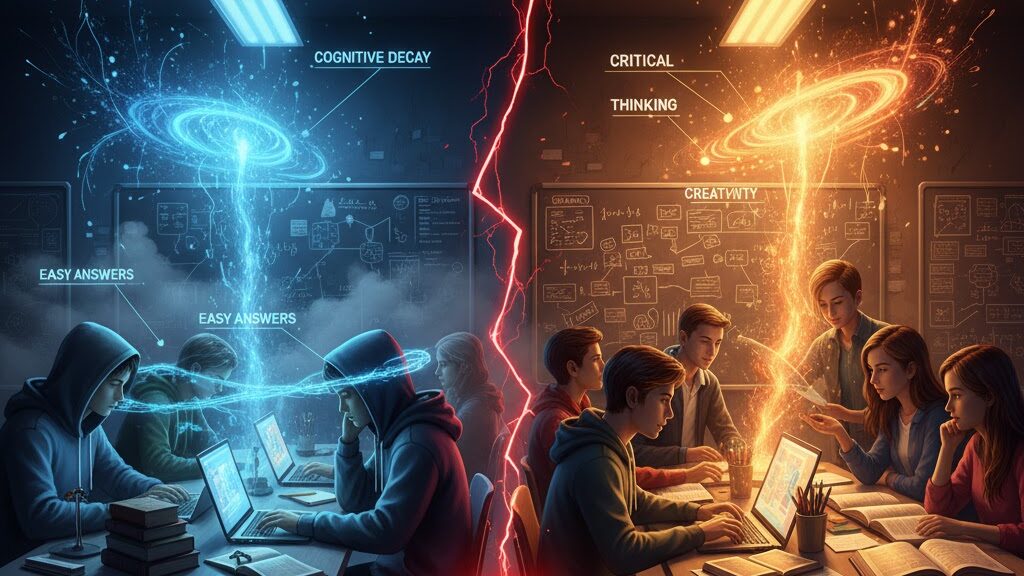
A split image contrasting two groups of students in a classroom. On the left, a blue-lit side represents "COGNITIVE DECAY" with students passively looking at laptops receiving "EASY ANSWERS." On the right, an orange-lit side represents "CRITICAL THINKING" and "CREATIVITY" with students actively collaborating and working. Image (and typos) generated by Nano Banana.
A critical question posed: Does the growing reliance on AI lead to cognitive decay, or can it be harnessed to foster critical thinking and creativity in students? Image (and typos) generated by Nano Banana.

Source

Radio New Zealand (RNZ) – Nine to Noon

Summary

University of Auckland professor Alex Sims examines whether the growing integration of artificial intelligence in classrooms and lecture halls enhances or impedes student learning. Drawing on findings from an MIT neuroscience study and an Oxford University report, Sims highlights both the cognitive effects of AI use and students’ own accounts of its impact on motivation and understanding. The research suggests that while AI tools can aid efficiency, overreliance may disrupt the brain processes central to deep learning and independent reasoning. The discussion raises questions about how to balance technological innovation with the preservation of critical thinking and sustained attention.

Key Points

  • AI use in education is expanding rapidly across levels and disciplines.
  • MIT research explores how AI affects neural activity linked to learning.
  • Oxford report includes students’ perceptions of AI’s influence on study habits.
  • Benefits include efficiency; risks include reduced cognitive engagement.
  • Experts urge educators to maintain a balance between AI support and active learning.

Keywords

URL

https://www.rnz.co.nz/national/programmes/ninetonoon/audio/2019010577/is-increasing-use-of-ai-damaging-students-learning-ability

Summary generated by ChatGPT 5


Pupils Fear AI Is Eroding Their Ability to Study, Research Finds


Four serious-looking teenage students (two boys, two girls) are seated across from each other at a long table in a library setting, each with an open laptop in front of them. Glowing, ethereal representations of open books made of data and digital information hover above their laptops, subtly connecting them to the screens. Their expressions convey concern and perhaps a touch of apprehension as they look directly at the viewer. The background features bookshelves, typical of a library or study area. Image (and typos) generated by Nano Banana.
A new study reveals that students are increasingly concerned about how artificial intelligence might be undermining their foundational study and research abilities. Explore the findings that confirm pupils’ fears about AI’s impact on learning. Image (and typos) generated by Nano Banana.

Source

The Guardian

Summary

A study commissioned by Oxford University Press (OUP) reveals that students across the UK increasingly worry that artificial intelligence is weakening their study habits, creativity, and motivation to learn. The report, Teaching the AI Native Generation, found that 98 per cent of pupils aged 13 to 18 use AI for schoolwork, with 80 per cent relying on it regularly. Many described AI as making tasks “too easy” and limiting their independent thinking. While students recognise its usefulness, they also express concern about overreliance and skill erosion. The findings highlight the urgent need for balanced AI education strategies that promote critical thinking, ethical awareness, and human creativity alongside digital competence.

Key Points

  • 98 per cent of UK secondary pupils use AI for schoolwork, most on a regular basis.
  • Many pupils say AI tools make studying too easy and reduce creativity.
  • Concerns are growing about AI’s impact on independent learning and problem-solving.
  • The study urges educators to develop frameworks for responsible, balanced AI use.
  • OUP calls for schools to integrate AI literacy into teaching while safeguarding learning depth.

Keywords

URL

https://www.theguardian.com/technology/2025/oct/15/pupils-fear-ai-eroding-study-ability-research

Summary generated by ChatGPT 5


Smarter Classrooms, Real Results: How AI is Rewriting the Rules of Education


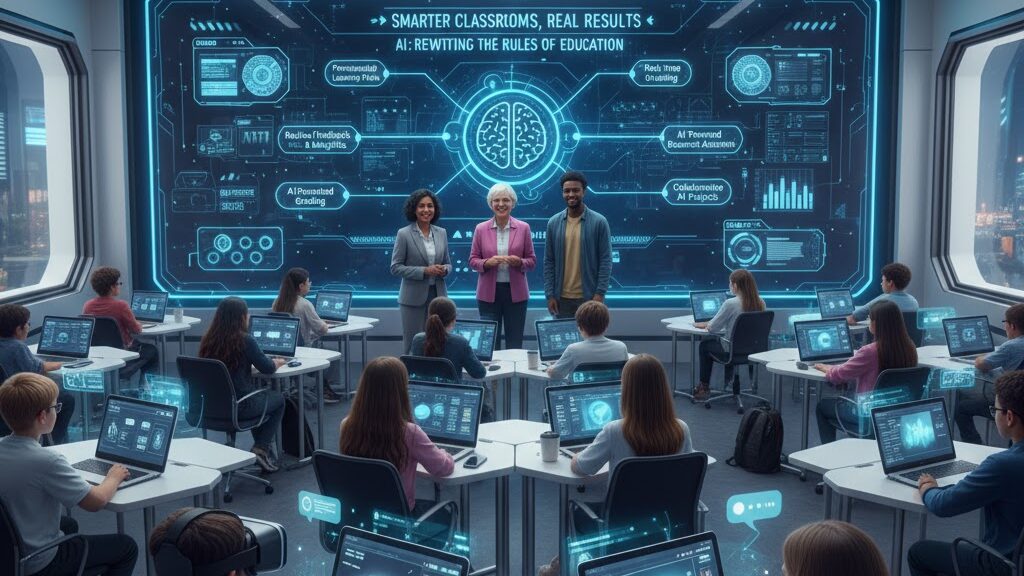
In a sleek, futuristic classroom filled with students using laptops and holographic interfaces, three educators (two female, one male) stand at the front, presenting to the class. A large, interactive screen prominently displays "SMARTER CLASSROOMS, REAL RESULTS: AI IS REWRITING THE RULES OF EDUCATION," featuring a central glowing brain icon surrounded by various AI applications like personalized learning paths, automated grading, and AI-powered assessment. Image (and typos) generated by Nano Banana.
Artificial intelligence is fundamentally “rewriting the rules of education,” ushering in an era of smarter classrooms and demonstrating tangible improvements in learning outcomes. This image envisions a dynamic, technologically advanced educational environment where AI tools enhance every aspect of teaching and learning, from personalised instruction and automated feedback to collaborative projects, ultimately delivering real and measurable results for students. Image (and typos) generated by Nano Banana.

Source

WTOP News

Summary

Will Vitka reports that artificial intelligence is transforming classrooms by saving teachers time, improving accessibility, and offering real-time personalised learning. University of Maryland professor Charles Harry describes AI as a “huge net positive” when used thoughtfully, helping educators create complex, adaptive assignments and enabling students to learn coding and data analysis more quickly. AI tools are also levelling the field for learners with disabilities and multilingual needs. However, privacy, ethical use, and over-reliance remain major concerns. Surveys show one in four teachers believe AI causes more harm than good, underscoring the need for balance between innovation and integrity.

Key Points

  • AI personalises learning and provides real-time academic feedback for students.
  • Educators using AI save up to six hours per week on administrative tasks.
  • Accessibility improves through tools like translation and voice-to-text.
  • Ethical concerns persist around cheating and student data privacy.
  • The global AI-in-education market could reach $90 billion by 2032.

Keywords

URL

https://wtop.com/education/2025/10/smarter-classrooms-real-results-how-ai-is-rewriting-the-rules-of-education/

Summary generated by ChatGPT 5