Teaching the Future: How Tomorrow’s Music Educators Are Reimagining Pedagogy

By James Hanley, Oliver Harris, Caitlin Walsh, Sam Blanch, Dakota Venn-Keane, Eve Whelan, Luke Kiely, Jake Power, and Alex Rockett Power in collaboration with ChatGPT and Dr Hazel Farrell
Estimated reading time: 7 minutes
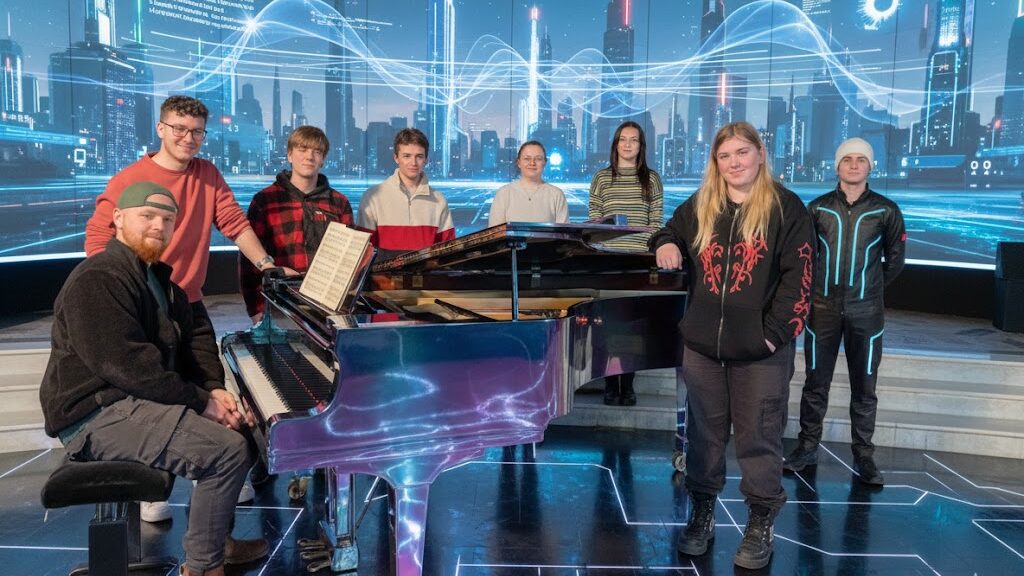
A group of eight music students from the BA (Hons) Music program at SETU are pictured in a futuristic, neon-lit "futureville" setting. They are gathered around a piano, which glows with digital accents, against a backdrop of towering, illuminated cityscapes and flowing data streams.
The future is now! BA (Hons) Music students from SETU in a vibrant “futureville” setting, blending the timeless artistry of music with cutting-edge technological imagination.

In recognition of how deeply AI is becoming embedded in the educational landscape, a co-created assignment exploring possibilities for music educators was considered timely. As part of the Year 3 Music Pedagogy module at South East Technological University (SETU), students were tasked with designing a learning activity that meaningfully integrated AI into the process. They were asked not only to create a resource but to trial it, evaluate it, and critically reflect on how AI shaped the learning experience. A wide range of free AI tools were used, including ChatGPT, SUNO, Audacity, Napkin, Google Gemini, Notebook LM, and Eleven Labs, and each student focused on a teaching resource that resonated with them, such as interactive tools, infographics, lesson plans, and basic websites.

Across their written and audio reflections, a rich picture emerged: AI is powerful, fallible, inspiring, frustrating, and always dependent on thoughtful human oversight. This blog is based on their reflections which reveal a generation of educators learning not just how to use AI, but why it must be used with care.

Expanding Pedagogical Possibilities

Students consistently highlighted AI’s ability to accelerate creativity and resource development. Several noted that AI made it easier to create visually engaging materials, such as diagrams, colourful flashcards, or child‑friendly graphics. One student reflected, “With just a click of the mouse, anyone can generate their own diagrams and flash cards for learning,” emphasising how AI allowed them to design tools they would otherwise struggle to produce manually.

Others explored AI‑generated musical content. One student used a sight‑reading generator to trial melodic exercises, observing that while the exercises themselves were well‑structured, “the feedback was exceedingly generous.” Another used ChatGPT to build a lesson structure, describing the process as “seamless and streamlined,” though still requiring adjustments to ensure accuracy and alignment with Irish terminology. One reflection explained, “AI can create an instrumental track in a completely different style, but it still needs human balance through EQ, compression, and reverb to make it sound natural.” This demonstrated how AI and hands-on editing can work together to develop both musical and technical skills.

An interactive rhythm game for children was designed by another student who used ChatGPT to progressively refine layout, colour schemes, difficulty levels, and supportive messages such as “Nice timing!” and “Perfect rhythm!” They described an iterative process requiring over 30 versions as the model continuously adapted to new instructions. The result was a working single‑player prototype that demonstrated both the creative potential and technical limits of AI‑assisted design.

The Teacher’s Role Remains Central

Across all reflections, students expressed strong awareness that AI cannot replace fundamental aspects of music teaching. Human judgment, accuracy, musical nuance, and relational connection were seen as irreplaceable. One student wrote that although AI can generate ideas and frameworks, “the underlying educational thinking remained a human responsibility.” Another reflected on voice‑training tools, noting that constant pitch guidance from AI could become “a crutch,” misleading students into believing they were singing correctly even when not. Many recognised that while AI can speed up creative processes, the emotional control, balance, and overall musical feel must still come from human input. One reflection put it simply: “AI gives you the idea, but people give it life.”

There was also a deep recognition of the social dimension of teaching. As one student put it, the “teacher–student relationship bears too much of an impact” to be substituted by automated tools. Many emphasised that confidence‑building, emotional support, and adaptive feedback come from real educators, not algorithms.

Challenges, Risks, and Ethical Considerations

The assignment surfaced several important realisations, including the fact that technical inaccuracies were common. Students identified incorrect musical examples, inconsistent notation, malfunctioning website features, and audio‑mixing problems. One student documented how, over time, the “quality of the site got worse,” illustrating AI’s tendency to forget earlier instructions in long interactions. This reinforced the need for rigorous verification when creating learning materials.

Another reflection noted that not all AI websites perform equally; some produce excellent results, while others generate distorted or incomplete outputs, forcing teachers to try multiple tools before finding one that works. It also reminded educators that even free or simple programs, like basic versions of Audacity, can still teach valuable mixing and editing skills without needing expensive software. A parallel concern was over‑reliance. Students worried that teachers might outsource too much planning to AI or that learners might depend on automated feedback rather than developing critical listening skills. As one reflection warned, “AI can and will become a key tool… the crucial factor is that we as real people know where the line is between a ‘tool’ and a ‘free worker.’”

Equity of access also arose as a barrier. Subscription‑based AI tools required credits or payment, creating challenges for students and highlighting ethical tensions between commercial technologies and educational use. Students demonstrated strong awareness of academic integrity. They distinguished between using AI to support structure and clarity versus allowing AI to generate entire lessons or presentations. One student cautioned that presenting AI‑produced content as one’s own is “blatant plagiarism,” highlighting the need for transparent and ethical practice.

Learning About Pedagogy and Professional Identity

Many students described developing a clearer sense of themselves as educators. They reflected on the complexity of communicating clearly, engaging learners, and designing accessible content. Some discovered gaps in their teaching confidence; others found new enthusiasm for pedagogical design. One wrote, “Teaching and clearly communicating my views was more challenging than I assumed,” acknowledging the shift from student to teacher mindset. Another recognised that while AI could support efficiency, it made them more aware of their responsibility for accuracy and learner experience.

Imagining the Future of AI in Music Education

Students were divided between optimism and caution. Some saw AI becoming a standard part of educational resource creation, enabling personalised practice, interactive learning, and rapid content generation. Others expressed concern about the possibility of AI replacing human instruction if not critically managed. However, all students agreed on one point: AI works best when treated as a supportive tool rather than an autonomous teacher. As one reflection summarised, “It is clear to me that AI is by no means a replacement for musical knowledge or teaching expertise.” Another added, “AI can make the process faster and more creative, but it still needs the human touch to sound right.”

Dr Hazel Farrell

Academic Lead for GenAI, Programme Leader BA (Hons) Music
South East Technological University
Dr Hazel Farrell is the SETU Academic Lead for Generative AI, and lead for the N-TUTORR National Gen AI Network project GenAI:N3, which aims to draw on expertise across the higher education sector to create a network and develop resources to support staff and students. She has presented her research on integrating AI into the classroom in a multitude of national and international forums focusing on topics such as Gen AI and student engagement, music education, assessment re-design, and UDL.

Keywords


This Professor Let Half His Class Use AI. Here’s What Happened


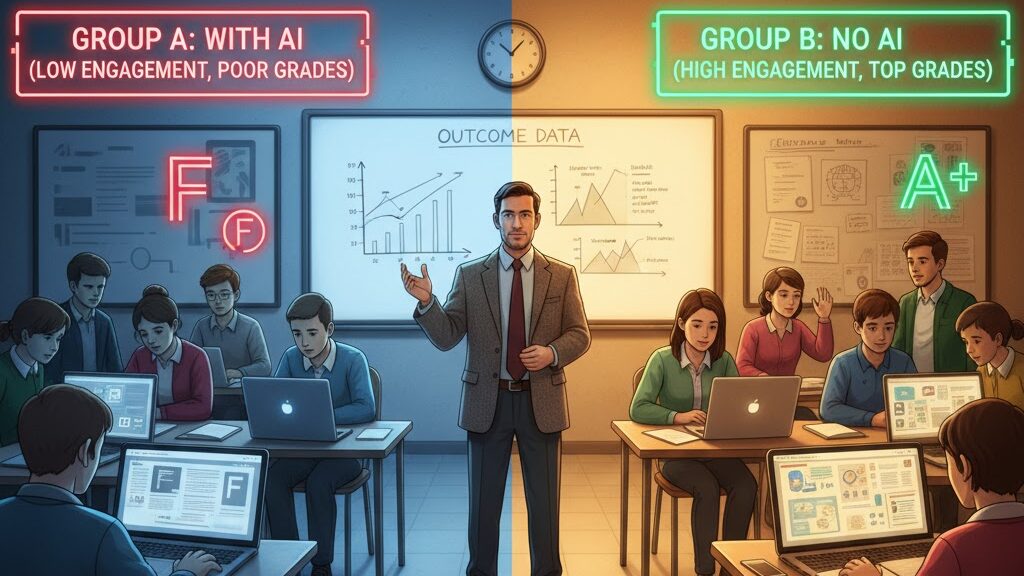
A split classroom scene with a professor in the middle, presenting data. The left side, labeled "GROUP A: WITH AI," shows disengaged students with "F" grades. The right side, labeled "GROUP B: NO AI," shows engaged students with "A+" grades, depicting contrasting outcomes of AI use in a classroom experiment. Image (and typos) generated by Nano Banana.
An academic experiment unfolds: Visualizing the stark differences in engagement and performance between students who used AI and those who did not, as observed by one professor. Image (and typos) generated by Nano Banana.

Source

Gizmodo

Summary

A study by University of Massachusetts Amherst professor Christian Rojas compared two sections of the same advanced economics course—one permitted structured AI use, the other did not. The results revealed that allowing AI under clear guidelines improved student engagement, confidence, and reflective learning but did not affect exam performance. Students with AI access reported greater efficiency and satisfaction with course design while developing stronger habits of self-correction and critical evaluation of AI outputs. Rojas concludes that carefully scaffolded AI integration can enrich learning experiences without fostering dependency or academic shortcuts, though larger studies are needed.

Key Points

  • Structured AI use increased engagement and confidence but not exam scores.
  • Students used AI for longer, more focused sessions and reflective learning.
  • Positive perceptions grew regarding efficiency and instructor quality.
  • AI integration encouraged editing, critical thinking, and ownership of ideas.
  • Researchers stress that broader trials are required to validate results.

Keywords

URL

https://gizmodo.com/this-professor-let-half-his-class-use-ai-heres-what-happened-2000678960

Summary generated by ChatGPT 5


Teachers Share More Ways to Engage AI in the Classroom


In a modern, technology-rich classroom, a diverse group of students works on laptops at individual desks. A female teacher stands at the front, gesturing towards a large interactive screen that displays "ENGAGING AI IN THE CLASSROOM: NEW STRATEGIES," along with various visual examples of AI tools and learning scenarios. Other teachers are visible on side screens, illustrating collaborative strategies. Image (and typos) generated by Nano Banana.
Educators are continuously innovating and discovering new methods to effectively integrate AI into classroom learning. This image showcases a vibrant educational setting where teachers are actively sharing and implementing a range of strategies to engage AI, transforming teaching methodologies and enriching student experiences. Image (and typos) generated by Nano Banana.

Source

Education Week (Opinion)

Summary

In this opinion blog, several K-12 English teachers describe practical strategies they use to integrate AI as a learning tool rather than letting it replace student thinking. They treat AI as a brainstorming assistant, prompt critic, or discussion partner rather than writer. Techniques include prompting AI to argue counterpoints, using it to surface alternative interpretations in literature, and setting roles (AI user, evaluator, synthesiser) in group tasks. Districts are also forming AI steering committees, piloting tools, and developing consistent guidelines to guide equitable, transparent adoption.

Key Points

  • AI is used as brainstorming / idea generation support, but students still revise and contextualise its output.
  • Teachers use AI in debate, persuasive writing, literary analysis, historical inquiry, science discussions, and Socratic questioning to deepen engagement.
  • Role assignments (AI user, evaluator, gatherer) help distribute responsibilities and prevent overreliance.
  • Districts should establish AI steering committees, pilot thoughtfully, and build shared understanding and policies.
  • AI should be scaffolded, not standalone; teachers emphasise transparency, critical review, and prompting skills.

Keywords

URL

https://www.edweek.org/technology/opinion-teachers-share-more-ways-to-engage-ai-in-the-classroom/2025/10

Summary generated by ChatGPT 5


Professors experiment as AI becomes part of student life


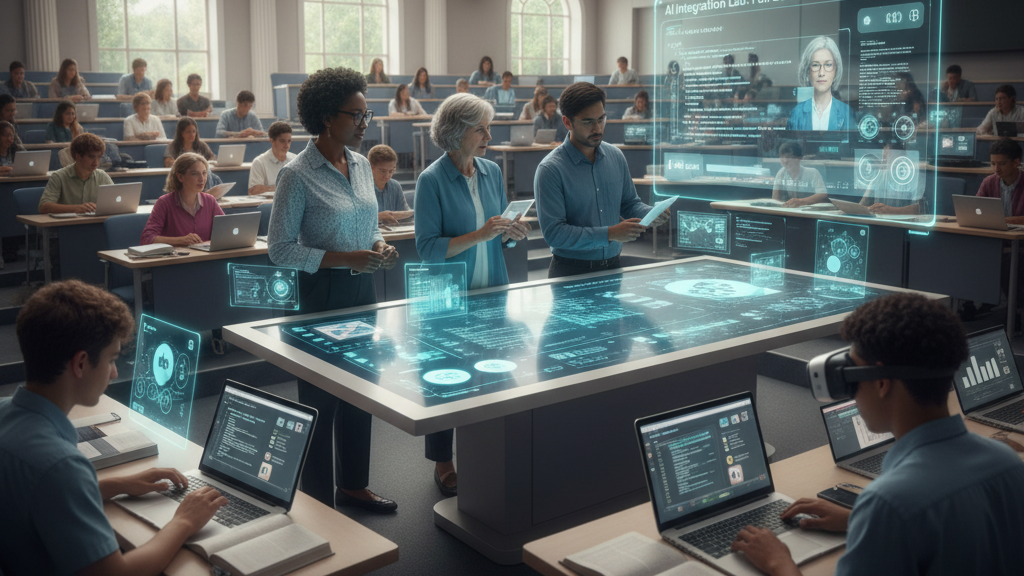
In a modern university lecture hall, three professors (two female, one male) stand at a glowing, interactive holographic table, actively demonstrating or discussing AI concepts. Students are seated at desks, some using laptops with glowing AI interfaces, and one student wears a VR headset. A large holographic screen in the background displays 'AI Integration Lab: Fall 2024'. The scene depicts educators experimenting with AI in a learning environment. Generated by Nano Banana.
As AI increasingly integrates into daily student life, professors are actively experimenting with new pedagogical approaches and tools to harness its potential. This image captures a dynamic classroom setting where educators are at the forefront of exploring how AI can enrich learning, adapt teaching methods, and prepare students for an AI-driven future. Image generated by Nano Banana.

Source

The Globe and Mail

Summary

AI has shifted from novelty to necessity in Canadian higher education, with almost 60% of students now using it. Professors are experimenting with different approaches: some resist, others regulate, and many actively integrate AI into assessments. Concerns remain about diminished critical thinking, but educators like those at the University of Toronto and University of Guelph argue that ignoring AI leaves graduates unprepared. Strategies include teaching students to refine AI-generated drafts, redesigning assignments to require human input, and adopting oral assessments. The consensus is that policies alone cannot keep pace; practical, ethical, and reflective engagement is essential for preparing students to use AI responsibly.

Key Points

  • Nearly 60% of Canadian students use AI for coursework, rising globally to over 90%.
  • Professors face a choice: resist, regulate, or embrace AI; ignoring it is seen as untenable.
  • Innovative teaching methods include refining AI drafts, training prompt skills, and oral assessments.
  • Concerns persist about weakening critical thinking and creativity.
  • Preparing students for AI-rich workplaces requires embedding literacy, ethics, and adaptability.

Keywords

URL

https://www.theglobeandmail.com/business/article-professors-experiment-as-ai-becomes-part-of-student-life/

Summary generated by ChatGPT 5