The Lecturers Learning to Spot AI Misconduct


Four serious and focused lecturers/academics (two men, two women) are gathered around a table in a dimly lit, high-tech setting. They are looking at a large, glowing blue holographic screen that displays complex text, code, and highlights, with the prominent title "AI MISCONDUCT DETECTION." The screen shows an example of potentially AI-generated text with highlighted sections. Two individuals are actively pointing at the screen, while others are taking notes on laptops and paper. Surrounding the main screen are smaller holographic icons representing documents and a magnifying glass, symbolizing investigation and analysis. Image (and typos) generated by Nano Banana.
As AI tools become more sophisticated, the challenge of maintaining academic integrity intensifies. This image depicts lecturers undergoing specialised training to hone their skills in identifying AI-generated misconduct, ensuring fairness and originality in student work. Image (and typos) generated by Nano Banana.

Source

BBC News

Summary

Academics at De Montfort University (DMU) in Leicester are receiving specialist training to identify when students misuse artificial intelligence in coursework. The initiative, led by Dr Abiodun Egbetokun and supported by the university’s new AI policy, seeks to balance ethical AI use with maintaining academic integrity. Lecturers are being taught to spot linguistic “markers” of AI generation, such as repetitive phrasing or Americanised language, though experts acknowledge that detection is becoming increasingly difficult. DMU encourages students to use AI tools to support critical thinking and research, but presenting AI-generated work as one’s own constitutes misconduct. Staff also highlight the flaws of AI detection software, which has produced false positives, prompting calls for education over punishment. Students, meanwhile, recognise both the value and ethical boundaries of AI in their studies and future professions.

Key Points

  • DMU lecturers are being trained to recognise signs of AI misuse in student work.
  • The university’s policy allows ethical AI use for learning support but bans misrepresentation.
  • Detection focuses on linguistic patterns rather than unreliable software tools.
  • Staff warn that false accusations can harm students as much as confirmed misconduct.
  • Educators stress fostering AI literacy and integrity rather than “catching out” students.
  • Students value AI for translation, study support, and clinical applications but accept clear ethical limits.

Keywords

URL

https://www.bbc.com/news/articles/c2kn3gn8vl9o

Summary generated by ChatGPT 5

Dartmouth Builds Its Own AI Chatbot for Student Well-Being


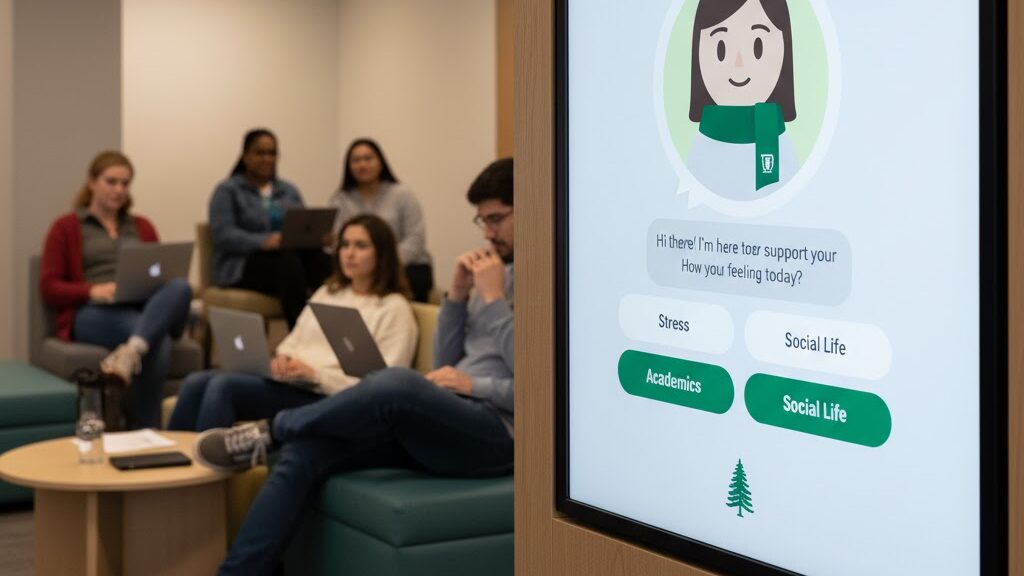
A close-up of a digital display screen showing a friendly AI chatbot interface titled "DARTMOUTH COMPANION." The chatbot has an avatar of a friendly character wearing a green scarf with the Dartmouth shield. Text bubbles read "Hi there! I'm here to support you. How you feeling today?" with clickable options like "Stress," "Social Life," and "Academics." In the blurred background, several college students are visible in a modern, comfortable common area, working on laptops and chatting, suggesting a campus environment. The Dartmouth logo (pine tree) is visible at the bottom of the screen. Image (and typos) generated by Nano Banana.
Dartmouth College takes a proactive step in student support by developing its own AI chatbot, “Dartmouth Companion.” This innovative tool aims to provide accessible assistance and resources for student well-being, addressing concerns from academics to social life. Image (and typos) generated by Nano Banana.

Source

Inside Higher Ed

Summary

Dartmouth College is developing Evergreen, a student-designed AI chatbot aimed at improving mental health and well-being on campus. Led by Professor Nicholas Jacobson, the project involves more than 130 undergraduates contributing research, dialogue, and content creation to make the chatbot conversational and evidence-based. Evergreen offers tailored guidance on health topics such as exercise, sleep, and time management, using opt-in data from wearables and campus systems. Unlike third-party wellness apps, it is student-built, privacy-focused, and designed to intervene early when students show signs of distress. A trial launch is planned for autumn 2026, with potential for wider adoption across universities.

Key Points

  • Evergreen is a Dartmouth-built AI chatbot designed to support student well-being.
  • Over 130 undergraduate researchers are developing its conversational features.
  • The app personalises feedback using student-approved data such as sleep and activity.
  • Safety features alert a self-identified support team if a user is in crisis.
  • The first controlled trial is set for 2026, with plans to share the model with other colleges.

Keywords

URL

https://www.insidehighered.com/news/student-success/health-wellness/2025/10/14/dartmouth-builds-its-own-ai-chatbot-student-well

Summary generated by ChatGPT 5


AI and Assessment Training Initiative Empowers Lecturers


A group of diverse lecturers and educators in a modern meeting room, actively participating in a training session. A male presenter stands in front of a large, interactive screen displaying "AI-POWERED ASSESSMENT STRATEGIES" and various glowing data visualizations, charts, and a central brain icon representing AI. Participants around a large table are engaged with laptops and tablets, with some looking towards the screen and others discussing amongst themselves. The overall atmosphere is collaborative and focused on learning new technologies.  Image (and typos) generated by Nano Banana.
Empowering educators for the future: A new AI and assessment training initiative is equipping lecturers with the knowledge and tools to effectively integrate artificial intelligence into their evaluation strategies, enhancing teaching and learning outcomes. Image (and typos) generated by Nano Banana.

Source

North-West University News (South Africa)

Summary

North-West University (NWU) has launched a large-scale professional development initiative to promote responsible use of artificial intelligence in teaching, learning, and assessment. The AI and Assessment course, supported by the Senior Deputy Vice-Chancellor for Teaching and Learning, the AI Hub, and the Centre for Teaching and Learning, awarded R500 Takealot vouchers to the first 800 lecturers who completed all eleven modules. Participants earned fifteen digital badges by achieving over 80 per cent in assessments and submitting a portfolio of evidence. The initiative underscores NWU’s commitment to digital transformation and capacity building. Lecturers praised the programme for strengthening their understanding of ethical and effective AI integration in higher education.

Key Points

  • 800 NWU lecturers were incentivised to complete the AI and Assessment training course.
  • The programme awarded fifteen digital badges for verified completion and assessment success.
  • Leadership highlighted AI’s transformative role in teaching and learning innovation.
  • Participants reported improved confidence in using AI tools responsibly and ethically.
  • The initiative reinforces NWU’s institutional focus on digital capability and staff development.

Keywords

URL

https://news.nwu.ac.za/ai-and-assessment-training-initiative-empowers-lecturers

Summary generated by ChatGPT 5


Meet the AI Professor: Coming to a Higher Education Campus Near You


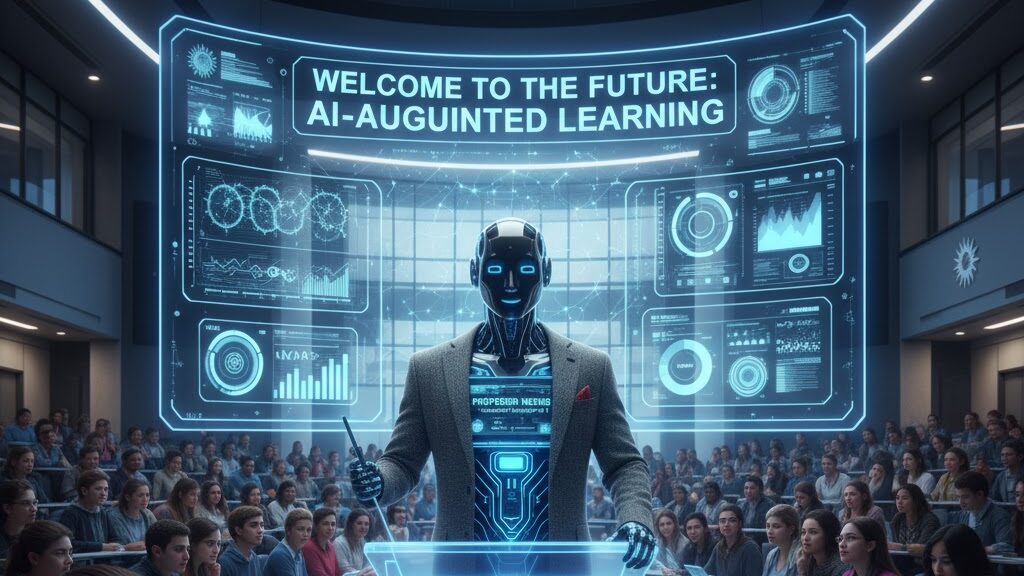
In a vast, modern university lecture hall filled with students working on holographic tablets, a sleek, humanoid AI figure in a business suit stands at the front, glowing blue and labeled "PROFESSOR NEXUS." Behind it, a massive interactive screen displays "WELCOME TO THE FUTURE: AI-AUGMENTED LEARNING," surrounded by various data, graphs, and educational interfaces, symbolizing AI's presence in higher education. Image (and typos) generated by Nano Banana.
The future of higher education is rapidly evolving, with the concept of an “AI Professor” soon becoming a reality on campuses worldwide. This image envisions an advanced lecture hall where an AI humanoid, serving as the instructor, delivers an engaging lesson on “AI-Augmented Learning,” highlighting the imminent shift towards a new era of technologically enhanced education. Image (and typos) generated by Nano Banana.

Source

Forbes

Summary

Nick Ladany explores how the rise of “AI professors” could transform higher education, blending machine precision with human mentorship. AI professors, envisioned as advanced avatars, could deliver 24/7 personalised instruction, adapt to diverse learning styles, and stay up-to-date with current knowledge. Human professors, meanwhile, would focus on relational, interdisciplinary, and ethical aspects of learning. Ladany suggests a “centaur model,” where human and AI educators collaborate—AI managing scalable instruction while humans build community and critical thinking. He warns that universities slow to adapt risk obsolescence, while those embracing this hybrid model may redefine teaching and student success.

Key Points

  • AI professors could deliver continuous, personalised, evidence-based education.
  • Human professors would shift toward mentoring, community-building, and ethical guidance.
  • The “centaur model” integrates human and AI teaching strengths.
  • Teaching roles would require new training, evaluation, and year-round engagement.
  • Universities that resist this shift risk falling behind institutional innovators.

Keywords

URL

https://www.forbes.com/sites/nicholasladany/2025/10/03/meet-the-ai-professor-coming-to-a-higher-education-campus-near-you/

Summary generated by ChatGPT 5


Research, curriculum and grading: new data sheds light on how professors are using AI


In a bright, modern classroom, students are actively engaged at individual desks with laptops. At the front, two female professors and one male professor are presenting to the class, while a large interactive screen displays "INNOVATIVE AI CHATBOT USE CASES." The screen shows four panels detailing applications such as "Personalized Tutoring," "Collaborative Research," "Creative Writing & Feedback," and "Language Practice." Image (and typos) generated by Nano Banana.
University professors are increasingly discovering and implementing creative ways to leverage AI chatbots to enhance learning in the classroom. This image illustrates a dynamic educational environment where various innovative use cases for AI chatbots are being explored, from personalised tutoring to collaborative research, transforming traditional teaching and learning methodologies. Image (and typos) generated by Nano Banana.

Source

NPR

Summary

Professors across U.S. universities are increasingly using AI chatbots like Gemini and Claude for curriculum design, grading support, and administrative work. A Georgia State professor described using AI to brainstorm assignments and draft rubrics, while Anthropic’s analysis of 74,000 higher-ed conversations with Claude found 57% related to curriculum planning and 13% to research. Some professors even create interactive simulations. Others use AI to automate emails, budgets, and recommendations. But concerns remain: faculty warn that AI-grading risks hollowing out the student–teacher relationship, while scholars argue universities lack clear guidance, leaving professors to “fend for themselves.”

Key Points

  • National survey: ~40% of administrators and 30% of instructors now use AI weekly or daily, up from 2–4% in 2023.
  • 57% of higher-ed AI conversations focus on curriculum development; 13% on research.
  • Professors use AI to design interactive simulations, draft rubrics, manage budgets, and write recommendations.
  • 7% of analysed use involved grading, though faculty report AI is least effective here.
  • Concerns: risk of “AI-grading AI-written papers,” weakening educational purpose; calls for stronger guidance.

Keywords

URL

https://www.npr.org/2025/10/02/nx-s1-5550365/college-professors-ai-classroom

Summary generated by ChatGPT 5