AI-Generated Lesson Plans Fall Short on Inspiring Students and Promoting Critical Thinking


A bright, modern classroom with rows of diverse students seated at individual desks, diligently working on laptops and taking notes. Above them, a large, glowing holographic projection of a generic, flowchart-style "LESSON PLAN" floats. Stamped diagonally across this lesson plan in red, bold letters is a censor-like bar that reads "LACKS INSPIRATION, NO CRITICAL THINKING," indicating its shortcomings. On the right side of the image, one student's laptop and notebook are surrounded by vibrant, colorful holographic icons and data representing creativity and rich learning, contrasting with the generic lesson plan. Lightbulb icons, some dimly lit, are also visible. Image (and typos) generated by Nano Banana.
While AI offers efficiency in creating lesson plans, a new report suggests that these automated curricula often fall short in fostering student inspiration and promoting essential critical thinking skills. This visual highlights the gap between AI-generated structures and the nuanced needs of engaging pedagogy. Image (and typos) generated by Nano Banana.

Source

The Conversation

Summary

Torrey Trust reports that AI-generated lesson plans, though convenient, fail to promote higher-order thinking and inclusivity in the classroom. In a study analysing 311 AI-created civics lesson plans from ChatGPT, Gemini, and Copilot, 90 per cent of activities were found to encourage only basic recall and comprehension rather than critical or creative thinking. Using frameworks such as Bloom’s taxonomy and Banks’ multicultural integration model, the researchers found that only 6 per cent of plans included diverse perspectives or representation of marginalised groups. The study warns that while AI tools can save teachers time, they risk reproducing formulaic, one-size-fits-all instruction. Teachers are encouraged to use AI for inspiration—not automation—and to embed context, creativity, and cultural depth into their own designs.

Key Points

  • 311 AI-generated civics lesson plans were analysed using Bloom’s taxonomy and Banks’ model.
  • 90 per cent of activities promoted only lower-order thinking skills such as memorisation and recall.
  • Only 6 per cent included multicultural or diverse perspectives.
  • AI tools produce generic, context-free lesson plans not tailored to real classrooms.
  • Educators should use AI as a support tool, prompting it with detailed, critical instructions.

Keywords

URL

https://theconversation.com/ai-generated-lesson-plans-fall-short-on-inspiring-students-and-promoting-critical-thinking-265355

Summary generated by ChatGPT 5


Meet the AI Professor: Coming to a Higher Education Campus Near You


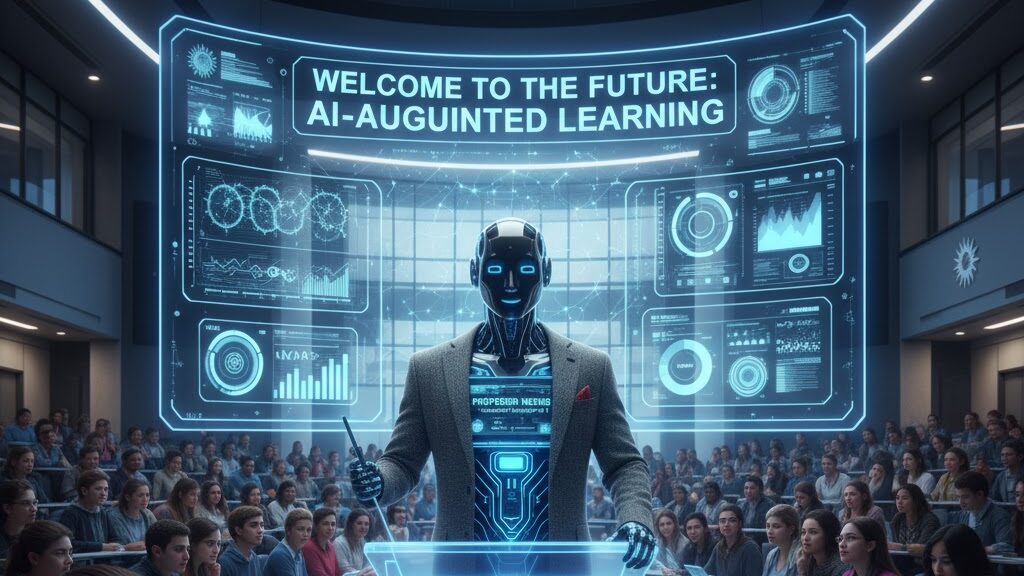
In a vast, modern university lecture hall filled with students working on holographic tablets, a sleek, humanoid AI figure in a business suit stands at the front, glowing blue and labeled "PROFESSOR NEXUS." Behind it, a massive interactive screen displays "WELCOME TO THE FUTURE: AI-AUGMENTED LEARNING," surrounded by various data, graphs, and educational interfaces, symbolizing AI's presence in higher education. Image (and typos) generated by Nano Banana.
The future of higher education is rapidly evolving, with the concept of an “AI Professor” soon becoming a reality on campuses worldwide. This image envisions an advanced lecture hall where an AI humanoid, serving as the instructor, delivers an engaging lesson on “AI-Augmented Learning,” highlighting the imminent shift towards a new era of technologically enhanced education. Image (and typos) generated by Nano Banana.

Source

Forbes

Summary

Nick Ladany explores how the rise of “AI professors” could transform higher education, blending machine precision with human mentorship. AI professors, envisioned as advanced avatars, could deliver 24/7 personalised instruction, adapt to diverse learning styles, and stay up-to-date with current knowledge. Human professors, meanwhile, would focus on relational, interdisciplinary, and ethical aspects of learning. Ladany suggests a “centaur model,” where human and AI educators collaborate—AI managing scalable instruction while humans build community and critical thinking. He warns that universities slow to adapt risk obsolescence, while those embracing this hybrid model may redefine teaching and student success.

Key Points

  • AI professors could deliver continuous, personalised, evidence-based education.
  • Human professors would shift toward mentoring, community-building, and ethical guidance.
  • The “centaur model” integrates human and AI teaching strengths.
  • Teaching roles would require new training, evaluation, and year-round engagement.
  • Universities that resist this shift risk falling behind institutional innovators.

Keywords

URL

https://www.forbes.com/sites/nicholasladany/2025/10/03/meet-the-ai-professor-coming-to-a-higher-education-campus-near-you/

Summary generated by ChatGPT 5