How generative AI is really changing education – by outsourcing the production of knowledge to Big Tech


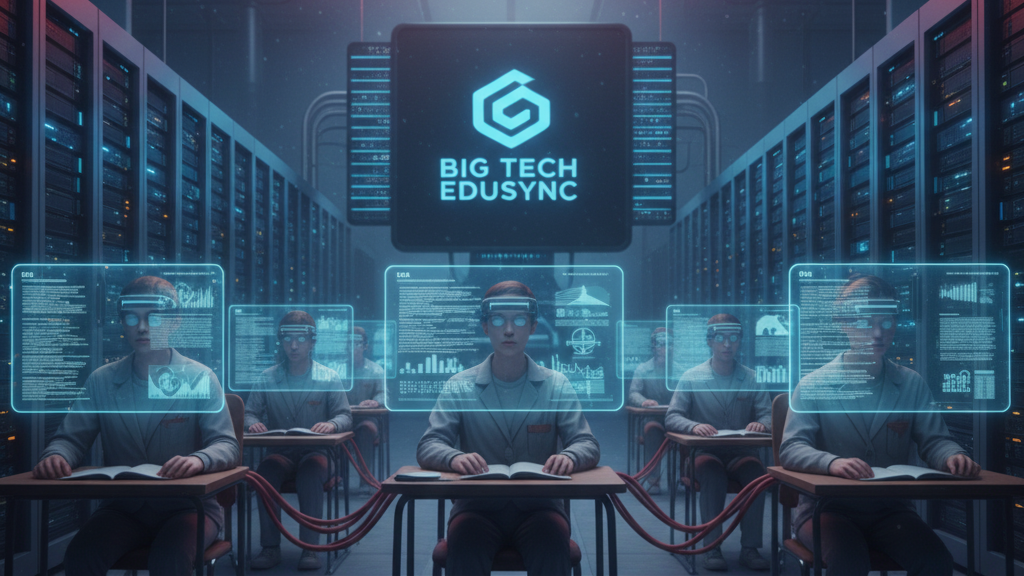
A classroom-like setting inside a large server room, where students in white lab coats sit at desks with holographic screens projected from their devices. Above them, a neon sign blue logo glows for 'BIG TECH EDUSYNC' is prominent. The students have blank expressions, connected by wires. The scene criticises the outsourcing of education to technology. Generated by Nano Banana.
The rise of generative AI is fundamentally reshaping education, leading to concerns that the critical process of ‘knowledge production’ is being outsourced to Big Tech companies. This image visualises a future where learning environments are dominated by AI, raising questions about autonomy, critical thinking, and the ultimate source of truth in an AI-driven academic landscape. Image (and typos) generated by Nano Banana.

Source

The Conversation

Summary

This article argues that generative AI is shifting the locus of knowledge production from academic institutions into the hands of Big Tech platforms. As students and educators increasingly rely on AI tools, the power to define what counts as knowledge — what is true, what is cited, what is authoritative — is ceded to private firms. That shift risks marginalising critical thinking, local curricula, and disciplinary expertise. The author calls for reclaiming epistemic authority: universities must define their own ways of knowing, educate students not just in content but in evaluative judgement, and negotiate more equitable relationships with AI platforms so that academic integrity and autonomy aren’t compromised.

Key Points

  • Generative AI tools increasingly mediate how knowledge is accessed, curated and presented—Big Tech becomes a gatekeeper.
  • Reliance on AI may weaken disciplinary expertise and the role of scholars as knowledge producers.
  • Students may accept AI outputs uncritically, transferring trust to algorithmic systems over faculty.
  • To respond, higher education must build student literacy in epistemics (how we know what we know) and insist AI remain assistive, not authoritative.
  • Universities should set policy, technical frameworks, and partnerships that protect research norms, attribution, and diverse knowledge systems.

Keywords

URL

https://theconversation.com/how-generative-ai-is-really-changing-education-by-outsourcing-the-production-of-knowledge-to-big-tech-263160

Summary generated by ChatGPT 5


AI Is Making the College Experience Lonelier


A male college student sits alone at a wooden desk in a grand, dimly lit library, intensely focused on his laptop which projects a glowing blue holographic interface. Rain streaks down the large gothic window in the background, enhancing the sense of isolation. Other students are sparsely visible in the distance, similarly isolated at their desks. The scene evokes a feeling of loneliness and individual digital engagement in an academic setting. Generated by Nano Banana.
As AI tools become increasingly integrated into academic life, some fear that the college experience is becoming more solitary. This image captures a student immersed in a digital world within a traditional library, symbolising a potential shift towards individual interaction with technology, rather than communal learning, and raising questions about the social impact of AI on university life. Image generated by Nano Banana.

Source

The Chronicle of Higher Education

Summary

Amid growing integration of AI into student learning (e.g. ChatGPT “study mode”), there’s a quieter but profound concern: the erosion of collaborative study among students. Instead of learning together, many may retreat into solo AI-mediated calls for efficiency and convenience. The authors argue that the informal, messy, social study moments — debating, explaining, failing together — are vital to the educational experience. AI may offer convenience, but it cannot replicate human uncertainty, peer correction, or the bonding formed through struggle and exploration.

Key Points

  • AI “study mode” may tempt students to bypass peer collaboration, weakening communal learning.
  • The social, frustrating, back-and-forth parts of learning are essential for deep understanding — AI cannot fully emulate them.
  • Faculty worry that students working alone miss opportunities to test, explain, and refine ideas together.
  • The shift risks hollowing out parts of education that are about connection, not just content transmission.
  • Authors advocate for pedagogy that re-centres collaboration, discourse, and community as buffers against “silent learning.”

Keywords

URL

https://www.chronicle.com/article/ai-is-making-the-college-experience-lonelier

Summary generated by ChatGPT 5


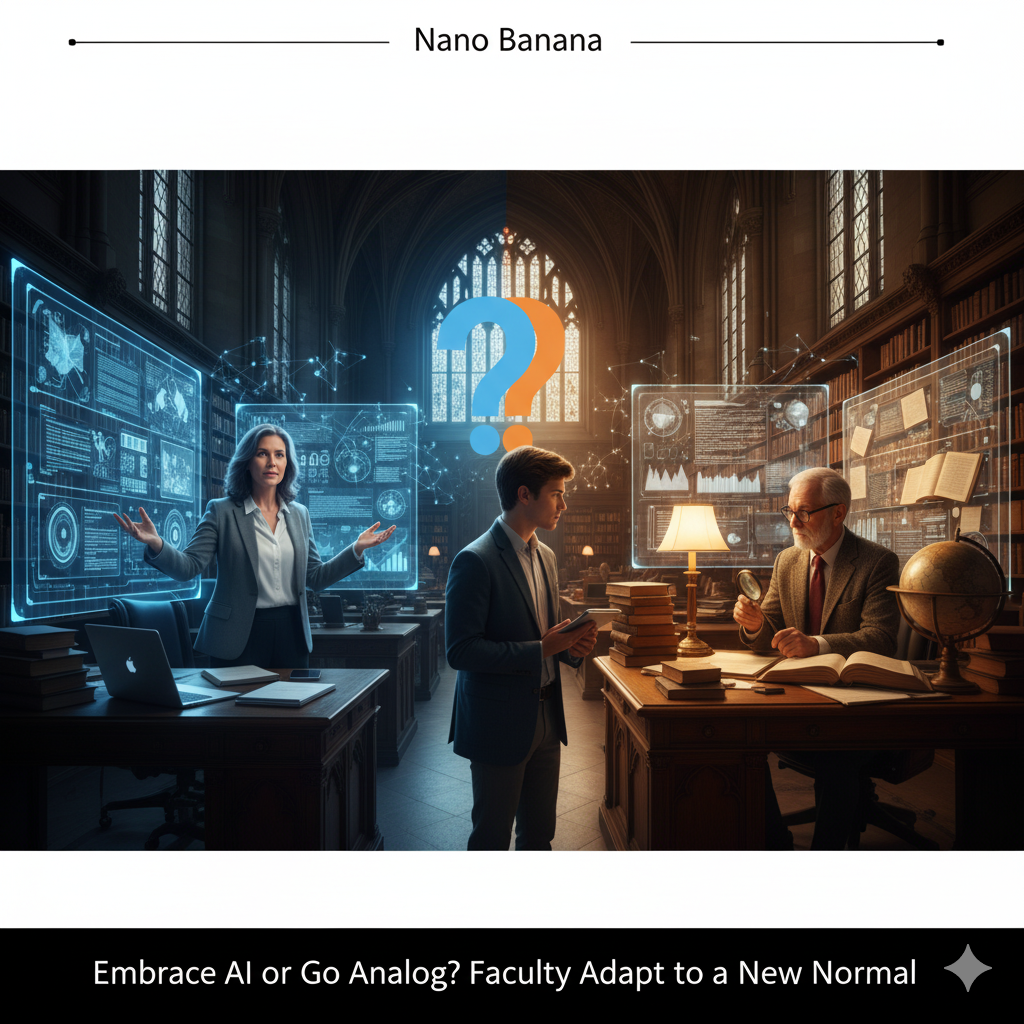
Embrace AI or Go Analog? Harvard Faculty Adapt to a New Normal


In a grand, traditional library setting, a female faculty member gestures towards a large glowing screen displaying AI data on the left, while a male faculty member examines a physical book with a magnifying glass on the right. Between them, a hovering question mark split in blue and orange signifies the choice between AI and traditional methods. The scene represents academics adapting to new technologies. Generated by Nano Banana.
As artificial intelligence becomes increasingly integrated into education, faculty in esteemed institutions face a pivotal choice: embrace the analytical power of AI or champion traditional analogue learning. This image captures the dynamic tension and adaptation required as educators navigate this new normal. Image generated by Nano Banana.

Source

The Harvard Crimson

Summary

AI is now a widespread presence in Harvard classrooms, and faculty are increasingly accepting it as part of teaching rather than trying to ignore it. Around 80% of surveyed faculty reported seeing coursework they believed was AI-generated. Yet most aren’t confident in spotting it. In response, different pedagogical strategies are emerging: some instructors encourage responsible AI use (e.g. tutor chatbots, AI homework), others “AI-proof” their classes via in-person exams. Harvard’s Bok Center is providing support with AI-specific tools and workshops. While concerns persist (cheating, undermined learning), many believe that adjusting to AI and preparing students for its reality is the more sustainable path.

Key Points

  • Nearly 80% of Harvard faculty have seen student work they believe used AI.
  • Only ~14% of faculty feel very confident distinguishing AI-generated content.
  • Faculty responses vary: some embrace AI (homework/assistant tools), others shift to in-person exams to reduce risks.
  • The Bok Center helps instructors design AI-resilient assignments, tutor chatbots, and offers pedagogical support.
  • Some faculty worry that AI use might degrade deep learning, but many accept that AI is here to stay and practices must evolve.

Keywords

URL

https://www.thecrimson.com/article/2025/9/19/AI-Shapes-Classroom-Embrace/

Summary generated by ChatGPT 5


AI teaching tools not a panacea, but can be a force multiplier


In a modern conference room with a city skyline view, two groups of students and a central female and male instructor are divided by a glowing, split-color light. On the left (red side), the text 'AI: NOT A PANECA' is displayed with error icons. On the right (blue side), 'AI: FORCE MULTIPLIFER' is displayed with growth and brain icons. Light streams intensely between the instructors, symbolizing AI's dual nature. The scene conveys a balanced perspective on AI's role in education. Generated by Nano Banana.
While AI teaching tools are certainly not a ‘panacea’ for all educational challenges, they possess immense potential as a ‘force multiplier,’ significantly enhancing learning experiences. This image visually contrasts AI’s limitations with its power to augment human capabilities, underscoring a nuanced approach to its integration in the classroom. Image (and typos) generated by Nano Banana.

Source

The New Indian Express

Summary

The author argues that while AI teaching tools are gaining attention, their value shows only when paired with thoughtful pedagogy, not when used in isolation. Meta-analyses and classroom studies suggest AI tools (adaptive quizzes, personalised feedback) can enhance student performance and time management—but only in learning environments where human feedback, active engagement, and scaffolding remain central. AI should assist, not replace, the relational, ethical, and mentoring roles of teachers. Without integrating AI into active learning, its benefits are diluted; it risks becoming mere decoration.

Key Points

  • AI tools deliver gains when embedded into active, interactive teaching—not used as standalone replacements.
  • Meta-studies show stronger outcomes when technology is personalised and integrated rather than simply overlaid.
  • Students report improved time management and performance when AI offers real-time feedback and adaptive quizzing.
  • Pedagogical design (feedback loops, scaffolding, mentor oversight) remains essential; AI alone doesn’t do that work.
  • AI cannot replicate human qualities such as creativity, ethics, judgement, and emotional understanding.

Keywords

URL

https://www.newindianexpress.com/opinions/2025/Sep/18/ai-teaching-tools-not-a-panacea-but-can-be-a-force-multiplier

Summary generated by ChatGPT 5