Latest Posts

The Future Learner: (Digital) Education Reimagined for 2040


Source

European Digital Education Hub (EDEH), European Commission, 2025

Summary

This foresight report explores four plausible futures for digital education in 2040, emphasising how generative and intelligent technologies could redefine learning, teaching, and human connection. Developed by the EDEH “Future Learner” squad, the study uses scenario planning to imagine how trends such as the rise of generative AI (GenAI), virtual assistance, lifelong learning, and responsible technology use might shape the education landscape. The report identifies 16 major drivers of change, highlighting GenAI’s central role in personalising learning, automating administration, and transforming the balance between human and machine intelligence.

In the most optimistic scenario – Empowered Learning – AI-powered personal assistants, immersive technologies, and data-driven systems make education highly adaptive, equitable, and learner-centred. In contrast, the Constrained Education scenario imagines over-regulated, energy-limited systems where AI use is tightly controlled, while The End of Human Knowledge portrays an AI-saturated collapse where truth, trust, and human expertise dissolve. The final Transformative Vision outlines a balanced, ethical future in which AI enhances – not replaces – human intelligence, fostering empathy, sustainability, and lifelong learning. Across all futures, the report calls for human oversight, explainability, and shared responsibility to ensure that AI in education remains ethical, inclusive, and transparent.

Key Points

  • Generative AI and intelligent systems are central to all future learning scenarios.
  • AI personal assistants, XR, and data analytics drive personalised, lifelong education.
  • Responsible use and ethical frameworks are essential to maintain human agency.
  • Overreliance on AI risks misinformation, cognitive overload, and social fragmentation.
  • Sustainability and carbon-neutral AI systems are core to educational innovation.
  • Data privacy and explainability remain critical for trust in AI-driven learning.
  • Equity and inclusion depend on access to AI-enhanced tools and digital literacy.
  • The line between human and artificial authorship will blur without strong governance.
  • Teachers evolve into mentors and facilitators supported by AI co-workers.
  • The most resilient future balances technology with human values and social purpose.

Conclusion

The Future Learner envisions 2040 as a pivotal point for digital education, where the success or failure of AI integration depends on ethical design, equitable access, and sustained human oversight. Generative AI can create unprecedented opportunities for personalisation and engagement, but only if education systems preserve their human essence – empathy, creativity, and community – amid the accelerating digital transformation.

Keywords

URL

https://ec.europa.eu/newsroom/eacea_oep/items/903368/en

Summary generated by ChatGPT 5

OpenAI’s network of deals is propping up the AI boom


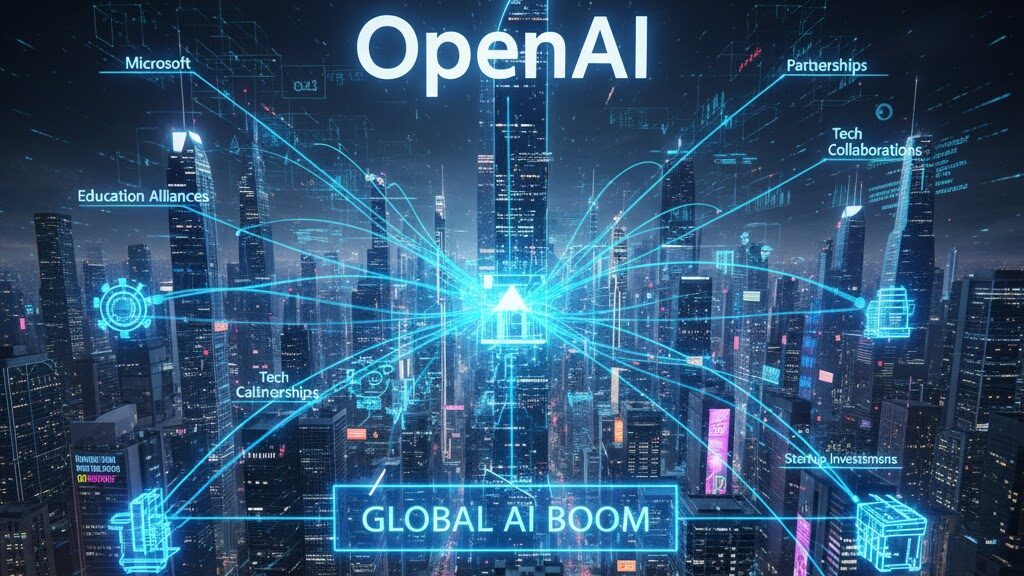
A high-angle, futuristic view of a sprawling metropolis at night, illuminated by glowing blue digital lines connecting various skyscrapers. At the center, "OpenAI" is prominently displayed, with the lines extending outwards to labels like "Microsoft," "Partnerships," "Education Alliances," and "Startup Investments," all converging to fuel a central "GLOBAL AI BOOM" graphic, illustrating OpenAI's extensive network. Image (and typos) generated by Nano Banana.
OpenAI’s vast and strategic network of deals and collaborations is acting as a crucial pillar, significantly propping up the current global AI boom. This image visualises OpenAI at the epicenter of a sprawling digital web, demonstrating how its alliances with major tech giants, educational institutions, and various startups are fueling rapid advancements and investments across the entire artificial intelligence ecosystem. Image (and typos) generated by Nano Banana.

Source

The Irish Times

Summary

Proinsias O’Mahony examines how OpenAI’s intricate web of financial partnerships has become central to sustaining the AI industry’s rapid expansion. Deals with major players such as Nvidia, AMD, and Oracle have created a self-reinforcing investment loop—OpenAI buys chips and services, suppliers reinvest in OpenAI, and valuations rise on expectations of continued demand. This “vendor-financing circle” keeps capital flowing and share prices high but also ties the sector’s fate to a handful of interconnected firms. While the system fuels the AI boom, analysts warn that any slowdown in ChatGPT’s growth could trigger a cascade of mutual losses across the industry.

Key Points

  • OpenAI’s partnerships with Nvidia, AMD, and Oracle form a self-sustaining investment loop.
  • AI suppliers and investors are increasingly financially interdependent.
  • The model boosts market valuations but concentrates systemic risk.
  • Analysts call it a “vendor-financing circle” that relies on perpetual demand.
  • A downturn in AI adoption could unravel the entire interconnected ecosystem.

Keywords

URL

https://www.irishtimes.com/your-money/2025/10/11/openais-network-of-deals-is-propping-up-the-ai-boom/

Summary generated by ChatGPT 5


Not Even Generative AI’s Developers Fully Understand How Their Models Work


In a futuristic lab or control room, a diverse group of frustrated scientists and developers in lab coats are gathered around a table with laptops, gesturing in confusion. Behind them, a large holographic screen prominently displays "GENERATIVE AI MODEL: UNKNOWABLE COMPLEXITY, INTERNAL LOGIC: BLACK BOX" overlaid on a glowing neural network. Numerous red question marks and "ACCESS DENIED" messages highlight their inability to fully comprehend the AI's workings. Image (and typos) generated by Nano Banana.
Groundbreaking research has unveiled a startling truth: even the developers of generative AI models do not fully comprehend the intricate inner workings of their own creations. This image vividly portrays a team of scientists grappling with the “black box” phenomenon of advanced AI, highlighting the profound challenge of understanding systems whose complexity surpasses human intuition and complete analysis. Image (and typos) generated by Nano Banana.

Source

The Irish Times

Summary

John Thornhill examines the paradox at the heart of the artificial intelligence boom: even the developers of generative AI systems cannot fully explain how their models function. Despite hundreds of billions being invested in the race toward artificial general intelligence (AGI), experts remain divided on what AGI means or whether it is achievable. While industry leaders such as OpenAI and Google DeepMind pursue it with near-religious zeal, critics warn of existential risks and call for restraint. At a Royal Society conference, scholars argued for redirecting research toward tangible, transparent goals and prioritising safety over hype in AI’s relentless expansion.

Key Points

  • Massive investment continues despite no shared understanding of AGI’s meaning or feasibility.
  • Industry figures frame AGI as imminent, while most academics consider it unlikely.
  • Experts highlight safety, transparency, and regulation as neglected priorities.
  • Alan Kay and Shannon Vallor urge shifting focus from “intelligence” to demonstrable utility.
  • Thornhill concludes that humanity’s true “superhuman intelligence” remains science itself.

Keywords

URL

https://www.irishtimes.com/business/2025/10/10/not-even-generative-ais-developers-fully-understand-how-their-models-work/

Summary generated by ChatGPT 5


Eight AI Tools That Can Help Generate Ideas for Your Classroom


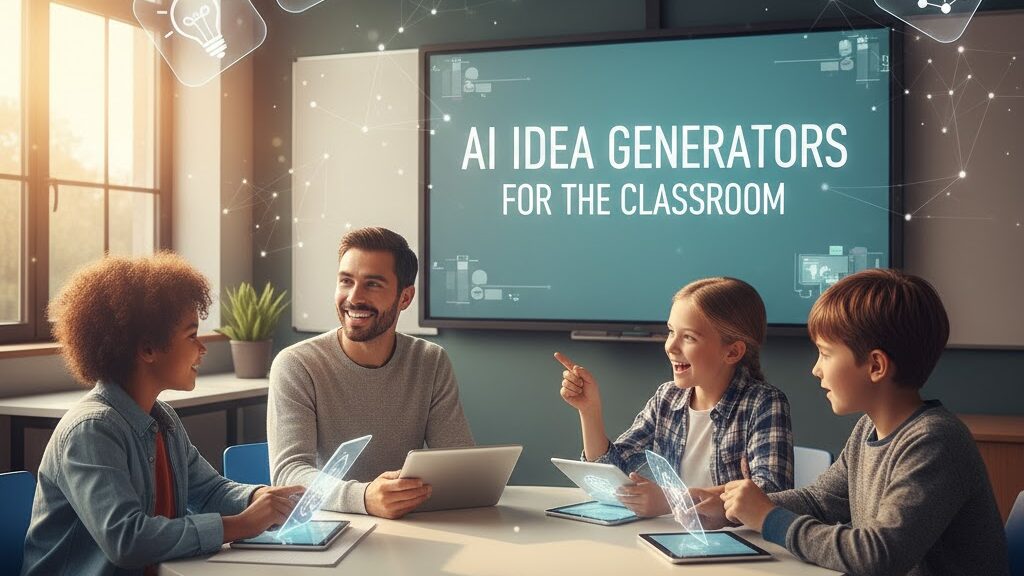
A diverse group of three elementary school children and one male teacher sitting around a table, actively engaged with tablets. Above them, a network of glowing AI-related icons (like a brain, speech bubble, robot, books, question mark, and a data network) floats, connected by lines, symbolizing idea generation. In the background, a large screen displays "AI IDEA GENERATORS FOR THE CLASSROOM." Image (and typos) generated by Nano Banana.
Spark creativity and innovation in your classroom with the power of artificial intelligence. Discover how AI tools can unlock new ideas and enhance learning experiences for both educators and students. Image (and typos) generated by Nano Banana.

Source

Edutopia

Summary

Alana Winnick outlines eight educator-tested AI tools that can help teachers overcome creative blocks and generate new lesson ideas. Emphasising accessibility, she distinguishes between advanced large language models such as ChatGPT, Gemini, and Claude, and beginner-friendly platforms like Curipod, Brisk, and SchoolAI, which require little technical skill. These tools can draft outlines, design interactive slides, and create tailored quizzes or discussion prompts. Curipod helps build engaging presentations, Brisk turns existing videos or articles into lesson plans, and SchoolAI enables personalised AI tutor spaces for students. Winnick encourages teachers to use AI as a creative partner rather than a replacement for their own professional insight.

Key Points

  • AI tools can boost creativity and save time during lesson planning.
  • Platforms like Curipod, Brisk, and SchoolAI simplify AI use for teachers.
  • ChatGPT, Gemini, and Claude offer greater flexibility for custom prompts.
  • AI can generate lesson outlines, discussion questions, and formative checks.
  • Educators should view AI as a collaborative support, not a substitute for teaching expertise.

Keywords

URL

https://www.edutopia.org/article/using-ai-generate-lesson-ideas/

Summary generated by ChatGPT 5


OpenAI’s newly launched Sora 2 makes AI’s environmental impact impossible to ignore


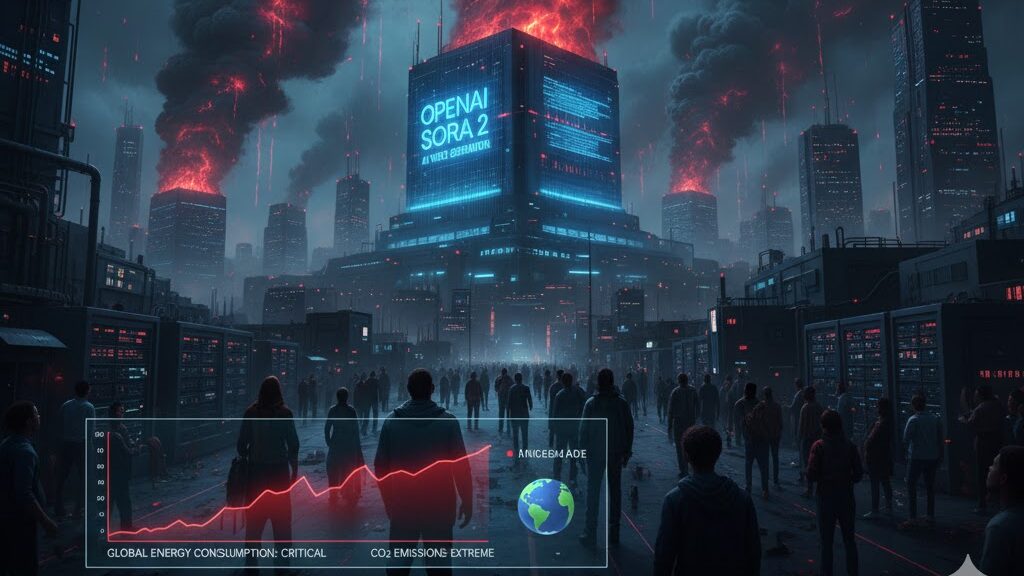
A dark, dystopian cityscape at night is dominated by towering data centers and skyscrapers, one of which prominently displays "OPENAI SORA 2" in glowing blue. Massive plumes of black and fiery red smoke billow from multiple buildings, symbolizing extreme environmental impact. A crowd of people looks on, while a holographic graph in the foreground shows "GLOBAL ENERGY CONSUMPTION: CRITICAL" and "CO2 EMISSIONS: EXTREME," with an icon of a distressed Earth. Image (and typos) generated by Nano Banana.
The recent launch of OpenAI’s Sora 2, a highly advanced AI model, unequivocally brings the environmental impact of artificial intelligence to the forefront, making it impossible to overlook. This dramatic image visually represents the significant energy consumption and CO2 emissions associated with powerful AI systems, urging a critical examination of the ecological footprint of cutting-edge technological advancements. Image (and typos) generated by Nano Banana.

Source

The Conversation

Summary

Robert Diab argues that the release of OpenAI’s Sora 2—a text-to-video model capable of generating ultra-realistic footage—has reignited urgent debate about AI’s environmental costs. While Sora 2’s creative potential is striking, its vast energy and water demands highlight the ecological footprint of large-scale AI. Data centres already consume around 1.5 % of global electricity, projected to double by 2030, with AI accounting for much of that growth. Competing narratives frame AI as either an ecological threat or a manageable risk, but Diab calls for transparency, regulation, and responsible scaling to ensure technological progress does not deepen environmental strain.

Key Points

  • Sora 2 showcases AI’s creative power but underscores its huge energy demands.
  • AI training and usage are accelerating global electricity and water consumption.
  • The “Jevons paradox” means efficiency gains can still drive higher total energy use.
  • Experts urge standardised, transparent reporting of AI’s environmental footprint.
  • Policymakers must balance innovation with sustainable data-centre expansion.

Keywords

URL

https://theconversation.com/openais-newly-launched-sora-2-makes-ais-environmental-impact-impossible-to-ignore-266867

Summary generated by ChatGPT 5