Latest Posts

Schools Urged to Use AI in Education with Caution


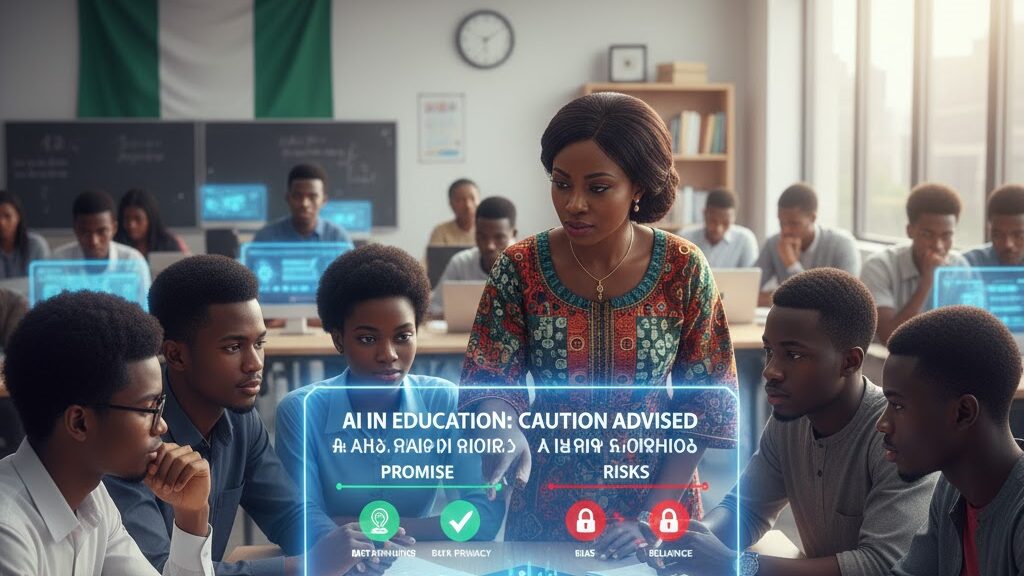
In a modern Nigerian classroom, a female teacher in traditional attire stands over a group of attentive students gathered around a table with laptops. A glowing holographic interface displays "AI IN EDUCATION: CAUTION ADVISED," with sections for "PROMISE" (showing benefits like efficiency) and "RISKS" (highlighting concerns such as bias, data privacy, and reliance) with corresponding checkmarks and X-marks. The Nigerian flag is visible in the background. Image (and typos) generated by Nano Banana.
Amidst the global integration of AI into education, Nigerian schools are being urged to proceed with caution. This image depicts a teacher guiding students through the nuanced landscape of AI, highlighting both its promising applications and significant risks like inherent biases, data privacy concerns, and over-reliance, advocating for a balanced and responsible approach to adopting AI technologies in the classroom. Image (and typos) generated by Nano Banana.

Source

Punch (Nigeria)

Summary

At the “Artificial Intelligence: Turning Disruption into Advantage” forum in Lagos, educators and technologists encouraged Nigerian schools to embrace AI while maintaining a balance between innovation and critical thinking. Speakers highlighted that AI can enhance learning efficiency and prepare students for future careers but warned against over-reliance that weakens analytical skills. John Todd of Charterhouse Lagos urged educators to teach responsible use, stressing the need for ethics and discernment. Eric Oliver of AidTrace added that Africa should invest in local infrastructure to process its own technology resources, reducing dependence on foreign supply chains and strengthening regional economies.

Key Points

  • Educators urged cautious but proactive adoption of AI in classrooms.
  • Over-reliance on AI risks undermining students’ independent thinking skills.
  • Responsible use requires ethics, discernment, and understanding of AI’s limits.
  • African nations should develop local tech infrastructure to capture more value.
  • The forum promoted AI as a tool for empowerment rather than replacement.

Keywords

URL

https://punchng.com/schools-urged-to-use-ai-with-caution/

Summary generated by ChatGPT 5

University wrongly accuses students of using artificial intelligence to cheat


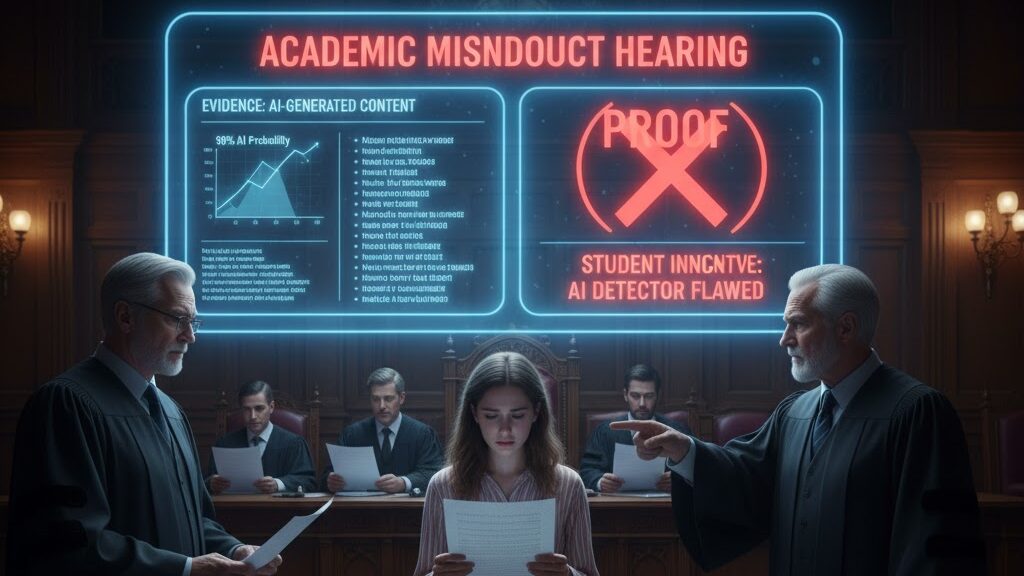
In a solemn academic hearing room, reminiscent of a courtroom, a distressed female student stands before a panel of university officials in robes, holding a document. A large holographic screen above displays "ACADEMIC MISCONDUCT HEARING." On the left, "EVIDENCE: AI-GENERATED CONTENT" shows a graph of AI probability, while on the right, a large red 'X' over "PROOF" is accompanied by text stating "STUDENT INNOCENT: AI DETECTOR FLAWED," highlighting a wrongful accusation. Image (and typos) generated by Nano Banana.
The burgeoning reliance on AI detection software has led to a disturbing trend: universities wrongly accusing students of using artificial intelligence to cheat. This dramatic image captures the devastating moment a student is cleared after an AI detector malfunctioned, highlighting the serious ethical challenges and immense distress caused by flawed technology in academic integrity processes. Image (and typos) generated by Nano Banana.

Source

ABC News (Australia)

Summary

The Australian Catholic University (ACU) has come under fire after wrongly accusing hundreds of students of using AI to cheat on assignments. Internal records showed nearly 6,000 academic misconduct cases in 2024, around 90 % linked to AI use. Many were based solely on Turnitin’s unreliable AI detection tool, later scrapped for inaccuracy. Students said they faced withheld results, job losses and reputational damage while proving their innocence. Academics reported low AI literacy, inconsistent policies and heavy workloads. Experts, including Sydney’s Professor Danny Liu, argue that banning AI is misguided and that universities should instead teach students responsible and transparent use.

Key Points

  • ACU recorded nearly 6,000 misconduct cases, most tied to alleged AI use.
  • Many accusations were based only on Turnitin’s flawed AI detector.
  • Students bore the burden of proof, with long investigation delays.
  • ACU has since abandoned the AI tool and introduced training on ethical AI use.
  • Experts urge universities to move from policing AI to teaching it responsibly.

Keywords

URL

https://www.abc.net.au/news/2025-10-09/artificial-intelligence-cheating-australian-catholic-university/105863524

Summary generated by ChatGPT 5


ChatGPT can hallucinate: College dean in Dubai urges students to verify data


In a modern, high-tech lecture hall with a striking view of the Dubai skyline at night, a female college dean stands at a podium, gesturing emphatically towards a large holographic screen. The screen prominently displays the ChatGPT logo surrounded by numerous warning signs and error messages such as "ERROR: FACTUAL INACCURACY" and "DATA HALLUCINATION DETECTED," with a bold command at the bottom: "VERIFY YOUR DATA!". Students in traditional Middle Eastern attire are seated, working on laptops. Image (and typos) generated by Nano Banana.
Following concerns over ChatGPT’s tendency to “hallucinate” or generate factually incorrect information, a college dean in Dubai is issuing a crucial directive to students: always verify data provided by AI. This image powerfully visualises the critical importance of scrutinising AI-generated content, emphasising that while AI can be a powerful tool, human verification remains indispensable for academic integrity and accurate knowledge acquisition. Image (and typos) generated by Nano Banana.

Source

Gulf News

Summary

Dr Wafaa Al Johani, Dean of Batterjee Medical College in Dubai, cautioned students against over-reliance on generative AI tools like ChatGPT during the Gulf News Edufair Dubai 2025. Speaking on the panel “From White Coats to Smart Care: Adapting to a New Era in Medicine,” she emphasised that while AI is transforming medical education, it can also produce false or outdated information—known as “AI hallucination.” Al Johani urged students to verify all AI-generated content, practise ethical use, and develop AI literacy. She stressed that AI will not replace humans but will replace those who fail to learn how to use it effectively.

Key Points

  • AI is now integral to medical education but poses risks through misinformation.
  • ChatGPT and similar tools can generate false or outdated medical data.
  • Students must verify AI outputs and prioritise ethical use of technology.
  • AI literacy, integrity, and continuous learning are essential for future doctors.
  • Simulation-based and hybrid training models support responsible tech adoption.

Keywords

URL

https://gulfnews.com/uae/chatgpt-can-hallucinate-college-dean-in-dubai-urges-students-to-verify-data-1.500298569

Summary generated by ChatGPT 5


Why Higher Ed’s AI Rush Could Put Corporate Interests Over Public Service and Independence


In a grand, traditional university meeting room with stained-glass windows, a group of academic leaders in robes and corporate figures in suits are gathered around a long table. Above them, a large holographic display illustrates a stark contrast: "PUBLIC SERVICE & INDEPENDENCE" on the left (glowing blue) versus "CORPORATE AI DOMINATION" on the right (glowing red), with glowing digital pathways showing the potential flow of influence from academic values towards corporate control, symbolized by locked icons and data clouds. Image (and typos) generated by Nano Banana.
The rapid embrace of AI in higher education, often driven by external pressures and vast resources, raises critical concerns that corporate interests could overshadow the foundational values of public service and academic independence. This image visually depicts the tension between these two forces, suggesting that universities risk compromising their core mission if the “AI rush” prioritises commercial gains over their commitment to unbiased research, equitable access, and intellectual autonomy. Image (and typos) generated by Nano Banana.

Source

The Conversation

Summary

Chris Wegemer warns that universities’ accelerating embrace of AI through corporate partnerships may erode academic independence and their public service mission. High-profile collaborations—such as those between Nvidia and the University of Florida, Microsoft and Princeton, and OpenAI with the California State University system—illustrate a growing trend toward “corporatisation.” Wegemer argues that financial pressures, prestige-seeking, and the decline in enrolment are driving institutions to adopt market-driven governance, aligning higher education with private-sector priorities. Without transparent oversight and faculty involvement, he cautions, universities risk sacrificing democratic values and intellectual freedom for commercial gain.

Key Points

  • Universities are partnering with tech giants to build AI infrastructure and credentials.
  • These partnerships deepen higher education’s dependence on corporate capital.
  • Market and prestige pressures are displacing public-interest research priorities.
  • Faculty governance and academic freedom are being sidelined in AI decision-making.
  • The author urges renewed focus on transparency, democracy, and public accountability.

Keywords

URL

https://theconversation.com/why-higher-eds-ai-rush-could-put-corporate-interests-over-public-service-and-independence-260902

Summary generated by ChatGPT 5


Smarter Classrooms, Real Results: How AI is Rewriting the Rules of Education


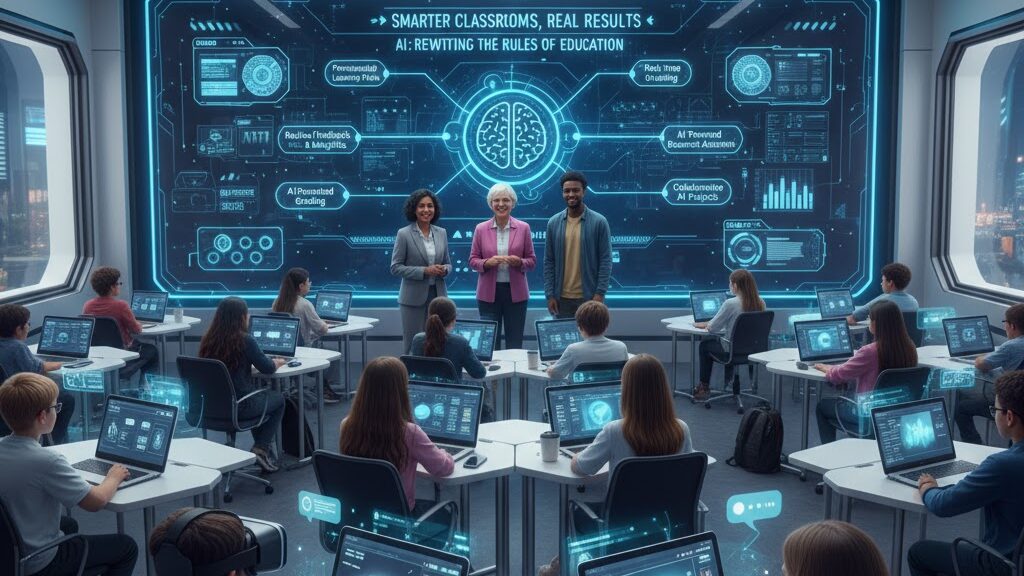
In a sleek, futuristic classroom filled with students using laptops and holographic interfaces, three educators (two female, one male) stand at the front, presenting to the class. A large, interactive screen prominently displays "SMARTER CLASSROOMS, REAL RESULTS: AI IS REWRITING THE RULES OF EDUCATION," featuring a central glowing brain icon surrounded by various AI applications like personalized learning paths, automated grading, and AI-powered assessment. Image (and typos) generated by Nano Banana.
Artificial intelligence is fundamentally “rewriting the rules of education,” ushering in an era of smarter classrooms and demonstrating tangible improvements in learning outcomes. This image envisions a dynamic, technologically advanced educational environment where AI tools enhance every aspect of teaching and learning, from personalised instruction and automated feedback to collaborative projects, ultimately delivering real and measurable results for students. Image (and typos) generated by Nano Banana.

Source

WTOP News

Summary

Will Vitka reports that artificial intelligence is transforming classrooms by saving teachers time, improving accessibility, and offering real-time personalised learning. University of Maryland professor Charles Harry describes AI as a “huge net positive” when used thoughtfully, helping educators create complex, adaptive assignments and enabling students to learn coding and data analysis more quickly. AI tools are also levelling the field for learners with disabilities and multilingual needs. However, privacy, ethical use, and over-reliance remain major concerns. Surveys show one in four teachers believe AI causes more harm than good, underscoring the need for balance between innovation and integrity.

Key Points

  • AI personalises learning and provides real-time academic feedback for students.
  • Educators using AI save up to six hours per week on administrative tasks.
  • Accessibility improves through tools like translation and voice-to-text.
  • Ethical concerns persist around cheating and student data privacy.
  • The global AI-in-education market could reach $90 billion by 2032.

Keywords

URL

https://wtop.com/education/2025/10/smarter-classrooms-real-results-how-ai-is-rewriting-the-rules-of-education/

Summary generated by ChatGPT 5