By Leigh Graves Wolf, University College Dublin Teaching & Learning
Estimated reading time: 5 minutes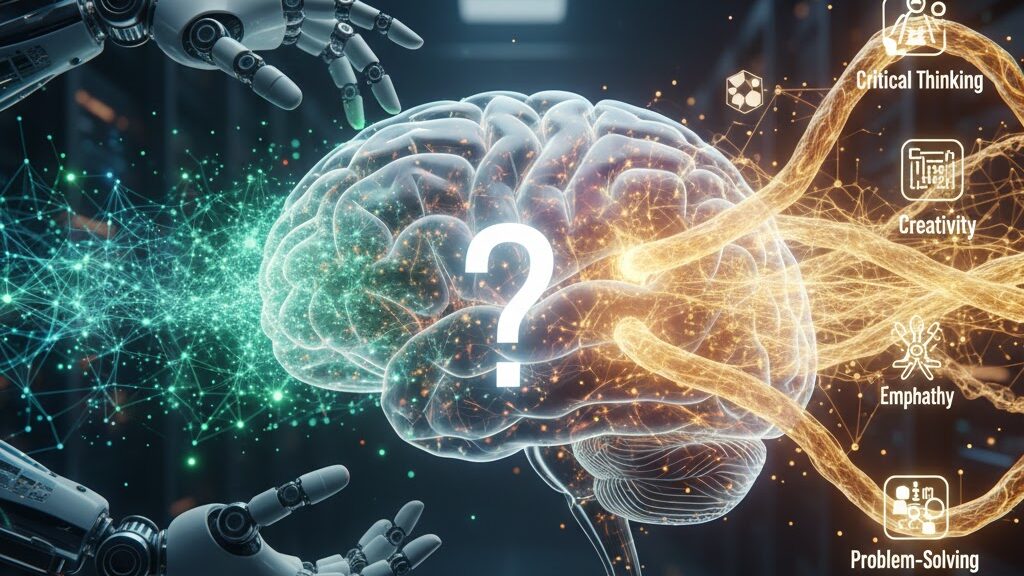
Thinking is a social activity. This isn’t a new insight (scholars have studied this for ages) but it’s one I keep coming back to lately as I try to stay afloat in the “AI Era.”
For a long stretch as I developed as an academic, I thought with others through technology (i.e. del.icio.us, Typepad, and Twitter.) We would bounce ideas off each other, glean golden nuggets of information, share resources that sparked new connections in our minds. There was something magical about that era, the serendipitous discovery of a colleague’s bookmark that led you down an unexpected intellectual rabbit hole, or a Twitter thread that challenged your thinking in ways you hadn’t anticipated. These weren’t just tools; they were extensions of our collective scholarly brain.
Then, all of that broke. (And I’m still. not. over it.)
When Our Digital Commons Began to Fracture
Koutropoulos et. al (2024) speak more eloquently to this fragmentation. They capture something I’ve been feeling but fail to articulate as clearly, the way our digital spaces have become increasingly unstable, the way platforms that once felt like home can shift beneath our feet overnight. Their collaborative autoethnography explores the metaphors we use to describe this movement and ultimately concludes that no single term captures what’s happening. What resonates most is their observation that we were never truly in control of these spaces, we were building communities on “the fickle and shifting sands of capitalism.”
Commercial generative AI feels social. You’re chatting, prompting, getting responses that (by design) seem thoughtful and engaged. But fundamentally, it is not social. You’re talking with biased algorithms. There is no human in the loop, no colleague who might push back on your thinking from their own lived experience, no peer who might share a resource you’d never have found on your own, no friend who might simply say “I’ve been thinking about this too.”
I haven’t seen genuine sharing built into any commercial generative AI tools. NotebookLM will let you share content that others can interact with, other tools allow you to create bots – but again, you’re not linking with a human. You’re not building a web of ambient findability (Morville, 2005) that made those early social media days so generative. There’s no AI equivalent of stumbling upon a colleague’s carefully curated collection and thinking, “Oh, they’re interested in this too – I should reach out.”
So in this fragmented, overly connected yet profoundly disconnected world, how do we stay connected to each other and each other’s ideas? I need my thought network now more than ever. And I suspect you do too.
Choosing Human Connection in an Algorithmic Age
Here are a few tools that have helped me navigate this landscape:
Raindrop.io – it’s not as social as del.icio.us was (oh, how I miss those days!), but it is a bookmark management tool that helps me keep track of the deluge of AI articles (and all sorts of other things) coming my way. I’ve made my collection public because (surprise!) I believe in working out loud and sharing what I’m learning. You can find it here: https://raindrop.io/leigh-wolf/ai-62057797.
RSS is Awesome is an “in-progress passion project” by Tom Hazledine. It has now become my morning ritual to open up this lovely, lightweight, no-login-needed, browser-based tool to catch up on my feeds. There’s something deeply satisfying about returning to RSS – a technology that puts the reader in control rather than an algorithm. (And yes, you can add the GenAI:N3 Blog to your feed simply by adding this URL: https://genain3.ie/blog/)
We need each other more than ever to navigate this sea of (mis)information. The platforms are fragmenting, the algorithms are optimising for engagement rather than insight, and AI offers the feeling of conversation without its substance – but we still have each other. We still have the ability to share, to curate, to point each other toward ideas worth wrestling with.
As Koutropoulos et al. (2024) challenge us, the solution isn’t to find the perfect platform – it’s to “take charge of our own data” and to invest in relationships with the humans in our educational networks. The platforms will always ebb and flow. But the connections we build with each other can (and do!) persist across whatever digital landscape emerges next.
Hold on to each other. Hold on to the tools that are enabling rather than disabling us to do this work together. And maybe, just maybe, start (re)building those thought networks – one shared bookmark, one RSS subscription, one genuine human connection at a time.
What tools are helping you stay connected to others’ thinking? What spaces have you found that still feel like home? I would love to know – please reach out in the comments below!!
Reference
Koutropoulos, A., Stewart, B., Singh, L., Sinfield, S., Burns, T., Abegglen, S., Hamon, K., Honeychurch, S., & Bozkurt, A. (2024). Lines of flight: The digital fragmenting of educational networks. Journal of Interactive Media in Education, 2024(1), 11. https://doi.org/10.5334/jime.850
Morville, P. (2005). Ambient findability: What we find changes who we become. O’Reilly.
Leigh Graves Wolf
Assistant Professor
University College Dublin