Report Reveals Potential of AI to Help UK Higher Education Sector Assess Its Research More Efficiently and Fairly


A stylized visual showing a network of research papers and data graphs being analyzed and sorted by a glowing, benevolent AI interface (represented by a digital hand) over the map of the United Kingdom, symbolizing efficiency and impartial assessment in academia. Image (and typos) generated by Nano Banana.
Streamlining academia: A new report illuminates how artificial intelligence can be leveraged to introduce greater efficiency and fairness into the complex process of assessing research within the UK’s higher education sector. Image (and typos) generated by Nano Banana.

Source

University of Bristol

Summary

This report highlights how UK universities are beginning to integrate generative AI into research assessment processes, marking a significant shift in institutional workflows. Early pilot programmes suggest that AI can assist in evaluating research outputs, managing reviewer assignments and streamlining administrative tasks associated with national research exercises. The potential benefits include increased consistency across assessments, reduced administrative burden and enhanced scalability for institutions with extensive research portfolios. Despite these advantages, the report underscores the importance of strong governance structures, transparent methodological frameworks and ongoing human oversight to ensure fairness, academic integrity and alignment with sector norms. The emerging consensus is that AI should serve as an augmenting tool rather than a replacement for expert judgement. Institutions are encouraged to take a measured approach that balances innovation with ethical responsibility while exploring long-term strategies for responsible adoption and sector-wide coordination. This marks a shift from viewing AI as a hypothetical tool for research assessment to recognising it as an active component of evolving academic practice.

Key Points

  • GenAI already used in UK HE for research assessment.
  • Potential efficiency gains in processing large volumes of research.
  • Increased standardisation of evaluation.
  • Governance and oversight essential.
  • Recommends controlled scaling across sector.

Keywords

URL

https://www.bristol.ac.uk/news/2025/november/report-reveals-potential-of-ai-to-help-assess-research-more-efficiently-.html

Summary generated by ChatGPT 5.1


We Asked Teachers About Their Experiences With AI in the Classroom — Here’s What They Said


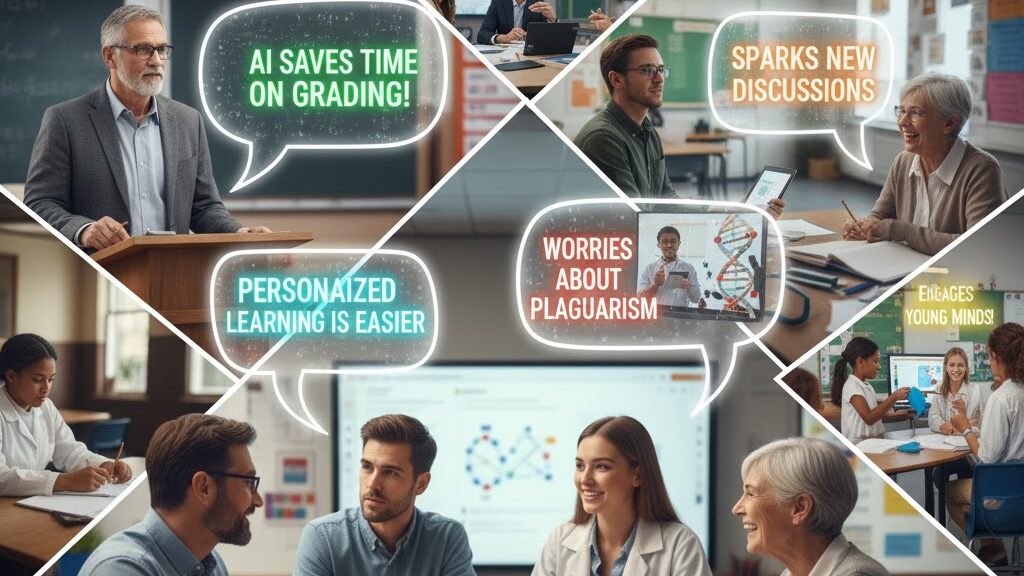
A digital illustration showing a diverse group of teachers sitting around a conference table in a modern classroom, each holding a speech bubble or screen displaying various short, contrasting statements about AI, such as "HELPFUL TOOL," "CHEAT DETECTOR," and "TIME SINK." Image (and typos) generated by Nano Banana.
Diverse perspectives on the digital frontier: Capturing the wide range of experiences and opinions shared by educators as they navigate the benefits and challenges of integrating AI into their classrooms. Image (and typos) generated by Nano Banana.

Source

The Conversation

Summary

Researcher Nadia Delanoy interviewed ten Canadian teachers to explore how generative AI is reshaping K–12 classrooms. The teachers, spanning grades 5–12 across multiple provinces, described mounting pressures to adapt amid ethical uncertainty and emotional strain. Common concerns included the fragility of traditional assessment, inequitable access to AI tools, and rising workloads compounded by inadequate policy support. Many expressed fear that AI could erode the artistry and relational nature of teaching, turning it into a compliance exercise. While acknowledging AI’s potential to enhance workflow, teachers emphasised the need for slower, teacher-led, and ethically grounded implementation that centres humanity and professional judgment.

Key Points

  • Teachers report anxiety over authenticity and fairness in assessment.
  • Equity gaps widen as some students have greater AI access than others.
  • Educators feel policies treat them as implementers, not professionals.
  • AI integration adds to burnout, threatening teacher autonomy.
  • Responsible policy must involve teachers, ethics, and slower adoption.

Keywords

URL

https://theconversation.com/we-asked-teachers-about-their-experiences-with-ai-in-the-classroom-heres-what-they-said-265241

Summary generated by ChatGPT 5


90% Of College Students Use AI: Higher Ed Needs AI Fluency Support Now


A large, ornate lecture hall is filled with numerous college students, each intensely focused on their glowing laptop screens displaying various AI interfaces. At the front, a professor addresses the class. A prominent holographic banner above the students reads '90% OF COLLEGE STUDENTS USE AI' with an upward-trending bar graph. The scene highlights the widespread use of AI in higher education. Generated by Nano Banana.
With a staggering 90% of college students now integrating AI tools into their academic lives, the demand for robust AI fluency support in higher education has never been more critical. This image underscores the widespread adoption of AI by students, signalling an urgent need for institutions to adapt their curricula and resources to equip learners for an AI-driven future. Image generated by Nano Banana.

Source

Forbes

Summary

AI is now deeply embedded in student life: roughly 90 % of college students report using AI tools, and the evidence suggests institutions are lagging in supporting this shift. Many students use AI for learning support—brainstorming, drafting, reviewing—but worry about its limitations, risks, and policy clarity. Educators argue that AI fluency should be integrated into curricula so students can use it responsibly, distinguish strong from weak output, and avoid over-reliance. The piece calls for higher education to embed AI ethics and practical AI skills to prepare students for a changing work environment.

Key Points

  • About 90 % of college students now use AI tools in their academic work.
  • Students use AI for brainstorming, feedback, editing, drafting—not necessarily to cheat—but feel under-prepared in distinguishing good versus bad AI output.
  • There is a gap between student usage and institutional support; many students believe their universities aren’t keeping pace.
  • AI fluency (understanding how AI works, its limitations, ethical issues) is increasingly seen as a necessary component of modern education.
  • Clear policy, guidance, and curricular integration are needed to ensure AI is a help, not a crutch.

Keywords

URL

https://www.forbes.com/sites/avivalegatt/2025/09/18/90-of-college-students-use-ai-higher-ed-needs-ai-fluency-support-now/

Summary generated by ChatGPT 5


Generative AI in Higher Education Teaching and Learning: Sectoral Perspectives


Source

Higher Education Authority

Summary

This report, commissioned by the Higher Education Authority (HEA), captures sector-wide perspectives on the impact of generative AI across Irish higher education. Through ten thematic focus groups and a leadership summit, it gathered insights from academic staff, students, support personnel, and leaders. The findings show that AI is already reshaping teaching, learning, assessment, and governance, but institutional responses remain fragmented and uneven. Participants emphasised the urgent need for national coordination, values-led policies, and structured capacity-building for both staff and students.

Key cross-cutting concerns included threats to academic integrity, the fragility of current assessment practices, risks of skill erosion, and unequal access. At the same time, stakeholders recognised opportunities for AI to enhance teaching, personalise learning, support inclusion, and free staff time for higher-value educational work. A consistent theme was that AI should not be treated merely as a technical disruption but as a pedagogical and ethical challenge that requires re-examining educational purpose.

Key Points

  • Sectoral responses to AI are fragmented; coordinated national guidance is urgently needed.
  • Generative AI challenges core values of authorship, originality, and academic integrity.
  • Assessment redesign is necessary—moving towards authentic, process-focused approaches.
  • Risks include skill erosion in writing, reasoning, and information literacy if AI is overused.
  • AI literacy for staff and students must go beyond tool use to include ethics and critical thinking.
  • Ethical use of AI requires shared principles, not just compliance or detection measures.
  • Inclusion is not automatic: without deliberate design, AI risks deepening inequality.
  • Staff feel underprepared and need professional development and institutional support.
  • Infrastructure challenges extend beyond tools to governance, procurement, and policy.
  • Leadership must shape educational vision, not just manage risk or compliance.

Conclusion

Generative AI is already embedded in higher education, raising urgent questions of purpose, integrity, and equity. The consultation shows both enthusiasm and unease, but above all a readiness to engage. The report concludes that a coordinated, values-led, and inclusive approach—balancing innovation with responsibility—will be essential to ensure AI strengthens, rather than undermines, Ireland’s higher education mission.

Keywords

URL

https://hea.ie/2025/09/17/generative-ai-in-higher-education-teaching-and-learning-sectoral-perspectives/

Summary generated by ChatGPT 5


Harvard Professors Are Adapting To AI. It’s Time Students Do the Same.


In a collegiate lecture hall, a female professor stands at the front, gesturing towards a large transparent screen displaying "AI ADAPTATION STRATEGIES" and a network of connected digital nodes. Students are seated at wooden desks with laptops, many showing similar AI-related content, actively engaged in learning about AI. Image (and typos) generated by Nano Banana.
As institutions like Harvard embrace and adapt to the integration of AI, the educational landscape is shifting rapidly. This image depicts a professor leading a class on “AI Adaptation Strategies,” underscoring the vital need for students to also acquire the skills and mindset necessary to effectively navigate and utilise artificial intelligence in their academic and future professional lives. Image (and typos) generated by Nano Banana.

Source

The Harvard Crimson

Summary

Harvard professors are moving away from blanket bans on AI and shifting toward nuanced, transparent policies that balance academic integrity with practical realities. Assignments are being redesigned to reduce misuse, and students are urged to treat AI as a tool for learning rather than a shortcut. Success depends on both institutional frameworks and student responsibility.

Key Points

  • 80% of faculty suspect or know AI is used in assignments.
  • Shift from total bans to clearer, nuanced policies.
  • AI often used as shortcut, undermining learning.
  • New assessments: oral exams, group work, AI-use disclosures.
  • Framework success depends on student buy-in.

Keywords

URL

https://www.thecrimson.com/article/2025/9/10/previn-harvard-ai-polocies/

Summary generated by ChatGPT 5