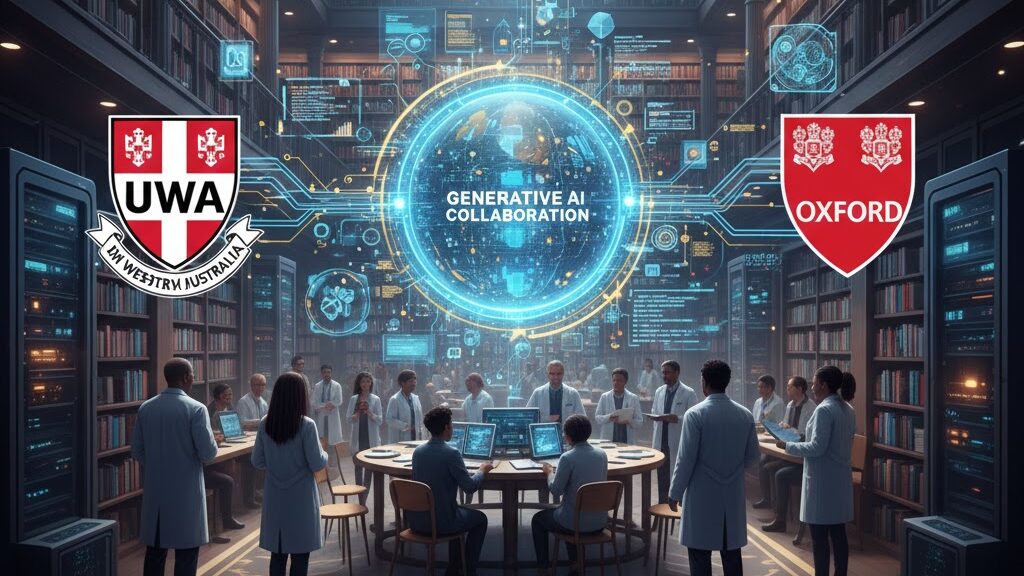
Global collaboration in the age of AI: UWA and Oxford University join forces to pioneer the integration and study of generative artificial intelligence within the landscape of higher education. Image (and typos) generated by Nano Banana.
Source
University of Western Australia
Summary
The University of Western Australia and the University of Oxford announced a formal partnership that positions generative AI as a strategic driver in the future of higher education. The collaboration focuses on advancing responsible AI research, developing governance models and integrating generative AI into teaching and learning in ways that uphold academic integrity and inclusivity. Both institutions highlight that the rapid acceleration of AI requires coordinated international responses that balance innovation with ethical safeguards. The partnership will explore curriculum transformation, staff development and AI-informed pedagogical frameworks intended to support both student learning and broader institutional capability building. By aligning two globally significant universities, the initiative signals a trend toward cross-border cooperation designed to shape sector-wide AI standards. It also indicates growing recognition that AI adoption in higher education must be underpinned by shared values, transparent methodologies and research-based evidence. This collaboration aims to become a blueprint for how universities can jointly shape the future of AI-enabled education while ensuring that human expertise remains central.
Key Points
Major partnership between UWA and Oxford to advance responsible AI
Focus on governance, research and curriculum innovation
Reflects global shift toward collaboration on AI strategy
Emphasises ethical frameworks for AI adoption in higher education
Positions AI as core to long-term institutional development
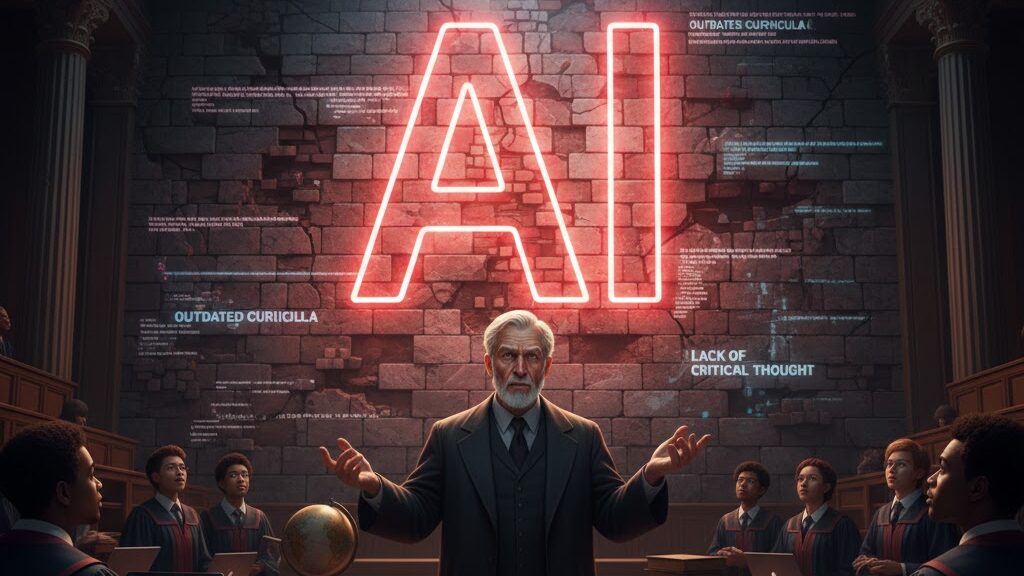
The educational overhaul: Universities are in a frantic race to adapt their curricula, ensuring their students are equipped for a job market and world fundamentally reshaped by artificial intelligence. Image (and typos) generated by Nano Banana.
Source
ScienceBlog – NeuroEdge
Summary
A new study in Frontiers of Digital Education argues that higher education must fundamentally redesign curricula to keep pace with rapid AI advancement. Led by researchers at Lanzhou Petrochemical University of Vocational Technology, the paper warns that traditional curriculum cycles are too slow for a world where generative AI is already standard in workplaces. It proposes a comprehensive framework built on AI literacy, ethical use, interdisciplinary integration and continuous updating. The authors emphasise a tiered model of AI learning—from core literacy for all students to advanced training for specialists—and call for modular course design, industry partnerships and cultural change within universities. Without sweeping reform, they argue, institutions risk preparing students for a world that no longer exists.
Key Points
AI is reshaping what and how universities must teach, creating urgency for reform.
Study identifies AI literacy as essential for every student, regardless of discipline.
Recommends a tiered AI curriculum: foundational, applied and specialist levels.
Calls for modular, continuously updated courses aligned with fast-moving AI developments.
Argues for cultural change: interdisciplinary collaboration, new assessment models and faculty training.
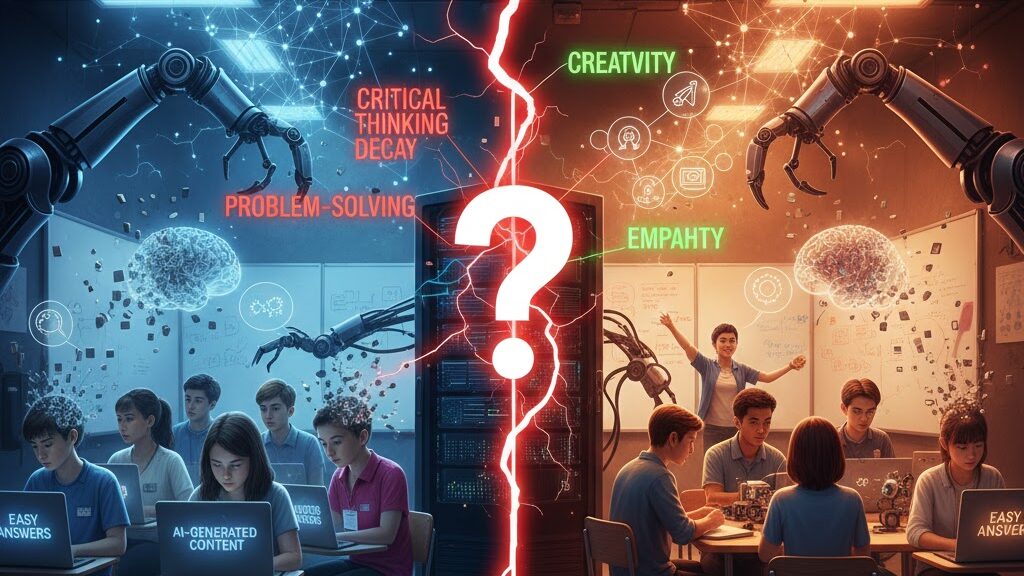
The automation paradox: Experts warn that while AI drives efficiency, its widespread adoption in education may inadvertently erode the crucial cognitive and creative skills US students need to thrive in a future dominated by technology. Image (and typos) generated by Nano Banana.
Source
Times of India (Education International Desk)
Summary
This article explores concerns that widespread adoption of AI tools in education may undermine essential skills that students require for long-term success in an increasingly automated world. Educators and analysts interviewed argue that easy access to generative AI for writing, problem solving and research may weaken students’ capacity for critical thinking, creativity and independent judgement. They note that while AI can accelerate tasks, it may also reduce opportunities for deep learning and cognitive struggle, both of which are crucial for intellectual development. The article raises concerns that students who rely heavily on AI may experience diminished confidence in producing original work and solving complex problems without technological support. Experts recommend curriculum renewal that blends responsible AI literacy with explicit instruction in foundational skills, ensuring that students can use AI effectively without sacrificing their broader intellectual growth. The discussion reflects a recurring theme in the global AI-in-education debate: the need to preserve human expertise and cognitive resilience in an era of pervasive automation. The article calls for educators, policymakers and institutions to strike a balance between embracing AI and safeguarding human capabilities.
Key Points
Widespread AI use may weaken foundational cognitive skills
Risks include reduced independent thinking and reduced confidence
Educators call for curriculum redesign with balanced AI integration
Diverse perspectives on the digital frontier: Capturing the wide range of experiences and opinions shared by educators as they navigate the benefits and challenges of integrating AI into their classrooms. Image (and typos) generated by Nano Banana.
Source
The Conversation
Summary
Researcher Nadia Delanoy interviewed ten Canadian teachers to explore how generative AI is reshaping K–12 classrooms. The teachers, spanning grades 5–12 across multiple provinces, described mounting pressures to adapt amid ethical uncertainty and emotional strain. Common concerns included the fragility of traditional assessment, inequitable access to AI tools, and rising workloads compounded by inadequate policy support. Many expressed fear that AI could erode the artistry and relational nature of teaching, turning it into a compliance exercise. While acknowledging AI’s potential to enhance workflow, teachers emphasised the need for slower, teacher-led, and ethically grounded implementation that centres humanity and professional judgment.
Key Points
Teachers report anxiety over authenticity and fairness in assessment.
Equity gaps widen as some students have greater AI access than others.
Educators feel policies treat them as implementers, not professionals.
AI integration adds to burnout, threatening teacher autonomy.
Responsible policy must involve teachers, ethics, and slower adoption.
by Brian Mulligan – e-learning consultant with Universal Learning Systems (ulsystems.com)
Estimated reading time: 5 minutes
Artificial intelligence is poised to unleash a revolution in higher education, not in the ways we’ve conventionally imagined, but through unexpected and profound transformations. This image visualises AI as a central, dynamic force reshaping academic landscapes, curriculum delivery, and the very nature of learning in universities. Image (and typos) generated by Nano Banana.
The current conversation about Artificial Intelligence (AI) in higher education primarily focuses on efficiency and impact. People talk about how AI can personalise learning, streamline administrative tasks, and help colleges “do more with less.” For decades, every new technology, from online training to MOOCs, promised a similar transformation. Generative AI certainly offers powerful tools to enhance existing processes.
However, perhaps the revolutionary potential of AI in higher education may come from a more critical and urgent pressure: its significant challenge to the integrity of academic credentials and the learning processes they are supposed to represent.
Historically, colleges haven’t had a strong incentive to completely overhaul their teaching models just because new technology arrived. Traditional lectures, established assessment methods, and the value of a physical campus have remained largely entrenched. Technology usually just served to augment existing practices, not to transform the underlying structures of teaching, learning, and accreditation.
AI, however, may be a different kind of catalyst for change.
The Integrity Challenge
AI’s ability to create human-quality text, solve complex problems, and produce creative outputs has presented a serious challenge to academic integrity. Reports show a significant rise in AI-driven cheating, with many students now routinely using these tools to complete their coursework. For a growing number of students, offloading cognitive labour, from summarising readings to generating entire essays, to AI is becoming the new norm.
This widespread and mostly undetectable cheating compromises the entire purpose of assessment: to verify genuine learning and award credible qualifications. Even students committed to authentic learning feel compromised, forced to compete against peers using AI for an unfair advantage.
Crucially, even when AI use is approved, there’s a legitimate concern that it can undermine the learning process itself. If students rely on AI for foundational tasks like summarisation and idea generation, they may bypass the essential cognitive engagement and critical thinking development. This reliance can lead to intellectual laziness, meaning the credentials universities bestow may no longer reliably signify genuine knowledge and skills. This creates an urgent imperative for institutions to act.
The Shift to Authentic Learning
While many believe we can address this just by redesigning assignments, the challenge offers, and may even require, a structural shift towards more radical educational models. These new approaches,which have been emerging to address the challenges of quality, access and cost, may also prove to be the most effective ways of addressing academic integrity challenges.
To illustrate the point, let’s look at three examples of such emerging models:
Flipped Learning: Students engage with core content independently online. Valuable in-person time is then dedicated to active learning like problem-solving, discussions, and collaborative projects. Educators can directly observe the application of knowledge, allowing for a more authentic assessment of understanding.
Project-Based Learning (PBL): Often seen as an integrated flipped model, PBL immerses students in complex, integrated projects over extended periods. The focus is on applying knowledge from multiple modules and independent research to solve real-world problems. These projects demand sustained, supervised engagement, creative synthesis, and complex problem-solving, capabilities that are very hard to simply outsource to AI.
Work-Based Learning (WBL): A significant part of the student’s journey takes place in authentic workplace settings. The emphasis shifts entirely to the demonstrable application of skills and knowledge in genuine professional contexts, a feat AI alone cannot achieve. Assessment moves to evaluating how a student performs and reflects in their role, including how they effectively and ethically integrate AI tools professionally.
AI as the Enabler of Change
Shifting to these models isn’t easy. Can institutions afford the resources to develop rich content, intricate project designs, and robust supervisory frameworks? Creating and assessing numerous, varied, and authentic tasks requires significant time and financial investment.
This is where technology, now including AI itself, becomes the key enabler for the feasibility of these new pedagogical approaches. Learning technologies, intelligently deployed, can help by:
Affordably Creating Content: AI tools rapidly develop diverse learning materials, including texts, videos and formative quizzes as well as more sophisticated assessment designs.
Providing Automated Learning Support: AI-powered tutors and chatbots offer 24/7 support, guiding students through challenging material, which personalises the learning journey.
Monitoring Independent Work: Learning analytics, enhanced by AI, track student engagement and flag struggling individuals. This allows educators to provide timely, targeted human intervention.
Easing the Assessment Burden: Technology can streamline the heavy workload associated with more varied assignments. Simple digital tools like structured rubrics and templated feedback systems free up educator time for nuanced, human guidance.
In summary, the most significant impact of AI isn’t the familiar promise of doing things better or faster. By undermining traditional methods of learning verification through the ease of academic dishonesty, AI has created an unavoidable pressure for systemic change. It forces colleges to reconsider what they are assessing and what value their degrees truly represent.
It’s that AI, by challenging the old system so thoroughly, makes the redesign of higher education a critical necessity.
Brian Mulligan
E-learning Consultant Universal Learning Systems (ulsystems.com)
Brian Mulligan is an e-learning consultant with Universal Learning Systems (ulsystems.com) having retired as Head of Online Learning Innovation at Atlantic Technological University in Sligo in 2022. His current interests include innovative models of higher education and the strategic use of learning technologies in higher education.