OECD (2026), OECD Digital Education Outlook 2026: Exploring Effective Uses of Generative AI in Education, OECD Publishing, Paris, https://doi.org/10.1787/062a7394-en..
Summary
This flagship OECD report examines how generative artificial intelligence (GenAI) is reshaping education systems, with a strong emphasis on evidence-based uses that enhance learning, teaching, assessment, and system capacity. Drawing on international research, policy analysis, and design experiments, the report moves beyond hype to identify where GenAI adds genuine educational value and where it introduces risks. It highlights GenAI’s potential to support personalised learning, high-quality feedback, teacher productivity, and system-level efficiency, while cautioning against uses that displace cognitive effort or undermine deep learning.
A central theme is the need for hybrid human–AI approaches that preserve teacher autonomy, learner agency, and professional judgement. The report shows that GenAI can be effective when embedded in pedagogically grounded designs, such as intelligent tutoring, formative feedback, and collaborative learning, but harmful when used as a shortcut to answers. It also reviews national policy responses, noting a global shift towards targeted guidance, AI literacy frameworks, and proportionate regulation aligned with ethical principles, transparency, and accountability. The report calls for coordinated strategies that integrate curriculum reform, assessment redesign, professional development, and governance to ensure GenAI strengthens, rather than substitutes, human learning and expertise.
Key Points
GenAI can enhance personalised learning and feedback at scale when pedagogically designed.
Overreliance on GenAI risks reducing cognitive engagement and deep learning.
Hybrid human–AI models are essential to preserve teacher and learner agency.
Generative AI should support formative assessment rather than replace judgement.
AI literacy is a foundational skill for students, teachers, and leaders.
Teacher autonomy and professional expertise must be protected in AI integration.
Evidence-informed design is critical to avoid unintended learning harms.
National policies increasingly favour guidance over blanket bans.
Ethical principles, transparency, and accountability underpin responsible use.
Cross-system collaboration strengthens sustainable AI adoption.
Conclusion
The OECD Digital Education Outlook 2026 positions generative AI as a powerful but conditional force in education. Its impact depends not on the technology itself, but on how thoughtfully it is designed, governed, and integrated into learning ecosystems. By prioritising human-centred, evidence-based, and ethically grounded approaches, education systems can harness GenAI to improve quality and equity while safeguarding the core purposes of education.
By Dr Hazel Farrell & Ken McCarthy, South East Technological University & GenAI:N3
Estimated reading time: 7 minutes
Moving from reaction to intentional practice: Exploring the collaborative future of Generative AI in higher education through human-led dialogue and pedagogical reflection. Image (and typos) generated by Nano Banana.
Generative AI has become part of higher education with remarkable speed.
In a short period of time, it has entered classrooms, assessment design, academic writing, feedback processes, and professional workflows. For many educators, its arrival felt sudden and difficult to make sense of, leaving little space to pause and consider what this shift means for learning, teaching, and academic practice.
Initial responses across the sector have often focused on risk, regulation, and control. These concerns are understandable. Yet they only tell part of the story. Alongside uncertainty and anxiety, there is also curiosity, experimentation, and a growing recognition that GenAI raises questions that are fundamentally pedagogical rather than purely technical.
On 21 January, we are delighted to host #LTHEchat to explore these questions together and to move the conversation from reaction towards more intentional, reflective practice.
The discussion will be grounded in the Manifesto for Generative AI in Higher Education, and informed by the wider work of GenAI:N3, a national initiative in Ireland supporting collaborative engagement with generative AI across higher education.
GenAI:N3: A Collaborative Project for the Sector
GenAI:N3 is a national network that was established in Ireland as part of the N-TUTORR programme, to support technological higher education institutions as they responded to the rapid emergence of generative AI. Rather than focusing on tools or technical solutions, the project centres on people, practice, and shared learning.
At its core, GenAI:N3 aims to build institutional and sectoral capacity by creating spaces where educators, professional staff, and leaders can explore GenAI together. Its work is grounded in collaboration across institutions and disciplines, recognising that no single university or role has all the answers.
The project focuses on several interconnected areas:
Supporting communities of practice where staff can share experiences, challenges, and emerging approaches
Encouraging critical and reflective engagement with GenAI in teaching, learning, assessment, and professional practice
Exploring the ethical, social, and institutional implications of GenAI, including questions of power, inclusion, sustainability, and academic judgement
Developing shared resources, events, and conversations that help the sector learn collectively rather than in isolation
GenAI:N3 is not about accelerating adoption for its own sake. It is about helping institutions and individuals make informed, values-led decisions that are aligned with the purposes of higher education.
The Manifesto as a Shared Thinking Space
The Manifesto for Generative AI in Higher Education emerged from this collaborative context. It did not begin as a formal deliverable or a policy exercise. Instead, it took shape gradually through workshops, conversations, reflections, and recurring questions raised by staff and students across the sector.
What became clear was a need for a shared language. Not a framework that closed down debate, but a set of statements that could hold complexity, uncertainty, and difference.
The Manifesto brings together 30 short statements organised across three themes:
Rethinking teaching and learning
Responsibility, ethics, and power
Imagination, humanity, and the future
It is intentionally concise and deliberately open. It does not offer instructions or compliance rules. Instead, it invites educators and institutions to pause, reflect, and ask what kind of learning we are designing for in a world where generative tools are readily available.
One of its central ideas is that GenAI does not replace thinking. Rather, it reveals the cost of not thinking. In doing so, it challenges us to look beyond surface solutions and to engage more deeply with questions of purpose, judgement, and educational values.
Why These Conversations Matter Now
Much of the early discourse around GenAI has centred on assessment integrity and detection. While these issues matter, they risk narrowing the conversation too quickly.
GenAI does not operate uniformly across disciplines, contexts, or learning designs. What is productive in one setting may be inappropriate in another. Students experience this inconsistency acutely, particularly when institutional policies feel disconnected from everyday teaching practice.
The work of GenAI:N3, and the thinking captured in the Manifesto, keeps this complexity in view. It foregrounds ideas such as transparency as a foundation for trust, academic judgement as something that can be supported but not automated, and ethical leadership as an institutional responsibility rather than an individual burden.
These ideas play out in very practical ways, in curriculum design, in assessment briefs, in conversations with students, and in decisions about which tools are used and why.
Why #LTHEchat?
#LTHEchat has long been a space for thoughtful, practice-led discussion across higher education. That makes it an ideal forum to explore generative AI not simply as a technology, but as a catalyst for deeper pedagogical and institutional reflection.
This chat is not about promoting a single position or reaching neat conclusions. Instead, it is an opportunity to surface experiences, tensions, and emerging practices from across the sector.
The questions we will pose are designed to open up dialogue around issues such as abundance, transparency, disciplinary difference, and what it means to keep learning human in a GenAI-rich environment.
An Invitation to Join the Conversation
Whether you are actively experimenting with generative AI, approaching it with caution, or still forming your views, your perspective is welcome.
Bring examples from your own context. Bring uncertainties and unfinished thinking. The Manifesto itself is open to use, adapt, and challenge, and GenAI:N3 continues to evolve through the contributions of those engaging with its work.
As the Manifesto suggests, the future classroom is a conversation. On 21 January, we hope you will join that conversation with us through #LTHEchat.
Hazel Farrell has been immersed in the AI narrative since 2023 both through practice-based research and the development of guidelines, frameworks, tools, and training to support educators and learners throughout the HE sector. She led the national N-TUTORR GenAI:N3 project which was included in the EDUCAUSE 2025 Horizon Report as an exemplar of good practice. She is the SETU Academic Lead for GenAI and Chair of the university’s GenAI Steering Committee. The practical application of GenAI provides a strong foundation for her research, with student engagement initiatives for creative disciplines at the forefront of her work. Hazel recently won DEC24 Digital Educator Award for her GenAI contributions to the HE sector. She has presented extensively on a variety of GenAI related topics and has several publications in this space.
Ken McCarthy
Head of Centre for Academic Practice SETU
Ken McCarthy is the Head of the Centre for Academic Practice at SETU, Ken leads strategic initiatives to enhance teaching, learning, and assessment across the university. He works with academic staff, professional teams, and students to promote inclusive, research-informed, and digitally enriched education. He is the current vice-president of ILTA (Irish Learning Technology Association) and was previously the university lead for the N-TUTORR programme. He has a lifelong interest in technology and education and combines this in his professional role. He has written and presented on technology enhanced learning in general and in GenAI in particular over the past number of years.
O’Sullivan, James, Colin Lowry, Ross Woods & Tim Conlon. Generative AI in Higher Education Teaching & Learning: Policy Framework. Higher Education Authority, 2025. DOI: 10.82110/073e-hg66.
Summary
This policy framework provides a national, values-based approach to guiding the adoption of generative artificial intelligence (GenAI) in teaching and learning across Irish higher education institutions. Rather than prescribing uniform rules, it establishes a shared set of principles to support informed, ethical, and pedagogically sound decision-making. The framework recognises GenAI as a structural change to higher education—particularly to learning design, assessment, and academic integrity—requiring coordinated institutional and sector-level responses rather than ad hoc or individual initiatives.
Focused explicitly on teaching and learning, the framework foregrounds five core principles: academic integrity and transparency; equity and inclusion; critical engagement, human oversight, and AI literacy; privacy and data governance; and sustainable pedagogy. It emphasises that GenAI should neither be uncritically embraced nor categorically prohibited. Instead, institutions are encouraged to adopt proportionate, evidence-informed approaches that preserve human judgement, ensure fairness, protect student data, and align AI use with the public mission of higher education. The document also outlines how these principles can be operationalised through governance, assessment redesign, staff development, and continuous sector learning.
Key Points
The framework offers a shared national reference point rather than prescriptive rules.
GenAI is treated as a systemic pedagogical challenge, not a temporary disruption.
Academic integrity depends on transparency, accountability, and visible authorship.
Equity and inclusion must be designed into AI adoption from the outset.
Human oversight and critical engagement remain central to learning and assessment.
AI literacy is positioned as a core capability for staff and students.
Privacy, data protection, and institutional data sovereignty are essential.
Assessment practices must evolve beyond reliance on traditional written outputs.
Sustainability includes both environmental impact and long-term educational quality.
Ongoing monitoring and sector-wide learning are critical to responsible adoption.
Conclusion
The HEA Policy Framework positions generative AI as neither a threat to be resisted nor a solution to be uncritically adopted. By grounding AI integration in shared academic values, ethical governance, and pedagogical purpose, it provides Irish higher education with a coherent foundation for navigating AI-enabled change while safeguarding trust, equity, and educational integrity.
Estimated reading time: 8 minutes
Moving from debate to action: Implementing a cross-departmental strategy to shape the future of GenAI in higher education. Image (and typos) generated by Nano Banana.
Debate continues to swing between those pushing rapid adoption and those advocating caution of GenAI, for example, panic about “AI taking over the classroom” and outrage at Big Tech’s labour practices. Both are important, but are these and other concerns causing inaction? In many cases, we are quietly watching students hand their data and their critical thinking over to the very Big Tech companies we are arguing against (while we still fly on holidays, stream on smart TVs and buy the same devices from the same companies). Pretending that GenAI in education is the one place we finally draw an ethical line, while doing nothing to make its use safer or more equitable, is not helpful. By all means, keep debating, but not at the cost of another three or four cohorts.
This opinion post suggests three things universities should address now: a minimal set of GenAI functions that should be available to staff and students, and a four-step teaching process to help lecturers rethink their role with GenAI.
Three things universities need to address now
1. Tell students and staff clearly what they can use (Déjà vu?)
Students and staff deserve clarity on which GenAI tools they have access to, what they can use them for and which ones are institutionally supported. Has your university provided this? No more grey areas or “ask your lecturer”. If people do not know this, it pushes GenAI use into secrecy. That secrecy hands more power to Big Tech to extract data and embed bias, while also quietly taking away their cognitive ability.
2. Untangle GenAI from “academic integrity”
Tightly linking GenAI to academic integrity was a mistake! It has created an endless debate about whether to permit or prohibit GenAI, which pushes use further underground. At this point, there is no real equity and no real academic integrity. Use of GenAI cannot simply be stopped, proved or disproved, so pretending otherwise, while holding endless anti‑AI discussions, will not lead to a solution. There is no putting GenAI back in the bottle!
3. Treat GenAI as a shared responsibility
GenAI affects curriculum design, assessment, student support, digital literacy, employability, libraries, disability support, IT, policy and everywhere in between. It cannot sit on the shoulders of one department or lead. Every university needs a cross‑departmental AI strategy that includes the student union, academic leads, IT, the data protection office, careers, student support, administration and teaching and learning personnel. Until leadership treats GenAI as systemic, lecturers will keep firefighting contradictions and marking assignments they know were AI-generated. Bring everyone to the table, and don’t adjourn until decisions have been made on students and staff clarity (even if this clarity is dynamic in nature – do not continue to leave them navigating this alone for another three years).
What GenAI functions should be provided
At a minimum, institutions should give safe, equitable access to:
A campus-licensed GenAI model One model for all staff and students to ask questions, draft, summarise, explain and translate text, including support for multilingual learners.
Multimodal creation tools Tools to create images, audio, video (including avatars), diagrams, code, etc., with clear ethical and legal guidance.
Research support tools Tools to support research, transcribing, coding, summaries, theme mapping, citations, etc., that reinforce critical exploration
Assessment and teaching design tools Tools to draft examples, case variations, rubrics, flashcards, questions, etc., are stored inside institutional systems.
Custom agents Staff create and share custom AI agents configured for specific purposes: subject-specific scaffolding for students, or workflow agents for planning, resource creation and content adaptation. Keep interactions within institutional systems.
Accessibility focused GenAI Tools that deliver captions, plain language rewrites, alt text and personalised study materials. Many institutions already have these in place.
Safer GenAI tools for exploration, collaboration and reflection. Now what do they do with them? This is where something like Gen.S.A.R comes in. A potential approach where staff and students explore together with GenAI, and one that is adaptable to different contexts/disciplines.
Gen.S.A.R.
Gen.S.A.R. is simply a suggested starting point; there is no magic wand, but this may help to ignite practical ideas from others. It suggests a shift from passive content delivery to constructivist and experiential learning.
GenAI exploration and collaborative knowledge construction
Scrutinise and share
Apply in real-world contexts with a low or no-tech approach
Reflect and evaluate
It keeps critical thinking, collaboration and real-world application at the centre, with GenAI as a set of tools rather than a replacement for learning. Note: GenAI is a set of tools, not a human!
Phase 1: GenAI, constructing, not copy-pasting
Students use GenAI, the lecturer, and reputable sources to explore a concept or problem linked to the learning outcomes. Lecturers guide this exploration as students work individually or in groups. With ongoing lecturer input, students may choose whether to use GenAI or other sources, but all develop an understanding of GenAI’s role in learning.
Phase 2: Scrutinise and Share
The second phase focuses on scrutinising and sharing ideas with others, not just presenting them as finished facts. Students bring GenAI outputs, reputable sources and their own thinking into dialogue. They interrogate evidence, assumptions and perspectives in groups or class discussion (social constructivism, dialogic teaching). The lecturer – the content expert – oversees this process and identifies the errors, draws attention to the errors and helps students clarify GenAI outputs.
Phase 3: Apply, low-tech, real-world
Screens step back. Students apply what they have discovered in low or no-tech ways: diagrams, mind maps, zines, prototypes, role plays, scenarios. They connect what they discovered to real contexts and show understanding through doing, making, explaining and practical application.
Phase 4: Reflect, evaluate and look forward
Students then evaluate and reflect on both their learning process and the role of GenAI. Using written, audio, video or visual reflections, they consider what they learned, how GenAI supported or distorted that learning and how this connects to their future. This reflective work, combined with artefacts from earlier phases, supports peer, self and lecturer assessment and moves us towards competency and readiness-based judgements.
Resourcing Gen.S.A.R. Yes, smaller class sizes and support would be required, but aspects of this can be implemented now (and are being implemented by some already). Time shifts to facilitation, co-learning, process feedback, and authentic evaluation (less three-thousand-word essays). This approach is not perfect but at least it’s an approach and one that draws on long‑standing learning theories, including constructivism, social constructivism, experiential learning, and traditions in inclusive and competency‑based education.
There’s No Stopping It, Time to Shape It
GenAI is not going away. Exploitative labour practices, data abuse and profit motives are real (and not exclusive to AI), and naming these harms is essential, but continuing to let these debates dominate any movement is not helpful. Universities can choose to lead (and I commend, not condemn, those who already are) with clear guidance, equitable access to safe GenAI tools and learning design. The alternative is all the risks associated with students and staff relying on personal accounts and workarounds.
For the integrity of education itself, it is time to translate debates into action. The genie is not going back in the bottle, and our profit-driven society is not only shaped by Big Tech but also by the everyday choices of those of us living privileged lives in westernised societies. It is time to be honest about our own complicity, to step out of the ivory tower and work with higher education students to navigate the impact GenAI is having on their lives right now.
Note: My views on GenAI for younger learners is very different; the suggestions here focus specifically on higher education.
Frances O’Donnell
Instructional Designer ATU
Exploring the pros and cons of AI & GenAI in education, and indeed in society. Currently completing a Doctorate in Education with a focus on AI & Emerging Technologies.
Passionate about the potential education has to develop one’s self-confidence and self-worth, but frustrated by the fact it often does the opposite. AI has magnified our tendency to overassess and our inability to truly move away from rote learning.
Whether I’m carrying out the role of an instructional designer, or delivering workshops or researching, I think we should work together to make education a catalyst of change where learners are empowered to become confident as well as socially and environmentally conscious members of society. With or without AI, let’s change the perception of what success looks like for young people.
By Leigh Graves Wolf, University College Dublin Teaching & Learning
Estimated reading time: 5 minutes
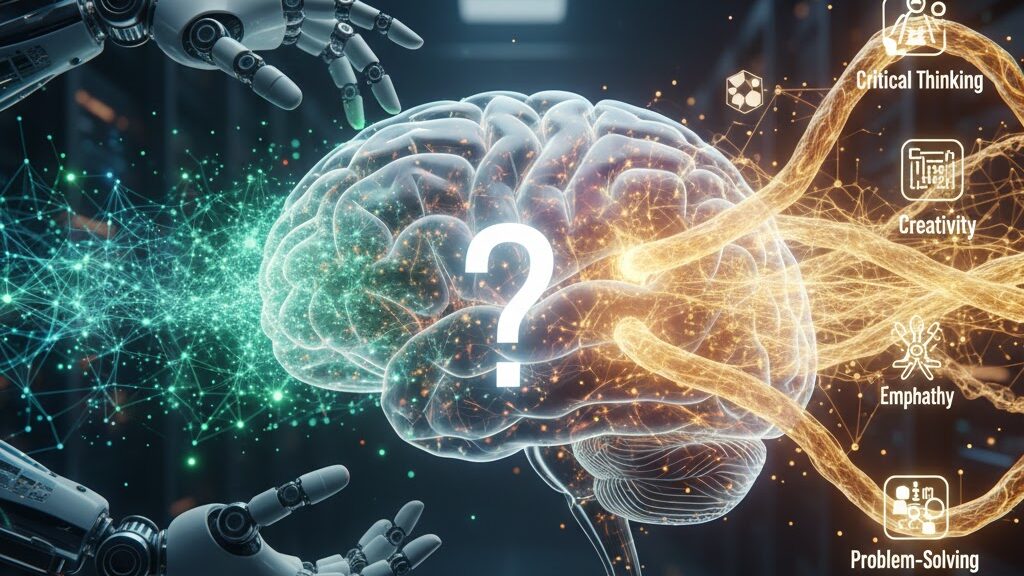
Strengthening the mind: Highlighting the crucial need and methodology for intentionally restructuring and reinforcing human cognitive and critical thinking skills in an environment increasingly dominated by artificial intelligence. Image (and typos) generated by Nano Banana.
Thinking is a social activity. This isn’t a new insight (scholars have studied this for ages) but it’s one I keep coming back to lately as I try to stay afloat in the “AI Era.”
For a long stretch as I developed as an academic, I thought with others through technology (i.e. del.icio.us, Typepad, and Twitter.) We would bounce ideas off each other, glean golden nuggets of information, share resources that sparked new connections in our minds. There was something magical about that era, the serendipitous discovery of a colleague’s bookmark that led you down an unexpected intellectual rabbit hole, or a Twitter thread that challenged your thinking in ways you hadn’t anticipated. These weren’t just tools; they were extensions of our collective scholarly brain.
Then, all of that broke. (And I’m still. not. over it.)
When Our Digital Commons Began to Fracture
Koutropoulos et. al (2024) speak more eloquently to this fragmentation. They capture something I’ve been feeling but fail to articulate as clearly, the way our digital spaces have become increasingly unstable, the way platforms that once felt like home can shift beneath our feet overnight. Their collaborative autoethnography explores the metaphors we use to describe this movement and ultimately concludes that no single term captures what’s happening. What resonates most is their observation that we were never truly in control of these spaces, we were building communities on “the fickle and shifting sands of capitalism.”
Commercial generative AI feels social. You’re chatting, prompting, getting responses that (by design) seem thoughtful and engaged. But fundamentally, it is not social. You’re talking with biased algorithms. There is no human in the loop, no colleague who might push back on your thinking from their own lived experience, no peer who might share a resource you’d never have found on your own, no friend who might simply say “I’ve been thinking about this too.”
I haven’t seen genuine sharing built into any commercial generative AI tools. NotebookLM will let you share content that others can interact with, other tools allow you to create bots – but again, you’re not linking with a human. You’re not building a web of ambient findability (Morville, 2005) that made those early social media days so generative. There’s no AI equivalent of stumbling upon a colleague’s carefully curated collection and thinking, “Oh, they’re interested in this too – I should reach out.”
So in this fragmented, overly connected yet profoundly disconnected world, how do we stay connected to each other and each other’s ideas? I need my thought network now more than ever. And I suspect you do too.
Choosing Human Connection in an Algorithmic Age
Here are a few tools that have helped me navigate this landscape:
Raindrop.io – it’s not as social as del.icio.us was (oh, how I miss those days!), but it is a bookmark management tool that helps me keep track of the deluge of AI articles (and all sorts of other things) coming my way. I’ve made my collection public because (surprise!) I believe in working out loud and sharing what I’m learning. You can find it here: https://raindrop.io/leigh-wolf/ai-62057797.
RSS is Awesome is an “in-progress passion project” by Tom Hazledine. It has now become my morning ritual to open up this lovely, lightweight, no-login-needed, browser-based tool to catch up on my feeds. There’s something deeply satisfying about returning to RSS – a technology that puts the reader in control rather than an algorithm. (And yes, you can add the GenAI:N3 Blog to your feed simply by adding this URL: https://genain3.ie/blog/)
We need each other more than ever to navigate this sea of (mis)information. The platforms are fragmenting, the algorithms are optimising for engagement rather than insight, and AI offers the feeling of conversation without its substance – but we still have each other. We still have the ability to share, to curate, to point each other toward ideas worth wrestling with.
As Koutropoulos et al. (2024) challenge us, the solution isn’t to find the perfect platform – it’s to “take charge of our own data” and to invest in relationships with the humans in our educational networks. The platforms will always ebb and flow. But the connections we build with each other can (and do!) persist across whatever digital landscape emerges next.
Hold on to each other. Hold on to the tools that are enabling rather than disabling us to do this work together. And maybe, just maybe, start (re)building those thought networks – one shared bookmark, one RSS subscription, one genuine human connection at a time.
What tools are helping you stay connected to others’ thinking? What spaces have you found that still feel like home? I would love to know – please reach out in the comments below!!
Reference
Koutropoulos, A., Stewart, B., Singh, L., Sinfield, S., Burns, T., Abegglen, S., Hamon, K., Honeychurch, S., & Bozkurt, A. (2024). Lines of flight: The digital fragmenting of educational networks. Journal of Interactive Media in Education, 2024(1), 11.https://doi.org/10.5334/jime.850
Morville, P. (2005). Ambient findability: What we find changes who we become. O’Reilly.
Leigh Graves Wolf
Assistant Professor University College Dublin
Leigh Graves Wolf is teacher-scholar and an Assistant Professor in Educational Development with Teaching and Learning at UCD. Her work focuses on online education, critical digital pedagogy, educator professional development and relationships mediated by and with technology. She has worked across the educational spectrum from primary to higher to further and lifelong. She believes passionately in collaboration and community.