Guidance on Artificial Intelligence in Schools


Source

Department of Education and Youth & Oide Technology in Education, October 2025

Summary

This national guidance document provides Irish schools with a framework for the safe, ethical, and effective use of artificial intelligence (AI), particularly generative AI (GenAI), in teaching, learning, and school leadership. It aims to support informed decision-making, enhance digital competence, and align AI use with Ireland’s Digital Strategy for Schools to 2027. The guidance recognises AI’s potential to support learning design, assessment, and communication while emphasising human oversight, teacher professionalism, and data protection.

It presents a balanced view of benefits and risks—AI can personalise learning and streamline administration but also raises issues of bias, misinformation, data privacy, and environmental impact. The report introduces a 4P framework—Purpose, Planning, Policies, and Practice—to guide schools in integrating AI responsibly. Teachers are encouraged to use GenAI as a creative aid, not a substitute, and to embed AI literacy in curricula. The document stresses the need for ethical awareness, alignment with GDPR and the EU AI Act (2024), and continuous policy updates as technology evolves.

Key Points

  • AI should support, not replace, human-led teaching and learning.
  • Responsible use requires human oversight, verification, and ethical reflection.
  • AI literacy for teachers, students, and leaders is central to safe adoption.
  • Compliance with GDPR and the EU AI Act ensures privacy and transparency.
  • GenAI tools must be age-appropriate and used within consent frameworks.
  • Bias, misinformation, and “hallucinations” demand critical human review.
  • The 4P Approach (Purpose, Planning, Policies, Practice) structures school-level implementation.
  • Environmental and wellbeing impacts must be considered in AI use.
  • Collaboration between the Department, Oide, and schools underpins future updates.
  • Guidance will be continuously revised to reflect evolving practice and research.

Conclusion

The guidance frames AI as a powerful but high-responsibility tool in education. By centring ethics, human agency, and data protection, schools can harness AI’s potential while safeguarding learners’ wellbeing, trust, and equity. Its iterative, values-led approach ensures Ireland’s education system remains adaptive, inclusive, and future-ready.

Keywords

URL

https://assets.gov.ie/static/documents/dee23cad/Guidance_on_Artificial_Intelligence_in_Schools_25.pdf

Summary generated by ChatGPT 5


How Education Can Transform Disruptive AI Advances into Workforce Opportunities


A vibrant and futuristic scene set within a modern, glass-roofed architectural complex that resembles a university campus or innovative workspace. In the foreground, a diverse group of students or young professionals are seated around a large table, interacting with glowing holographic interfaces projected onto the tabletop, showing data and digital connections. In the background, many people are walking, and a humanoid robot is visible. Dominating the scene is a massive, glowing blue upward-trending arrow, composed of interconnected digital lines and data points, symbolizing growth and opportunity. Image (and typos) generated by Nano Banana.
As AI continues to disrupt industries, education holds the key to transforming these advancements into unprecedented workforce opportunities. This image visualizes how strategic educational initiatives can bridge the gap between AI innovation and career readiness, equipping individuals to thrive in an evolving job market. Image (and typos) generated by Nano Banana.

Source

World Economic Forum

Summary

Mallik Tatipamula and Azad Madni argue that education systems must evolve rapidly to prepare workers for the AI-native, autonomous, and ethically aligned economy of the future. While AI is expected to displace 92 million jobs globally, it will also create 170 million new roles requiring AI literacy, ethical judgment, and transdisciplinary thinking. The authors call for a “transdisciplinary systems mindset” in education—integrating physical sciences, life sciences, computation, and engineering—to equip graduates with creative, contextual, and ethical reasoning skills that AI cannot replicate. Future success will depend less on narrow technical expertise and more on the ability to collaborate across disciplines, apply systems thinking, and use AI to augment human potential responsibly.

Key Points

  • AI will both displace and create millions of jobs, demanding rapid educational adaptation.
  • Education must prioritise AI literacy, ethics, and cognitive resilience alongside technical skills.
  • A “net-positive AI framework” should ensure technology benefits society and human cognition.
  • Transdisciplinary curricula combining science, engineering, and ethics are vital for future-ready workers.
  • Physical AI, data fluency, and human-AI collaboration will become core competencies.
  • Universities should promote challenge-driven learning and convergence hubs for innovation.

Keywords

URL

https://www.weforum.org/stories/2025/10/education-disruptive-ai-workforce-opportunities/

Summary generated by ChatGPT 5


Microsoft and OpenAI Invest Millions in AI Training for Teachers


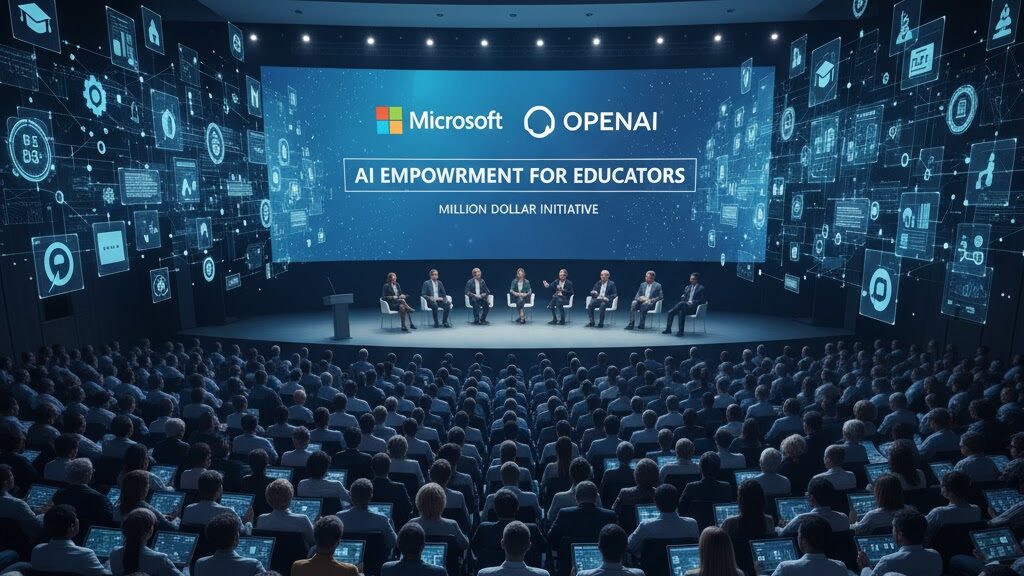
A vast, futuristic auditorium filled with hundreds of teachers, all seated and looking towards a large stage. Each teacher has a glowing tablet or laptop in front of them, displaying various digital interfaces and data. On the stage, a panel of six speakers is seated, addressing the audience. Behind them, a massive screen prominently displays the Microsoft and OpenAI logos side-by-side, with the text "AI EMPOWERMENT FOR EDUCATORS" and "MILLION DOLLAR INITIATIVE." The entire scene is bathed in a blue digital glow, and abstract data interfaces float around the screen and stage, emphasizing the technological theme. Image (and typos) generated by Nano Banana.
In a landmark initiative, tech giants Microsoft and OpenAI are investing millions to provide comprehensive AI training for teachers. This program aims to equip educators with the skills and knowledge needed to integrate artificial intelligence effectively into classrooms, preparing the next generation for an AI-driven world. Image (and typos) generated by Nano Banana.

Source

Associated Press

Summary

Microsoft, OpenAI, and Anthropic are investing millions to fund large-scale AI training for U.S. teachers through partnerships with the American Federation of Teachers (AFT) and the National Education Association (NEA). The initiative aims to equip educators with practical AI skills and ethical awareness to integrate technology effectively into classrooms. Microsoft has pledged $12.5 million over five years, while OpenAI is contributing $10 million in funding and technical support. The AFT will build an AI training hub in New York City and plans to train 400,000 teachers within five years. While the partnerships promise to expand AI literacy rapidly, experts and union leaders caution that schools must retain control over programme design and ensure training aligns with educational—not corporate—priorities.

Key Points

  • Microsoft, OpenAI, and Anthropic are funding nationwide AI training for teachers.
  • The AFT will launch an AI training hub in New York City with plans for additional centres.
  • The initiative seeks to train 400,000 teachers over five years.
  • The NEA is developing AI “microcredential” courses for its 3 million members.
  • Unions insist that educators, not tech companies, will design and lead the programmes.
  • Experts warn against corporate influence and stress maintaining educational integrity.

Keywords

URL

https://apnews.com/article/artificial-intelligence-teacher-union-microsoft-f7554b6550fb90519dd8129acac8e291

Summary generated by ChatGPT 5


AI Won’t Replace Teachers—but Teachers Who Use AI Will Change Teaching


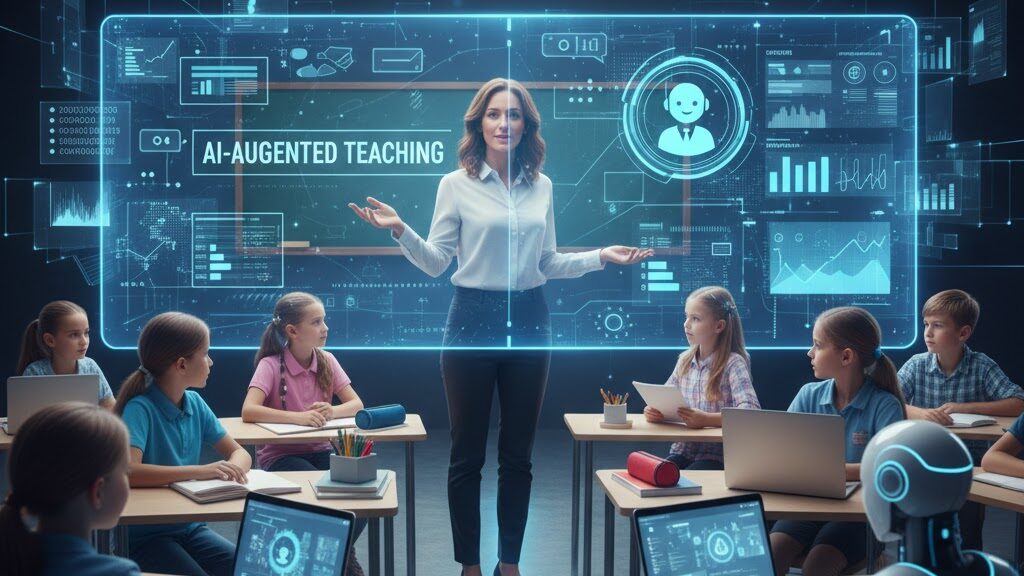
A female teacher stands confidently at the front of a modern classroom, gesturing towards a large, glowing holographic screen behind her that displays "AI-AUGMENTED TEACHING" along with various educational data, student profiles, and analytical charts. Rows of elementary school students are seated at desks, each engaged with a laptop. In the foreground to the right, a sleek, white humanoid robot is also seated at a desk, looking towards the teacher, symbolizing AI as a supportive tool rather than a replacement. The classroom is neat and well-lit. Image (and typos) generated by Nano Banana.
While the fear of AI replacing educators is prevalent, the reality is more nuanced: AI is set to empower teachers. This image illustrates how educators who embrace and integrate AI tools will fundamentally transform teaching methodologies, enhancing learning experiences rather than being superseded by technology. Image (and typos) generated by Nano Banana.

Source

Education Week

Summary

Ingrid Guerra-López argues that artificial intelligence will not replace teachers but will transform how they teach, provided educators engage with the technology thoughtfully and ethically. While AI can automate lesson planning, grading, and data organisation, Guerra-López emphasises that these efficiencies should enhance—not replace—teachers’ human judgment, empathy, and creativity. Drawing on research from RAND and the National Center for Education Statistics, she notes that teachers spend nearly ten hours a week on planning and administrative work—time AI could help recover for more meaningful teaching. However, without proper preparation and professional development, AI risks becoming another underused classroom innovation. Guerra-López calls for investment in AI literacy within teacher training and ongoing professional learning communities to ensure technology integration supports instructional quality and student engagement.

Key Points

  • AI can streamline routine teaching tasks, freeing time for deeper instructional work.
  • Educators remain essential for providing human connection, judgment, and mentorship.
  • Teacher-preparation programmes must include AI training and reflective practice.
  • Schools should create professional learning networks to support responsible AI use.
  • The goal is not to outsource thinking to AI but to use it as a scaffold for learning.
  • Failing to adapt risks both inefficiency and missed opportunities for innovation.

Keywords

URL

https://www.edweek.org/technology/opinion-ai-wont-replace-teachers-but-teachers-who-use-ai-will-change-teaching/2025/10

Summary generated by ChatGPT 5


AI and the Future of Universities


Source

Higher Education Policy Institute (HEPI), October 2025

Summary

This collection of essays explores how artificial intelligence—particularly generative AI (GenAI)—is reshaping the university sector across teaching, research, and administration. Contributors, including Dame Wendy Hall, Vinton Cerf, Rose Luckin, and others, argue that AI represents a profound structural shift rather than a passing technological wave. The report emphasises that universities must respond strategically, ethically, and holistically: developing AI literacy among staff and students, redesigning assessment, and embedding responsible innovation into governance and institutional strategy.

AI is portrayed as both a disruptive and creative force. It automates administrative processes, accelerates research, and transforms strategy-making, while simultaneously challenging ideas of authorship, assessment, and academic integrity. Luckin and others call for universities to foster uniquely human capacities—critical thinking, creativity, emotional intelligence, and metacognition—so that AI augments rather than replaces human intellect. Across the essays, there is strong consensus that AI literacy, ethical governance, and institutional agility are vital if universities are to remain credible and relevant in the AI era.

Key Points

  • AI literacy is now essential for all staff and students.
  • GenAI challenges traditional assessment and integrity systems.
  • Universities must act quickly but ethically in AI integration.
  • Professional services can achieve major efficiency gains through AI.
  • AI enables real-time strategy analysis and forecasting.
  • AI literacy must extend to leadership and governance structures.
  • Human intelligence—creativity, criticality, empathy—remains central.
  • Ethical frameworks and transparency are essential for trust.
  • Data maturity and infrastructure underpin successful adoption.
  • Collaboration across disciplines and sectors will shape sustainable change.

Conclusion

The report concludes that AI will redefine the university’s purpose, requiring institutions to shift from reactive adaptation to active leadership in shaping the AI future. The challenge is not simply to use AI but to ensure it strengthens human intelligence, academic integrity, and social purpose in higher education.

Keywords

URL

https://www.hepi.ac.uk/reports/right-here-right-now-new-report-on-how-ai-is-transforming-higher-education/

Summary generated by ChatGPT 5