Edufair 2025: Why outthinking AI is the next big skill for students


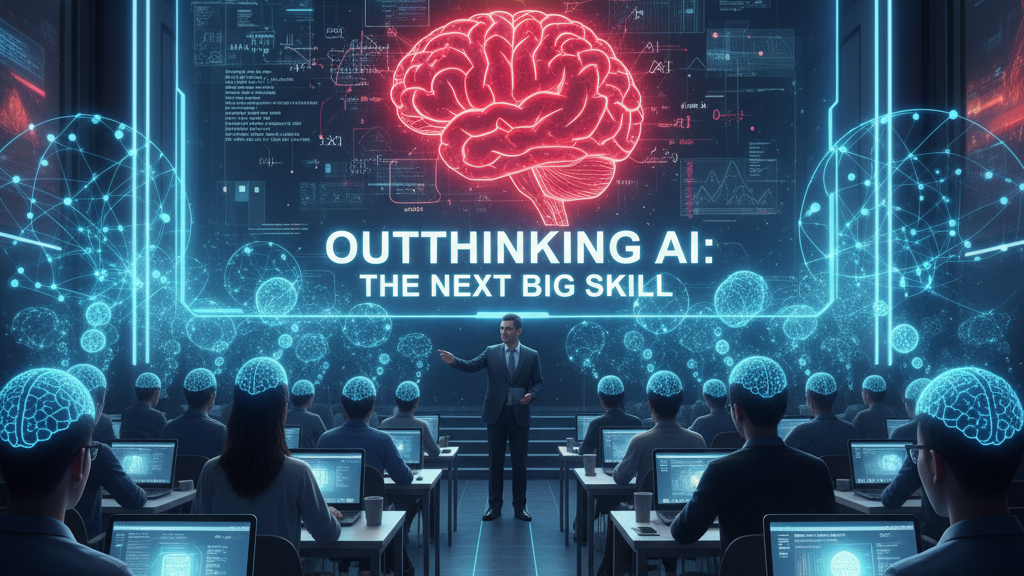
In a futuristic classroom or lecture hall, a male professor stands at the front, gesturing towards a large interactive screen. The screen prominently displays "OUTTHINKING AI: THE NEXT BIG SKILL," with a glowing red human brain at the center and icons illustrating the process of human thought surpassing AI. Students are seated in rows, all wearing glowing brain-shaped neural interfaces and working on laptops, deeply engaged in the lesson. Image (and typos) generated by Nano Banana.
In an era increasingly dominated by artificial intelligence, the capacity to “outthink AI” is emerging as the next indispensable skill for students. This image visualises an advanced educational setting focused on cultivating superior human cognitive abilities, emphasising critical thinking, creativity, and problem-solving that can go beyond the capabilities of current AI systems. Image (and typos) generated by Nano Banana.

Source

Gulf News

Summary

At Gulf News Edufair 2025, education leaders argued that as AI becomes better at recalling facts, the real skill universities must teach is how to outthink AI. That means equipping students with judgment to critique AI outputs, detect bias or hallucinations, and interrogate machine-generated suggestions. Panelists emphasised embedding reflective routines, scaffolded assessment, and toolkits (e.g. 3-2-1 reflection, peer review) so students must pause, question, and add human insight. The shift demands rethinking course design, teaching methods, and assessment strategies to emphasise reasoning over regurgitation.

Key Points

  • AI can reliably recall facts; the human task is to question, judge, and contextualise these outputs.
  • Reflection must be built into learner routines (journals, peer reviews, short prompts) to avoid blind acceptance.
  • Toolkits should reshape how content is structured and assessed to push students beyond surface use.
  • AI literacy is not optional: students must grasp bias, hallucination, model mechanisms, and interpret AI output.
  • Interdisciplinary exposure, structured critical prompts, and scaffolding across curricula help broaden perspective.

Keywords

URL

https://gulfnews.com/uae/edufair-2025-why-outthinking-ai-is-the-next-big-skill-for-students-1.500294455

Summary generated by ChatGPT 5


AI as the Next Literacy


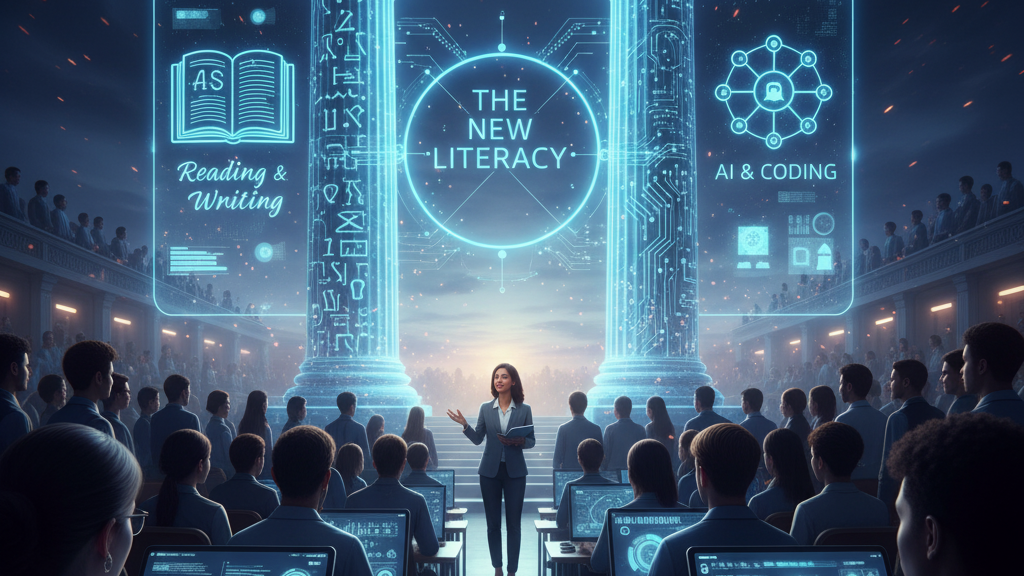
In a grand, columned lecture hall filled with students working on glowing laptops, a female professor stands at the front, gesturing towards a massive holographic screen. The screen is framed by two digital-circuitry columns and displays "THE NEW LITERACY" at its center. To the left, "Reading & Writing" is shown with traditional book icons, while to the right, "AI & CODING" is represented with connected nodes and circuits, symbolizing the evolution of foundational skills. Image (and typos) generated by Nano Banana.
Just as reading and writing have long been fundamental literacies, proficiency in Artificial Intelligence is rapidly emerging as the next essential skill. This image envisions a future where understanding AI, its principles, and its applications becomes a cornerstone of education, preparing individuals to navigate and thrive in an increasingly technologically advanced world. Image (and typos) generated by Nano Banana.

Source

Psychology Today

Summary

The article argues that as AI becomes pervasive, society is developing a new kind of literacy—not just how to read and write, but how to prompt, evaluate, and iterate with AI systems. AI extends our reach like a tool or “racket” in sport, but it can’t replace foundational skills like perception, language, and meaning making. The author warns that skipping fundamentals (critical thinking, writing, reasoning) risks hollowing out our capacities. In practice, education should blend traditional learning (drafting essays, debugging code) with AI-assisted revision and engagement, treating AI as augmentation, not replacement.

Key Points

  • AI literacy involves encoding intent → prompt design, interpreting output, iteration.
  • Just as literacy layered on speaking/listening, AI layers on existing cognitive skills.
  • Overreliance on AI without grounding in fundamentals weakens human capabilities.
  • Classrooms might require initial manual drafts or debugging before AI enhancement.
  • The challenge: integrate AI into scaffolding so it amplifies thinking rather than replacing it.

Keywords

URL

https://www.psychologytoday.com/us/blog/the-emergence-of-skill/202510/ai-as-the-next-literacy

Summary generated by ChatGPT 5


Harvard Business School Uses AI to Evaluate Students’ Work, Dean Says


In a sophisticated university lecture hall, reminiscent of Harvard, a female speaker stands at a podium, gesturing towards a large interactive screen. The screen prominently displays "AI EVALUATION SYSTEM" along with various complex charts, graphs, and data points, indicating detailed assessment metrics. An audience of students in business attire are seated at tiered desks, working on laptops. Image (and typos) generated by Nano Banana.
Harvard Business School is at the forefront of integrating artificial intelligence into academic assessments, with its Dean confirming the use of AI to evaluate students’ work. This image illustrates a high-tech academic environment where advanced AI evaluation systems are being employed, signifying a significant shift in how student performance is analyzed and graded in prestigious institutions. Image (and typos) generated by Nano Banana.

Source

The Harvard Crimson

Summary

Dean Srikant M. Datar revealed that Harvard Business School (HBS) is actively using AI tools to evaluate student assignments and provide rapid feedback, such as on spreadsheets. At Boston AI Week, he explained that HBS faculty are integrating AI into teaching and research, including through Foundry, a platform connecting entrepreneurs with HBS content. Administrators emphasised that AI supplements, not replaces, classroom learning—supporting tasks like condensing student feedback into actionable insights and offering 24/7 support. HBS leaders frame AI as part of an ongoing digital transformation, stressing the importance of adaptability and a “30 percent rule” for AI literacy.

Key Points

  • HBS uses AI to evaluate coursework and give students rapid feedback.
  • The Foundry platform leverages AI to connect entrepreneurs globally with HBS resources.
  • AI tools condense student feedback for faculty, improving teaching design.
  • Administrators stress AI complements, not replaces, the classroom experience.
  • HBS promotes the “30 percent rule”: basic literacy is enough to work with AI effectively.

Keywords

URL

https://www.thecrimson.com/article/2025/10/2/hbs-dean-ai-use/

Summary generated by ChatGPT 5


2025 Horizon Action Plan: Building Skills and Literacy for Teaching with GenAI


Source

Jenay Robert, EDUCAUSE (2025)

Summary

This collection of essays explores how artificial intelligence—particularly generative AI (GenAI)—is reshaping the university sector across teaching, research, and administration. Contributors, including Dame Wendy Hall, Vinton Cerf, Rose Luckin, and others, argue that AI represents a profound structural shift rather than a passing technological wave. The report emphasises that universities must respond strategically, ethically, and holistically: developing AI literacy among staff and students, redesigning assessment, and embedding responsible innovation into governance and institutional strategy.

AI is portrayed as both a disruptive and creative force. It automates administrative processes, accelerates research, and transforms strategy-making, while simultaneously challenging ideas of authorship, assessment, and academic integrity. Luckin and others call for universities to foster uniquely human capacities—critical thinking, creativity, emotional intelligence, and metacognition—so that AI augments rather than replaces human intellect. Across the essays, there is strong consensus that AI literacy, ethical governance, and institutional agility are vital if universities are to remain credible and relevant in the AI era.

Key Points

  • GenAI is reshaping all aspects of higher education teaching and learning.
  • AI literacy must be built into curricula, staff training, and institutional culture.
  • Faculty should use GenAI to enhance creativity and connection, not replace teaching.
  • Clear, flexible policies are needed for responsible and ethical AI use.
  • Institutions must prioritise equity, inclusion, and closing digital divides.
  • Ongoing professional development in AI is essential for staff and administrators.
  • Collaboration across institutions and with industry accelerates responsible adoption.
  • Assessment and pedagogy must evolve to reflect AI’s role in learning.
  • GenAI governance should balance innovation with accountability and transparency.
  • Shared toolkits and global practice networks can scale learning and implementation.

Conclusion

The Action Plan positions GenAI as both a challenge and a catalyst for renewal in higher education. Institutions that foster literacy, ethics, and innovation will not only adapt but thrive. Teaching with AI is framed as a collective, values-led enterprise—one that keeps human connection, creativity, and critical thinking at the centre of the learning experience.

Keywords

URL

https://library.educause.edu/resources/2025/9/2025-educause-horizon-action-plan-building-skills-and-literacy-for-teaching-with-genai

Summary generated by ChatGPT 5


How AI is reshaping education – from teachers to students


A split image depicting the impact of AI on education. On the left, a female teacher stands in front of a holographic 'AI POWERED INSTRUCTION' diagram, addressing a group of students. On the right, students are engaged with 'AI LEARNING PARTNER' interfaces, one wearing a VR headset. A central glowing orb with 'EDUCATION TRANSFORMED: AI' connects both sides, symbolizing the pervasive change AI brings to both teaching and learning. Generated by Nano Banana.
From empowering educators with intelligent instruction tools to providing students with personalised AI learning partners, artificial intelligence is fundamentally reshaping every facet of education. This image illustrates the transformative journey, highlighting how AI is creating new dynamics in classrooms and preparing both teachers and learners for a future redefined by technology. Image (and typos) generated by Nano Banana.

Source

TribLIVE

Summary

In this article, educators in a Pennsylvania school district discuss how AI is being woven into teaching practice and student learning—not by replacing teachers, but amplifying their capacity. AI tools like Magic School help teachers personalise lesson plans, adjust reading levels, reduce repetitive tasks, and monitor student use. A “traffic light” system is used to label assignments by allowed level of AI. New teachers are required to learn AI tools; students begin learning about AI ethically from early grades. The district emphasises that AI should not replace human work but free teachers to focus more on interpersonal and high-order thinking.

Key Points

  • Magic School is used to adapt assignments by subject, grade, and reading level, giving teachers flexibility.
  • Teachers are being trained and supported in AI adoption via workshops, pilot programs, and guided experiments.
  • A colour-coded “traffic light” system distinguishes when AI is allowed (green), allowed for some parts (yellow), or disallowed (red).
  • Starting in early grades, students are taught what AI is and how to use it ethically; higher grades incorporate more active use.
  • The goal: reduce workload on teachers for repetitive tasks so they can devote more energy to student interaction and complex thinking.

Keywords

URL

https://triblive.com/local/regional/heres-how-ai-is-reshaping-education-from-teachers-to-students/

Summary generated by ChatGPT 5