AI as the Next Literacy


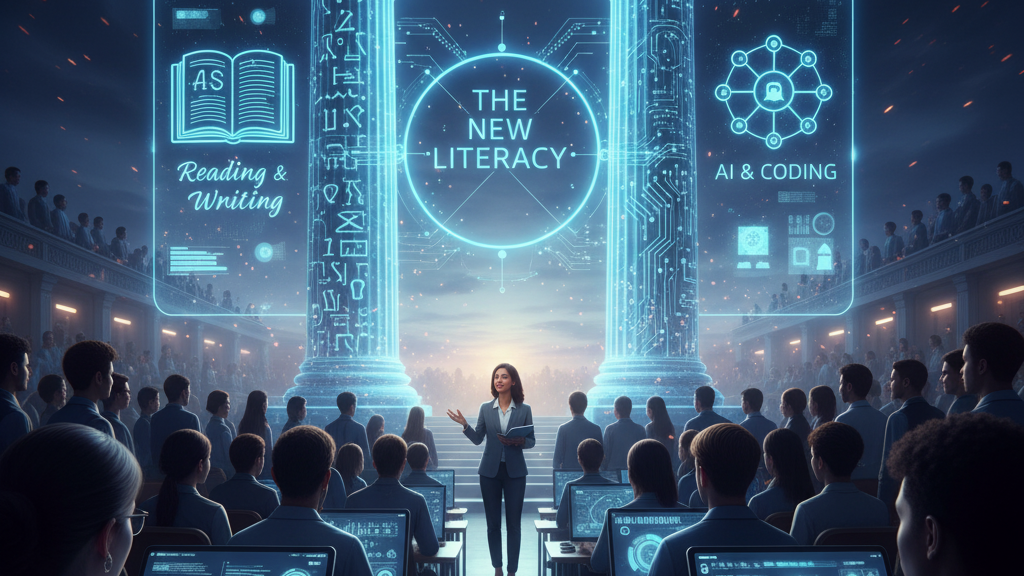
In a grand, columned lecture hall filled with students working on glowing laptops, a female professor stands at the front, gesturing towards a massive holographic screen. The screen is framed by two digital-circuitry columns and displays "THE NEW LITERACY" at its center. To the left, "Reading & Writing" is shown with traditional book icons, while to the right, "AI & CODING" is represented with connected nodes and circuits, symbolizing the evolution of foundational skills. Image (and typos) generated by Nano Banana.
Just as reading and writing have long been fundamental literacies, proficiency in Artificial Intelligence is rapidly emerging as the next essential skill. This image envisions a future where understanding AI, its principles, and its applications becomes a cornerstone of education, preparing individuals to navigate and thrive in an increasingly technologically advanced world. Image (and typos) generated by Nano Banana.

Source

Psychology Today

Summary

The article argues that as AI becomes pervasive, society is developing a new kind of literacy—not just how to read and write, but how to prompt, evaluate, and iterate with AI systems. AI extends our reach like a tool or “racket” in sport, but it can’t replace foundational skills like perception, language, and meaning making. The author warns that skipping fundamentals (critical thinking, writing, reasoning) risks hollowing out our capacities. In practice, education should blend traditional learning (drafting essays, debugging code) with AI-assisted revision and engagement, treating AI as augmentation, not replacement.

Key Points

  • AI literacy involves encoding intent → prompt design, interpreting output, iteration.
  • Just as literacy layered on speaking/listening, AI layers on existing cognitive skills.
  • Overreliance on AI without grounding in fundamentals weakens human capabilities.
  • Classrooms might require initial manual drafts or debugging before AI enhancement.
  • The challenge: integrate AI into scaffolding so it amplifies thinking rather than replacing it.

Keywords

URL

https://www.psychologytoday.com/us/blog/the-emergence-of-skill/202510/ai-as-the-next-literacy

Summary generated by ChatGPT 5


OpenAI Releases List of Work Tasks ChatGPT Can Already Replace


In a sleek, modern open-plan office, a group of professionals stands around a glowing holographic display that projects "OpenAI: ChatGPT's Replaceable Work Tasks." A list of tasks like "Drafting Emails," "Writing Basic Reports," and "Data Entry & Cleaning" is visible, with checkmarks or X's next to them, indicating tasks ChatGPT can handle. Some individuals are holding tablets, observing the display, while others are in the background. Image (and typos) generated by Nano Banana.
OpenAI has released a significant list detailing numerous work tasks that its advanced AI, ChatGPT, is already capable of performing or even replacing. This image illustrates professionals observing these capabilities, highlighting the transformative impact AI is having on the modern workforce and prompting discussions about job roles and efficiency. Image (and typos) generated by Nano Banana.

Source

Futurism

Summary

OpenAI published a new evaluation, GDPval, assessing how well its models perform “economically valuable” tasks across 44 occupations. The results suggest that current frontier models are approaching the quality of expert work in many domains. Examples include legal briefs, marketing analyses, technical documentation, medical image assessments, and sales brochures. While AI might not replace entire jobs, it can outperform humans in well-specified tasks. OpenAI emphasises that models currently handle repetitive, clearly defined tasks better than nuanced judgment work. GPT-5-High matched or surpassed expert deliverables in ~40% of evaluated cases. Critics warn of hallucinations, overconfidence, and the risk of overestimating AI’s real-world reach.

Key Points

  • GDPval tests 44 occupations on real-world tasks to benchmark AI against experts.
  • GPT-5-High achieved parity or better than expert work in ~40% of tasks.
  • Tasks include analytics, document drafting, medical imaging, and sales collateral.
  • AI models perform best on repetitive, narrow tasks; struggle on ambiguous, poorly defined ones.
  • OpenAI positions this not as job replacement but augmentation—yet raises deeper questions about labour, oversight, and trust.

Keywords

URL

https://futurism.com/future-society/openai-work-tasks-chatgpt-can-already-replace

Summary generated by ChatGPT 5