Latest Posts

Edufair 2025: Why outthinking AI is the next big skill for students


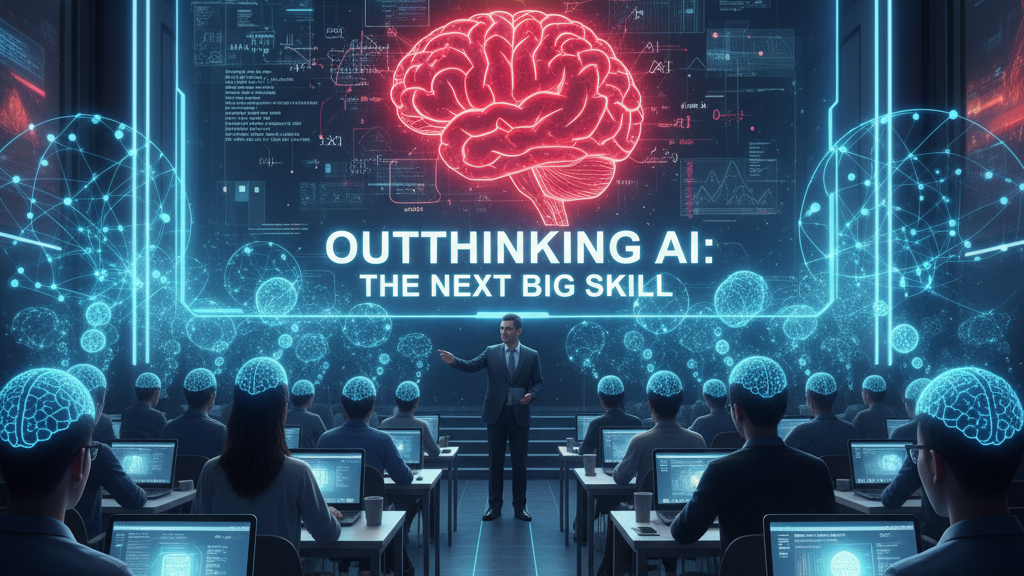
In a futuristic classroom or lecture hall, a male professor stands at the front, gesturing towards a large interactive screen. The screen prominently displays "OUTTHINKING AI: THE NEXT BIG SKILL," with a glowing red human brain at the center and icons illustrating the process of human thought surpassing AI. Students are seated in rows, all wearing glowing brain-shaped neural interfaces and working on laptops, deeply engaged in the lesson. Image (and typos) generated by Nano Banana.
In an era increasingly dominated by artificial intelligence, the capacity to “outthink AI” is emerging as the next indispensable skill for students. This image visualises an advanced educational setting focused on cultivating superior human cognitive abilities, emphasising critical thinking, creativity, and problem-solving that can go beyond the capabilities of current AI systems. Image (and typos) generated by Nano Banana.

Source

Gulf News

Summary

At Gulf News Edufair 2025, education leaders argued that as AI becomes better at recalling facts, the real skill universities must teach is how to outthink AI. That means equipping students with judgment to critique AI outputs, detect bias or hallucinations, and interrogate machine-generated suggestions. Panelists emphasised embedding reflective routines, scaffolded assessment, and toolkits (e.g. 3-2-1 reflection, peer review) so students must pause, question, and add human insight. The shift demands rethinking course design, teaching methods, and assessment strategies to emphasise reasoning over regurgitation.

Key Points

  • AI can reliably recall facts; the human task is to question, judge, and contextualise these outputs.
  • Reflection must be built into learner routines (journals, peer reviews, short prompts) to avoid blind acceptance.
  • Toolkits should reshape how content is structured and assessed to push students beyond surface use.
  • AI literacy is not optional: students must grasp bias, hallucination, model mechanisms, and interpret AI output.
  • Interdisciplinary exposure, structured critical prompts, and scaffolding across curricula help broaden perspective.

Keywords

URL

https://gulfnews.com/uae/edufair-2025-why-outthinking-ai-is-the-next-big-skill-for-students-1.500294455

Summary generated by ChatGPT 5


Meet the AI Professor: Coming to a Higher Education Campus Near You


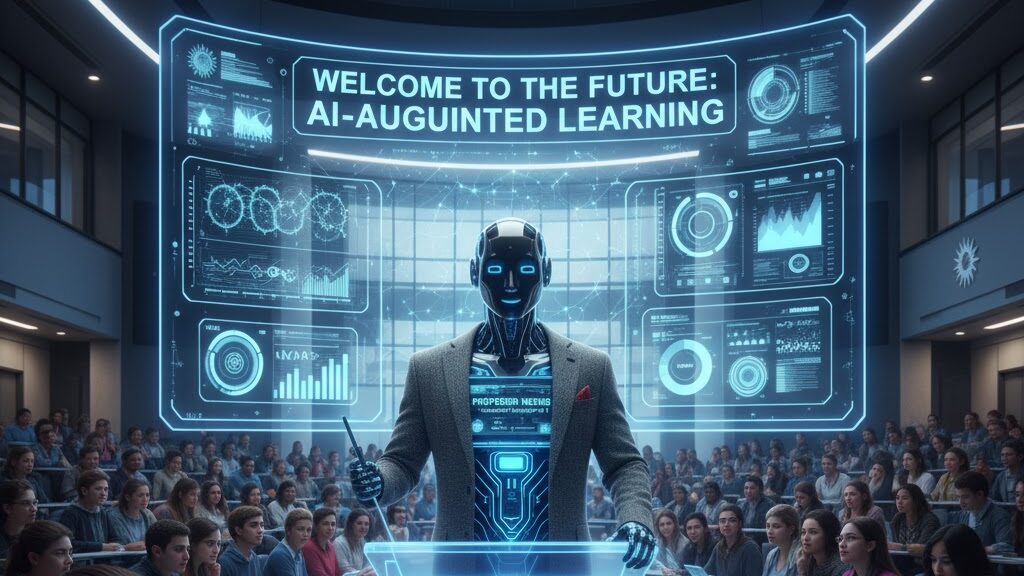
In a vast, modern university lecture hall filled with students working on holographic tablets, a sleek, humanoid AI figure in a business suit stands at the front, glowing blue and labeled "PROFESSOR NEXUS." Behind it, a massive interactive screen displays "WELCOME TO THE FUTURE: AI-AUGMENTED LEARNING," surrounded by various data, graphs, and educational interfaces, symbolizing AI's presence in higher education. Image (and typos) generated by Nano Banana.
The future of higher education is rapidly evolving, with the concept of an “AI Professor” soon becoming a reality on campuses worldwide. This image envisions an advanced lecture hall where an AI humanoid, serving as the instructor, delivers an engaging lesson on “AI-Augmented Learning,” highlighting the imminent shift towards a new era of technologically enhanced education. Image (and typos) generated by Nano Banana.

Source

Forbes

Summary

Nick Ladany explores how the rise of “AI professors” could transform higher education, blending machine precision with human mentorship. AI professors, envisioned as advanced avatars, could deliver 24/7 personalised instruction, adapt to diverse learning styles, and stay up-to-date with current knowledge. Human professors, meanwhile, would focus on relational, interdisciplinary, and ethical aspects of learning. Ladany suggests a “centaur model,” where human and AI educators collaborate—AI managing scalable instruction while humans build community and critical thinking. He warns that universities slow to adapt risk obsolescence, while those embracing this hybrid model may redefine teaching and student success.

Key Points

  • AI professors could deliver continuous, personalised, evidence-based education.
  • Human professors would shift toward mentoring, community-building, and ethical guidance.
  • The “centaur model” integrates human and AI teaching strengths.
  • Teaching roles would require new training, evaluation, and year-round engagement.
  • Universities that resist this shift risk falling behind institutional innovators.

Keywords

URL

https://www.forbes.com/sites/nicholasladany/2025/10/03/meet-the-ai-professor-coming-to-a-higher-education-campus-near-you/

Summary generated by ChatGPT 5


AI technology ‘replacing critical thinking in university lectures’ – student


In a grand, Gothic-style university lecture hall, rows of students are seated, all intently focused on glowing laptops. At the front, a large, cold blue holographic display titled "AI LECTURE AUTOMATION SYSTEM" prominently states: "Critical Thinking: Replaced. Information: Delivered." A small whiteboard in the background sarcastically asks, "AI IS 'HERE,' WHERE'S THE PROF?!" Image (and typos) generated by Nano Banana.
According to a student’s observation, AI technology is alarmingly “replacing critical thinking in university lectures,” transforming the learning environment into one focused solely on information delivery. This dystopian image visualizes a future where traditional human instruction is minimized, and AI automates the lecture process, raising serious questions about the impact on students’ cognitive development and the very essence of higher education. Image (and typos) generated by Nano Banana.

Source

Waikato Times

Summary

A University of Waikato student has voiced concern that widespread use of AI in lectures is eroding students’ ability to think critically. Speaking anonymously, the fourth-year student said many peers now use ChatGPT to generate lecture notes, discussion questions, and ideas—essentially outsourcing thinking itself. While she acknowledged that AI has benefits when used judiciously, she worries it encourages intellectual passivity and dependence. The student warned that such habits could eventually harm employability, as employers increasingly seek graduates with strong analytical and critical-thinking skills.

Key Points

  • Students are using ChatGPT to generate lecture notes and workshop discussion prompts.
  • The student fears this practice undermines the purpose of higher education—to cultivate independent thinking.
  • She admits AI has value when used responsibly but sees overreliance as damaging to learning.
  • The trend risks producing graduates who lack the analytical abilities employers prize most.
  • The concern reflects wider tensions in universities over balancing AI’s benefits and harms.

Keywords

URL

https://www.waikatotimes.co.nz/nz-news/360843243/ai-technology-replacing-critical-thinking-university-lectures-student

Summary generated by ChatGPT 5


The fear: Wholesale cheating with AI. The reality: It’s complicated.


A split image contrasting two scenarios related to AI in education. On the left, titled "THE FEAR: WHOLESALE CHEATING," a demonic AI figure with red eyes looms over a dark library filled with students on laptops, many displaying "AI GENERATED ESSAY - 100%" and "PLAGIARISM DETECTED" warnings, symbolizing widespread academic dishonesty. On the right, titled "THE REALITY: IT'S COMPLICATED," a bright classroom shows teachers and students collaboratively discussing a whiteboard diagram that explores the nuances of AI use, distinguishing between "Cheating," "AI-Assisted Research," "Writing Prompt," and "Critical Thought." Image (and typos) generated by Nano Banana.
While the initial fear surrounding AI in academia was wholesale cheating, the reality of its integration is far more intricate. This image visually contrasts the dire prediction of pervasive dishonesty with the nuanced reality, where discerning legitimate AI-assisted learning from actual cheating requires sophisticated frameworks, critical thinking, and innovative teaching methods. Image (and typos) generated by Nano Banana.

Source

Harvard Gazette

Summary

A large new working paper by David Deming and OpenAI economists finds that usage of ChatGPT for work and school is less dystopian than feared — more “wholesome and practical” — though with important caveats. Instead of fully outsourcing assignments, people tend to use AI as an assistant: to brainstorm, revise, or check ideas, not to replace thinking. The study also charts how adoption is closing gender and geographic gaps, and classifies message types (information requests, “practical guidance”, document editing). But the authors caution that while the patterns are not alarming, they don’t yet support dramatic claims of productivity leaps or wholesale job displacement.

Key Points

  • Rather than rampant cheating, the researchers observe AI being used as a partner rather than a substitute.
  • By mid-2025, ~10 % of global adults were users; adoption among women has caught up to men.
  • AI message types are diversifying: personal, informational, and work-related uses each comprise substantial shares.
  • Writing tasks (summarising, editing) have declined as share of use, replaced more by “practical guidance” and informational queries.
  • The findings suggest the narrative of AI as a rampant cheat tool is overblown — but it’s too soon to predict strong productivity gains.

Keywords

URL

https://news.harvard.edu/gazette/story/2025/10/the-fear-wholesale-cheating-with-ai-at-work-school-the-reality-its-complicated/

Summary generated by ChatGPT 5


Students Use This “AI Humaniser” To Make ChatGPT Essays Undetectable


In a modern university library, a focused female student is intently typing on her laptop. A glowing holographic interface displays "AI HUMANISER PRO," showing a side-by-side comparison of an "AI GENERATED ESSAY" and a "HUMANISED ESSAY." A prominent green message reads "UNDETECTABLE: 100% HUMAN SCORE," indicating the tool's effectiveness. Other students are visible working on their laptops in the background. Image (and typos) generated by Nano Banana.
The emergence of “AI Humaniser” tools marks a new frontier in the battle against AI detection, allowing students to make ChatGPT-generated essays virtually undetectable. This image illustrates a student utilizing such a sophisticated tool, highlighting the technological cat-and-mouse game between AI content creation and detection, and posing significant challenges for academic integrity. Image (and typos) generated by Nano Banana.

Source

Forbes

Summary

The article reveals a growing trend: students are using “AI humaniser” tools to mask signatures of ChatGPT-generated essays so they pass AI detectors. These humanisers tweak syntax, phrasing, rhythm and lexical choices to reduce detection risk. The practice raises serious concerns: it not only undermines efforts to preserve academic integrity, but also escalates the arms race between detection and evasion. Educators warn that when students outsource not only content but also disguise, distinguishing genuine work becomes even harder.

Key Points

  • AI humaniser apps are designed to rewrite AI output so it appears more human and evade detectors.
  • The tools adjust stylistic features—such as sentence variety, tone, and lexical choices—to reduce red flags.
  • Use of these tools amplifies the challenge for educators trying to detect AI misuse.
  • This escalates a detection-evasion arms race: detectors get better, humanisers evolve.
  • The phenomenon underlines the urgency of redesigning assessment and emphasising process, not just output.

Keywords

URL

https://www.forbes.com/sites/larsdaniel/2025/10/03/students-use-ai-humanizer-apps-to-make-chatgpt-essays-undetectable/

Summary generated by ChatGPT 5