AI-Generated Lesson Plans Fall Short on Inspiring Students and Promoting Critical Thinking


A bright, modern classroom with rows of diverse students seated at individual desks, diligently working on laptops and taking notes. Above them, a large, glowing holographic projection of a generic, flowchart-style "LESSON PLAN" floats. Stamped diagonally across this lesson plan in red, bold letters is a censor-like bar that reads "LACKS INSPIRATION, NO CRITICAL THINKING," indicating its shortcomings. On the right side of the image, one student's laptop and notebook are surrounded by vibrant, colorful holographic icons and data representing creativity and rich learning, contrasting with the generic lesson plan. Lightbulb icons, some dimly lit, are also visible. Image (and typos) generated by Nano Banana.
While AI offers efficiency in creating lesson plans, a new report suggests that these automated curricula often fall short in fostering student inspiration and promoting essential critical thinking skills. This visual highlights the gap between AI-generated structures and the nuanced needs of engaging pedagogy. Image (and typos) generated by Nano Banana.

Source

The Conversation

Summary

Torrey Trust reports that AI-generated lesson plans, though convenient, fail to promote higher-order thinking and inclusivity in the classroom. In a study analysing 311 AI-created civics lesson plans from ChatGPT, Gemini, and Copilot, 90 per cent of activities were found to encourage only basic recall and comprehension rather than critical or creative thinking. Using frameworks such as Bloom’s taxonomy and Banks’ multicultural integration model, the researchers found that only 6 per cent of plans included diverse perspectives or representation of marginalised groups. The study warns that while AI tools can save teachers time, they risk reproducing formulaic, one-size-fits-all instruction. Teachers are encouraged to use AI for inspiration—not automation—and to embed context, creativity, and cultural depth into their own designs.

Key Points

  • 311 AI-generated civics lesson plans were analysed using Bloom’s taxonomy and Banks’ model.
  • 90 per cent of activities promoted only lower-order thinking skills such as memorisation and recall.
  • Only 6 per cent included multicultural or diverse perspectives.
  • AI tools produce generic, context-free lesson plans not tailored to real classrooms.
  • Educators should use AI as a support tool, prompting it with detailed, critical instructions.

Keywords

URL

https://theconversation.com/ai-generated-lesson-plans-fall-short-on-inspiring-students-and-promoting-critical-thinking-265355

Summary generated by ChatGPT 5


‘Urgent Need’ for More AI Literacy in Higher Education, Report Says


An aerial, wide shot of a large, circular university lecture hall filled with many students seated at desks, all looking towards a prominent stage and screen at the front. A powerful spotlight shines onto the empty stage. Above the students and emanating from the screen, a dense network of glowing digital lines, icons, and data points fills the air, representing AI and digital information. Below the central spotlight, floating holographic icons labeled "AI KNOWLEDGE" and "DIGITAL SKILLS" are prominently displayed, emphasizing the core concepts. Image (and typos) generated by Nano Banana.
A recent report highlights the critical need for increased AI literacy across higher education institutions. As technology rapidly advances, universities face an urgent challenge to equip students with the essential knowledge and digital skills required for an AI-driven future. Image (and typos) generated by Nano Banana.

Source

Research Professional News

Summary

A new report from the Higher Education Policy Institute warns that British universities must urgently improve AI literacy among both staff and students to stay relevant and equitable in an era of rapid digital transformation. Co-authored by Professor Wendy Hall and Giles Carden of the University of Southampton, the report argues that universities can no longer afford to simply “acknowledge AI’s presence” and must adopt structured strategies for skills development, teaching innovation, and research support. It highlights growing digital divides across gender, income, and subject disciplines. Contributions include a chapter written by ChatGPT itself, advocating AI training within doctoral and staff development programmes, and cautioning against uneven capability across institutions. The report also predicts that AI adoption could lead to job reductions in professional services as universities seek financial efficiencies.

Key Points

  • The Higher Education Policy Institute calls for systemic AI literacy across the UK university sector.
  • Experts stress active engagement and structured upskilling, not passive awareness.
  • Digital divides linked to gender, wealth, and discipline risk deepening inequality.
  • ChatGPT’s own chapter recommends integrating AI training into research and doctoral curricula.
  • Financial pressures may drive automation and staff cuts in professional services.

Keywords

URL

https://www.researchprofessionalnews.com/rr-news-uk-universities-2025-10-urgent-need-for-more-ai-literacy-in-higher-education-report-says/

Summary generated by ChatGPT 5


AI in School Affects Pupils’ Ability to Create Original Work, Report Finds


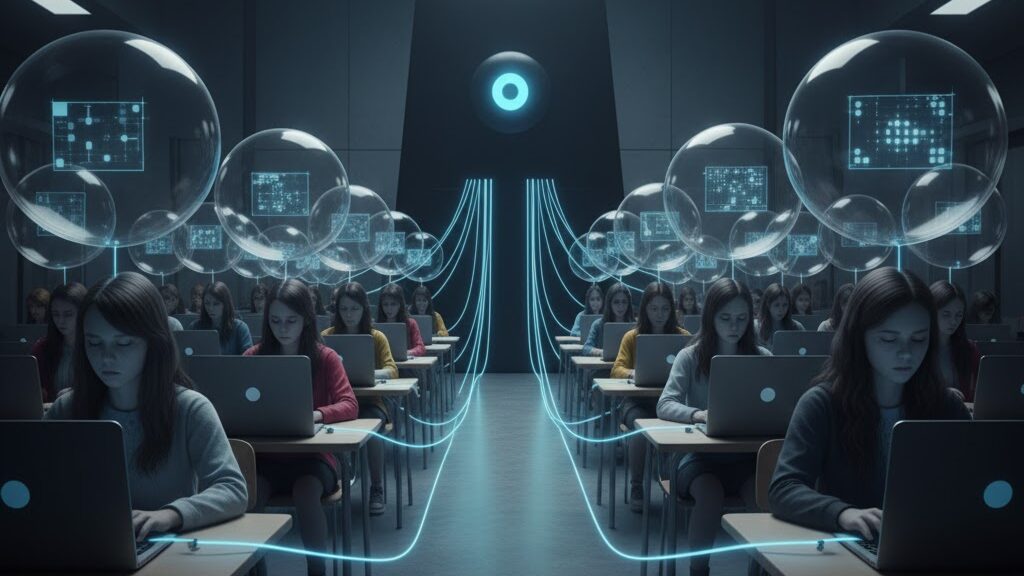
A dimly lit, futuristic classroom with rows of young students, predominantly girls, seated at individual desks, each intensely focused on an open laptop. Above each student's head, a clear, transparent bubble contains glowing digital circuitry and data, symbolizing ideas or creativity. These bubbles are connected by glowing blue lines that lead back to a large, imposing, glowing blue eye or orb on a dark monolith at the front of the classroom, suggesting a central AI influence. The students appear subdued and uniform. Image (and typos) generated by Nano Banana.
A concerning new report indicates that the increasing integration of AI in schools may be diminishing students’ capacity for original thought and creative work. This image visualizes the potential impact, raising questions about how technology might inadvertently hinder the development of essential human skills. Image (and typos) generated by Nano Banana.

Source

The Stage

Summary

A new Oxford University Press report warns that secondary school students in the UK fear artificial intelligence is limiting their creativity and originality. The study found that 80 per cent of pupils aged 13 to 18 use AI regularly for schoolwork, and while 90 per cent said it has helped them develop at least one skill, many expressed concern that it encourages imitation rather than innovation. Sixty per cent reported that AI makes them more likely to copy existing content, while 12 per cent said it hinders creative thinking and writing. Over half also feared AI tools reinforce biased or inaccurate stereotypes. The Writers’ Guild of Great Britain has called on schools and government to protect young people’s creative development and critical independence in the classroom.

Key Points

  • 80 per cent of pupils regularly use AI for schoolwork; only 2 per cent have never used it.
  • 60 per cent say AI encourages imitation and reduces originality.
  • 12 per cent believe AI negatively affects their creative thinking and writing.
  • 51 per cent worry AI tools reinforce bias and untrue stereotypes.
  • The Writers’ Guild urges policies to safeguard creativity and human-centred learning.

Keywords

URL

https://www.thestage.co.uk/news/ai-in-school-affects-pupils-ability-to-create-original-work-report

Summary generated by ChatGPT 5


AI Won’t Replace Teachers—but Teachers Who Use AI Will Change Teaching


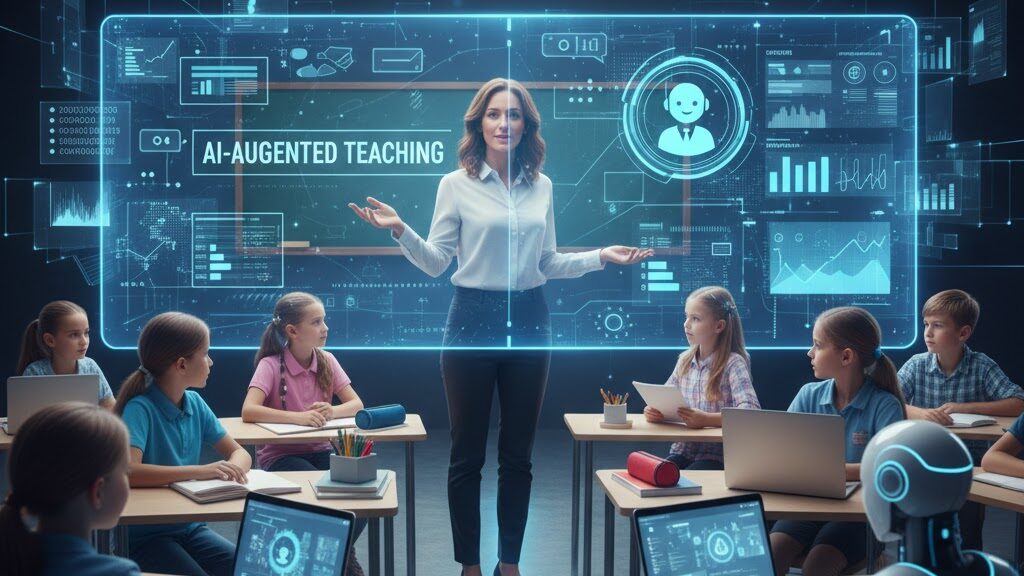
A female teacher stands confidently at the front of a modern classroom, gesturing towards a large, glowing holographic screen behind her that displays "AI-AUGMENTED TEACHING" along with various educational data, student profiles, and analytical charts. Rows of elementary school students are seated at desks, each engaged with a laptop. In the foreground to the right, a sleek, white humanoid robot is also seated at a desk, looking towards the teacher, symbolizing AI as a supportive tool rather than a replacement. The classroom is neat and well-lit. Image (and typos) generated by Nano Banana.
While the fear of AI replacing educators is prevalent, the reality is more nuanced: AI is set to empower teachers. This image illustrates how educators who embrace and integrate AI tools will fundamentally transform teaching methodologies, enhancing learning experiences rather than being superseded by technology. Image (and typos) generated by Nano Banana.

Source

Education Week

Summary

Ingrid Guerra-López argues that artificial intelligence will not replace teachers but will transform how they teach, provided educators engage with the technology thoughtfully and ethically. While AI can automate lesson planning, grading, and data organisation, Guerra-López emphasises that these efficiencies should enhance—not replace—teachers’ human judgment, empathy, and creativity. Drawing on research from RAND and the National Center for Education Statistics, she notes that teachers spend nearly ten hours a week on planning and administrative work—time AI could help recover for more meaningful teaching. However, without proper preparation and professional development, AI risks becoming another underused classroom innovation. Guerra-López calls for investment in AI literacy within teacher training and ongoing professional learning communities to ensure technology integration supports instructional quality and student engagement.

Key Points

  • AI can streamline routine teaching tasks, freeing time for deeper instructional work.
  • Educators remain essential for providing human connection, judgment, and mentorship.
  • Teacher-preparation programmes must include AI training and reflective practice.
  • Schools should create professional learning networks to support responsible AI use.
  • The goal is not to outsource thinking to AI but to use it as a scaffold for learning.
  • Failing to adapt risks both inefficiency and missed opportunities for innovation.

Keywords

URL

https://www.edweek.org/technology/opinion-ai-wont-replace-teachers-but-teachers-who-use-ai-will-change-teaching/2025/10

Summary generated by ChatGPT 5


Pupils Fear AI Is Eroding Their Ability to Study, Research Finds


Four serious-looking teenage students (two boys, two girls) are seated across from each other at a long table in a library setting, each with an open laptop in front of them. Glowing, ethereal representations of open books made of data and digital information hover above their laptops, subtly connecting them to the screens. Their expressions convey concern and perhaps a touch of apprehension as they look directly at the viewer. The background features bookshelves, typical of a library or study area. Image (and typos) generated by Nano Banana.
A new study reveals that students are increasingly concerned about how artificial intelligence might be undermining their foundational study and research abilities. Explore the findings that confirm pupils’ fears about AI’s impact on learning. Image (and typos) generated by Nano Banana.

Source

The Guardian

Summary

A study commissioned by Oxford University Press (OUP) reveals that students across the UK increasingly worry that artificial intelligence is weakening their study habits, creativity, and motivation to learn. The report, Teaching the AI Native Generation, found that 98 per cent of pupils aged 13 to 18 use AI for schoolwork, with 80 per cent relying on it regularly. Many described AI as making tasks “too easy” and limiting their independent thinking. While students recognise its usefulness, they also express concern about overreliance and skill erosion. The findings highlight the urgent need for balanced AI education strategies that promote critical thinking, ethical awareness, and human creativity alongside digital competence.

Key Points

  • 98 per cent of UK secondary pupils use AI for schoolwork, most on a regular basis.
  • Many pupils say AI tools make studying too easy and reduce creativity.
  • Concerns are growing about AI’s impact on independent learning and problem-solving.
  • The study urges educators to develop frameworks for responsible, balanced AI use.
  • OUP calls for schools to integrate AI literacy into teaching while safeguarding learning depth.

Keywords

URL

https://www.theguardian.com/technology/2025/oct/15/pupils-fear-ai-eroding-study-ability-research

Summary generated by ChatGPT 5