How Education Can Transform Disruptive AI Advances into Workforce Opportunities


A vibrant and futuristic scene set within a modern, glass-roofed architectural complex that resembles a university campus or innovative workspace. In the foreground, a diverse group of students or young professionals are seated around a large table, interacting with glowing holographic interfaces projected onto the tabletop, showing data and digital connections. In the background, many people are walking, and a humanoid robot is visible. Dominating the scene is a massive, glowing blue upward-trending arrow, composed of interconnected digital lines and data points, symbolizing growth and opportunity. Image (and typos) generated by Nano Banana.
As AI continues to disrupt industries, education holds the key to transforming these advancements into unprecedented workforce opportunities. This image visualizes how strategic educational initiatives can bridge the gap between AI innovation and career readiness, equipping individuals to thrive in an evolving job market. Image (and typos) generated by Nano Banana.

Source

World Economic Forum

Summary

Mallik Tatipamula and Azad Madni argue that education systems must evolve rapidly to prepare workers for the AI-native, autonomous, and ethically aligned economy of the future. While AI is expected to displace 92 million jobs globally, it will also create 170 million new roles requiring AI literacy, ethical judgment, and transdisciplinary thinking. The authors call for a “transdisciplinary systems mindset” in education—integrating physical sciences, life sciences, computation, and engineering—to equip graduates with creative, contextual, and ethical reasoning skills that AI cannot replicate. Future success will depend less on narrow technical expertise and more on the ability to collaborate across disciplines, apply systems thinking, and use AI to augment human potential responsibly.

Key Points

  • AI will both displace and create millions of jobs, demanding rapid educational adaptation.
  • Education must prioritise AI literacy, ethics, and cognitive resilience alongside technical skills.
  • A “net-positive AI framework” should ensure technology benefits society and human cognition.
  • Transdisciplinary curricula combining science, engineering, and ethics are vital for future-ready workers.
  • Physical AI, data fluency, and human-AI collaboration will become core competencies.
  • Universities should promote challenge-driven learning and convergence hubs for innovation.

Keywords

URL

https://www.weforum.org/stories/2025/10/education-disruptive-ai-workforce-opportunities/

Summary generated by ChatGPT 5


Educator Voice: Generative AI has no place in my classroom


A stern-faced female teacher stands in the middle of a traditional classroom, holding up a cardboard sign with "GENERATIVE AI" written on it and a large red 'X' through the words, signifying rejection. In the foreground, on a student desk, a laptop screen displays a similar "no AI" symbol. The blackboard behind her has phrases like "CRITICAL THINKING" and "HUMAN CONNECTION" written on it. The classroom is filled with empty wooden desks and chairs, globes, and bookshelves, suggesting a focus on traditional learning values. Image (and typos) generated by Nano Banana.
A growing number of educators are taking a firm stance against the integration of generative AI in their classrooms, citing concerns that it detracts from critical thinking and genuine human connection. This “Educator Voice” reflects a deliberate choice to prioritise fundamental learning principles over emerging technological tools. Image (and typos) generated by Nano Banana.

Source

PBS NewsHour Classroom

Summary

Teacher and writer David Cutler argues that generative AI, particularly ChatGPT-5, has become too powerful to coexist with authentic writing instruction. After testing the system, he found it could flawlessly imitate student voices and produce fully cited essays indistinguishable from genuine work. Cutler contends that AI now replaces—not supplements—the thinking process, undermining the slow, reflective work through which students develop reasoning and expression. To restore intellectual independence, he has banned take-home essays in favour of monitored, in-class writing and peer revision. He likens AI’s impact to calculators in maths, but warns that, unlike computation, writing cannot be meaningfully automated without losing thought itself.

Key Points

  • ChatGPT-5 can now mimic student writing styles with near-perfect accuracy, including voice and citation.
  • AI erodes the process that builds writing skill and patience; it replaces rather than supports thinking.
  • Cutler plans to require all substantial writing to occur in class under supervision.
  • He uses secure digital tools like Digiexam to monitor real-time writing processes.
  • The real danger is dependence: students may start trusting algorithms over their own judgement.

Keywords

URL

https://www.pbs.org/newshour/classroom/classroom-voices/educator-voices/2025/10/generative-ai-has-no-place-in-my-classroom

Summary generated by ChatGPT 5


Greece Launches “AI in Schools” Program to Bring ChatGPT Edu into Classrooms


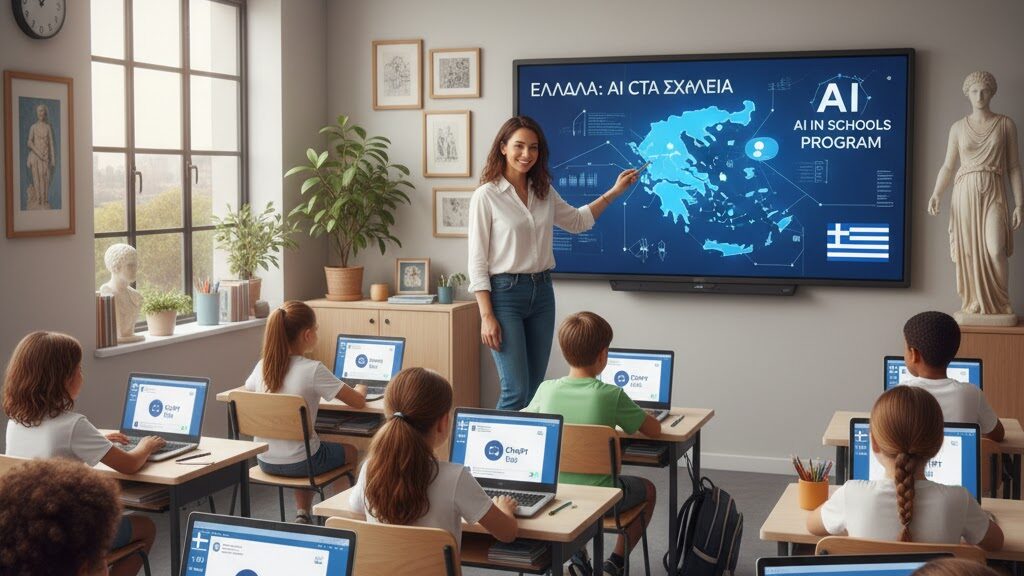
A bright and modern elementary school classroom where a female teacher stands in front of a large digital screen, pointing at a map of Greece with an "AI IN SCHOOLS PROGRAM" logo. The screen also displays the Greek flag and "ΕΛΛΑΔΑ: AI ΣΤΑ ΣΧΟΛΕΙΑ" (Greece: AI in Schools). Rows of young students are seated at individual desks, each actively engaged with a laptop displaying the "ChatGPT Edu" interface. The classroom has large windows, plants, and classical artwork, blending traditional and modern educational elements. Image (and typos) generated by Nano Banana.
Greece is making a significant leap into the future of education by launching its “AI in Schools” program, introducing ChatGPT Edu into classrooms nationwide. This initiative aims to equip students with cutting-edge AI tools, fostering innovation and preparing them for a technology-driven world. Image (and typos) generated by Nano Banana.

Source

Greek Reporter

Summary

Greece has announced a nationwide initiative, AI in Schools, making it one of the first European countries to formally integrate generative AI into public education. Beginning with a pilot in December 2025, the programme will introduce ChatGPT Edu—OpenAI’s education-focused platform—into 20 high schools. Led by The Tipping Point in Education and funded by the Onassis Foundation, the initiative aims to enhance AI literacy among teachers and students while maintaining ethical standards and data privacy. The rollout includes four phases: teacher training, pilot implementation, student participation, and full integration by 2027. The Ministry of Education has established strict GDPR-compliant data protocols, ensuring that AI supports creativity, collaboration, and critical thinking without replacing teachers’ central role in learning.

Key Points

  • Greece will pilot ChatGPT Edu in 20 high schools from December 2025.
  • The project is run by The Tipping Point in Education and funded by the Onassis Foundation.
  • A four-phase rollout prioritises teacher training, student engagement, and responsible AI use.
  • ChatGPT Edu offers secure, ad-free, GDPR-compliant tools for schools.
  • The initiative promotes AI literacy, ethical awareness, and digital innovation.
  • Teachers remain central to guiding creative and critical classroom use of AI.

Keywords

URL

https://greekreporter.com/2025/10/18/greece-ai-schools-program-chatgpt-edu-classrooms/

Summary generated by ChatGPT 5


From Textbook to a Second Teacher: How AI Has Changed Study


A split image illustrating the evolution of studying. The left side shows a young male student in a warmly lit, traditional setting, deeply engrossed in reading a physical textbook under a desk lamp, with other books around him. The right side shows the same student, but in a modern, blue-lit setting, smiling as he interacts with a laptop. A glowing, holographic AI tutor in the shape of a friendly, simplistic figure hovers above his laptop, surrounded by intricate data visualizations and educational content, symbolizing AI as a "second teacher." Image (and typos) generated by Nano Banana.
The landscape of learning is transforming dramatically. This image contrasts the traditional method of studying with textbooks against the modern approach, where AI has emerged as a dynamic “second teacher,” offering personalised guidance and insights that are fundamentally changing how students learn. Image (and typos) generated by Nano Banana.

Source

The Post (New Zealand)

Summary

Hanna McCallum reports on how artificial intelligence is reshaping study habits, teaching methods, and classroom culture in New Zealand schools. Students at Wellington East Girls’ College describe AI as a “second teacher” that provides on-demand academic support, while educators work to build digital literacy and responsible-use frameworks. Some students view AI as empowering—enhancing access to personalised study tools and creative learning—while others fear it undermines independent thinking and deep learning. Teachers and experts note growing divides between schools that embrace AI and those that resist it, with potential long-term effects on cognitive development. As one lecturer observes, AI can either accelerate learning or encourage intellectual shortcuts depending on how students use it.

Key Points

  • Students describe AI as a “second teacher” offering instant academic assistance.
  • Wellington East Girls’ College is developing an AI strategy focusing on staff training and digital literacy.
  • Some students report overreliance on AI, while others feel left behind without it.
  • Educators warn that unmanaged AI use may reduce critical thinking and motivation.
  • University experts note widening gaps between AI-literate students and those from AI-restricted schools.

Keywords

URL

https://www.thepost.co.nz/nz-news/360856298/textbook-second-teacher-how-ai-has-changed-study

Summary generated by ChatGPT 5


Microsoft and OpenAI Invest Millions in AI Training for Teachers


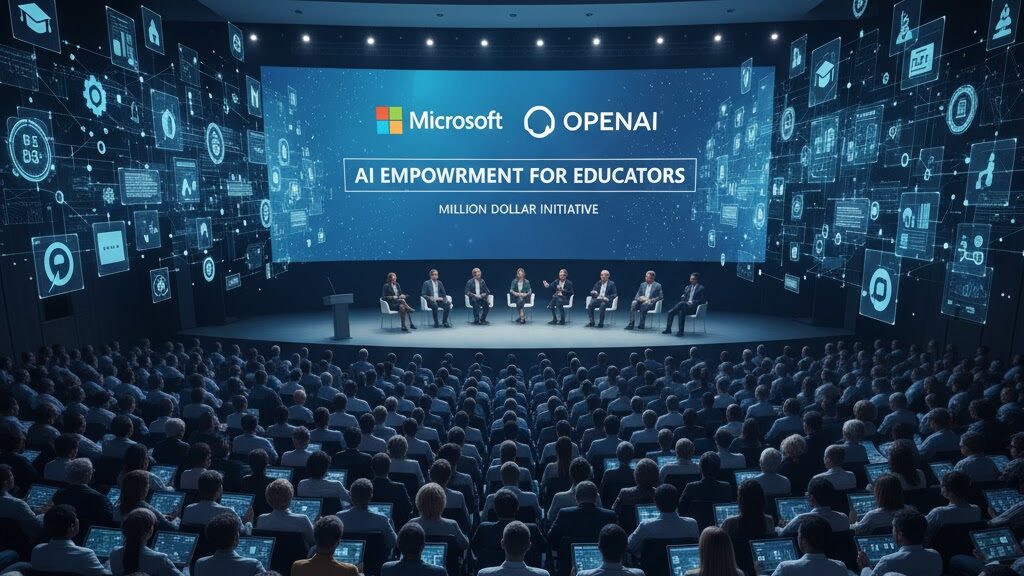
A vast, futuristic auditorium filled with hundreds of teachers, all seated and looking towards a large stage. Each teacher has a glowing tablet or laptop in front of them, displaying various digital interfaces and data. On the stage, a panel of six speakers is seated, addressing the audience. Behind them, a massive screen prominently displays the Microsoft and OpenAI logos side-by-side, with the text "AI EMPOWERMENT FOR EDUCATORS" and "MILLION DOLLAR INITIATIVE." The entire scene is bathed in a blue digital glow, and abstract data interfaces float around the screen and stage, emphasizing the technological theme. Image (and typos) generated by Nano Banana.
In a landmark initiative, tech giants Microsoft and OpenAI are investing millions to provide comprehensive AI training for teachers. This program aims to equip educators with the skills and knowledge needed to integrate artificial intelligence effectively into classrooms, preparing the next generation for an AI-driven world. Image (and typos) generated by Nano Banana.

Source

Associated Press

Summary

Microsoft, OpenAI, and Anthropic are investing millions to fund large-scale AI training for U.S. teachers through partnerships with the American Federation of Teachers (AFT) and the National Education Association (NEA). The initiative aims to equip educators with practical AI skills and ethical awareness to integrate technology effectively into classrooms. Microsoft has pledged $12.5 million over five years, while OpenAI is contributing $10 million in funding and technical support. The AFT will build an AI training hub in New York City and plans to train 400,000 teachers within five years. While the partnerships promise to expand AI literacy rapidly, experts and union leaders caution that schools must retain control over programme design and ensure training aligns with educational—not corporate—priorities.

Key Points

  • Microsoft, OpenAI, and Anthropic are funding nationwide AI training for teachers.
  • The AFT will launch an AI training hub in New York City with plans for additional centres.
  • The initiative seeks to train 400,000 teachers over five years.
  • The NEA is developing AI “microcredential” courses for its 3 million members.
  • Unions insist that educators, not tech companies, will design and lead the programmes.
  • Experts warn against corporate influence and stress maintaining educational integrity.

Keywords

URL

https://apnews.com/article/artificial-intelligence-teacher-union-microsoft-f7554b6550fb90519dd8129acac8e291

Summary generated by ChatGPT 5