Teachers Worry AI Will Impede Students’ Critical Thinking Skills. Many Teens Aren’t So Sure


A split image contrasting teachers' concerns about AI with teenagers' perspectives. On the left, a worried female teacher stands in a traditional classroom, gesturing with open hands towards a laptop on a desk. A glowing red 'X' mark covers the words "CRITICAL THINKING" and gears/data on the laptop screen, symbolizing the perceived threat to cognitive skills. On the right, three engaged teenagers (two boys, one girl) are working collaboratively on laptops in a bright, modern setting. Glowing keywords like "PROBLEM-SOLVING," "INNOVATION," and "CREATIVITY" emanate from their screens, representing AI's perceived benefits. A large question mark is placed in the middle top of the image. Image (and typos) generated by Nano Banana.
A clear divide emerges in the debate over AI’s impact on critical thinking: while many teachers express concern that AI will hinder students’ cognitive development, a significant number of teenagers remain unconvinced, often viewing AI as a tool that can enhance their problem-solving abilities. This image visualises the contrasting viewpoints on this crucial educational challenge. Image (and typos) generated by Nano Banana.

Source

Education Week

Summary

Alyson Klein reports on the growing divide between teachers and students over how artificial intelligence is affecting critical thinking. While educators fear that AI tools like ChatGPT are eroding students’ ability to reason independently, many teens argue that AI can actually enhance their thinking when used responsibly. Teachers cite declining originality and over-reliance on AI-generated answers, expressing concern that students are losing confidence in forming their own arguments. Students, however, describe AI as a useful study companion—helping clarify concepts, model strong writing, and guide brainstorming. Experts suggest that the key issue is not whether AI harms or helps, but how schools teach students to engage with it critically. Educators who integrate AI into lessons rather than banning it outright are finding that students can strengthen, rather than surrender, their analytical skills.

Key Points

  • Teachers fear AI use is diminishing critical thinking and originality in student work.
  • Many students view AI as a learning aid that supports understanding and creativity.
  • The divide reflects differing expectations around what “thinking critically” means.
  • Experts recommend structured AI literacy education over prohibition or punishment.
  • Responsible AI use depends on reflection, questioning, and teacher guidance.

Keywords

URL

https://www.edweek.org/technology/teachers-worry-ai-will-impede-students-critical-thinking-skills-many-teens-arent-so-sure/2025/10

Summary generated by ChatGPT 5


Why Students Shouldn’t Use AI, Even Though It’s OK for Teachers


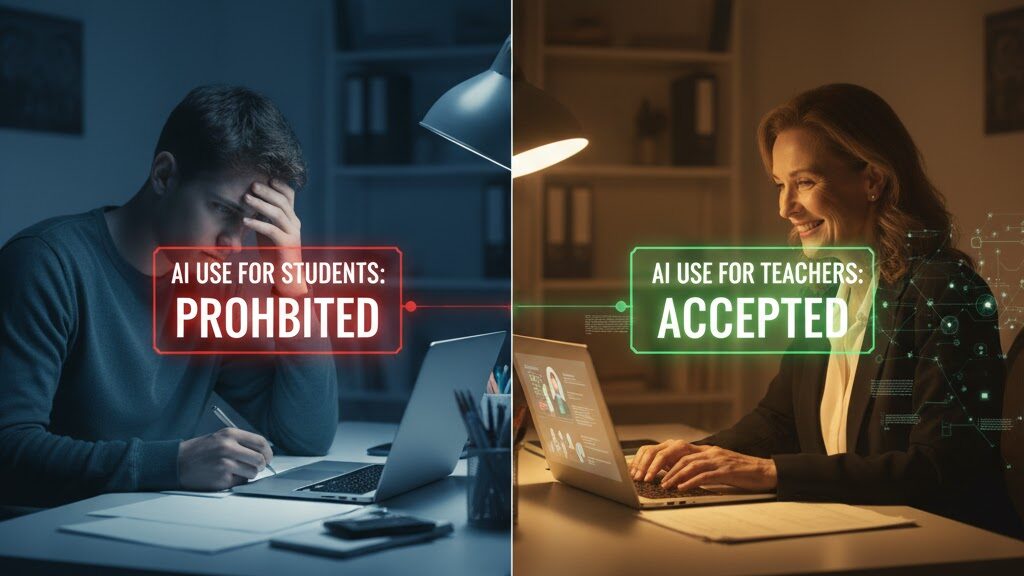
A split image showing a frustrated male student on the left, with text "AI USE FOR STUDENTS: PROHIBITED," and a smiling female teacher on the right, with text "AI USE FOR TEACHERS: ACCEPTED." Both are working on laptops in a contrasting light. Image (and typos) generated by Nano Banana.
The double standard: Exploring why AI use might be acceptable for educators yet detrimental for students’ learning and development. Image (and typos) generated by Nano Banana.

Source

Edutopia

Summary

History and journalism teacher David Cutler argues that while generative AI can meaningfully enhance teachers’ feedback and efficiency, students should not use it unsupervised. Teachers possess the critical judgment to evaluate AI outputs, but students risk bypassing essential cognitive processes and genuine understanding. Cutler likens premature AI use to handing a calculator to someone who hasn’t learned basic arithmetic. He instead promotes structured, transparent use—AI for non-assessed learning or teacher moderation—while continuing to teach critical thinking and writing through in-class work. His stance reflects both ethical caution and pragmatic optimism about AI’s potential to support, not supplant, human learning.

Key Points

  • Teachers can use AI to improve feedback, fairness, and grading efficiency.
  • Students lack the maturity and foundational skills for unsupervised AI use.
  • In-class writing fosters integrity, ownership, and authentic reasoning.
  • Transparent teacher use models responsible AI practice.
  • Slow, deliberate adoption best protects student learning and trust.

Keywords

URL

https://www.edutopia.org/article/why-students-should-not-use-ai/

Summary generated by ChatGPT 5


My Students Use AI. So What?


A confident female teacher stands at the center of a modern classroom, holding up a tablet that displays a world map, symbolizing global connection. She looks directly at the viewer with a slight smile. Around her, a diverse group of college-aged students are seated at collaborative tables, actively working on laptops that show glowing digital interfaces. Above the entire scene, a large, vibrant word cloud hovers, with prominent words like "CREATIVITY," "INNOVATION," "COLLABORATION," "CRITICAL THINKING," and "PROBLEM-SOLVING," all associated with AI and learning. The words are illuminated with a soft, energetic glow. Image (and typos) generated by Nano Banana.
In a world where AI is ubiquitous, some educators are embracing its presence in the classroom. This image captures the perspective of a teacher who views AI not as a threat, but as an integral tool that can foster creativity, innovation, and critical thinking, challenging traditional views on technology in education. Image (and typos) generated by Nano Banana.

Source

The Atlantic

Summary

John McWhorter, a linguist and professor at Columbia University, argues that fears about artificial intelligence destroying academic integrity are exaggerated. He contends that educators should adapt rather than resist, acknowledging that AI has become part of how students read, write, and think. While traditional essay writing once served as a key training ground for argumentation, AI now performs that function efficiently, prompting teachers to develop more relevant forms of assessment. McWhorter urges educators to replace formulaic essays with classroom discussions, personal reflections, and creative applications that AI cannot replicate. Grammar and stylistic rules, he suggests, should no longer dominate education; instead, AI can handle mechanical precision, freeing students to focus on reasoning and ideas. For McWhorter, the goal is not to preserve outdated academic rituals but to help students learn to think more deeply in a changed world.

Key Points

  • The author challenges alarmist narratives about AI eroding higher education.
  • AI has replaced traditional essay writing as a mechanical exercise but not genuine thought.
  • Teachers should create assessments that require personal insight and classroom engagement.
  • Grammar and stylistic conventions are becoming obsolete as AI handles technical writing.
  • AI allows students to focus on creativity, reasoning, and synthesis rather than busywork.
  • The shift mirrors earlier transitions in media—from print to digital—without diminishing intellect.

Keywords

URL

https://www.theatlantic.com/ideas/archive/2025/10/ai-college-crisis-overblown/684642/

Summary generated by ChatGPT 5


AI Chatbots Fail at Accurate News, Major Study Reveals


A distressed young woman sits at a desk in a dim room, holding her head in her hands while looking at a glowing holographic screen. The screen prominently displays a "AI CHATBOT NEWS ACCURACY REPORT" table. The table has columns for "QUERY," "AI CHATBOT RESPONSE" (filled with garbled, incorrect text and large red 'X' marks), and "REALITY/CORRECTION" (showing accurate but simple names/phrases). A prominent red siren icon flashes above the table, symbolizing an alert or warning. Image (and typos) generated by Nano Banana.
A major new study has delivered a sobering revelation: AI chatbots are significantly failing when it comes to reporting accurate news. This image highlights the frustration and concern arising from AI’s inability to provide reliable information, underscoring the critical need for verification and human oversight in news consumption. Image (and typos) generated by Nano Banana.

Source

Deutsche Welle (DW)

Summary

A landmark study by 22 international public broadcasters, including DW, BBC, and NPR, found that leading AI chatbots—ChatGPT, Copilot, Gemini, and Perplexity—misrepresented or distorted news content in 45 per cent of their responses. The investigation, which reviewed 3,000 AI-generated answers, identified widespread issues with sourcing, factual accuracy, and the ability to distinguish fact from opinion. Gemini performed the worst, with 72 per cent of its responses showing significant sourcing errors. Researchers warn that the systematic nature of these inaccuracies poses a threat to public trust and democratic discourse. The European Broadcasting Union (EBU), which coordinated the study, has urged governments to strengthen media integrity laws and called on AI companies to take accountability for how their systems handle journalistic content.

Key Points

  • AI chatbots distorted or misrepresented news 45 per cent of the time.
  • 31 per cent of responses had sourcing issues; 20 per cent contained factual errors.
  • Gemini and Copilot were the least accurate, though all models underperformed.
  • Errors included outdated information, misattributed quotes, and false facts.
  • The EBU and partner broadcasters launched the “Facts In: Facts Out” campaign for AI accountability.
  • Researchers demand independent monitoring and regulatory enforcement on AI-generated news.

Keywords

URL

https://www.dw.com/en/chatbot-ai-artificial-intelligence-chatgpt-google-gemini-news-misinformation-fact-check-copilot-v2/a-74392921

Summary generated by ChatGPT 5


The Lecturers Learning to Spot AI Misconduct


Four serious and focused lecturers/academics (two men, two women) are gathered around a table in a dimly lit, high-tech setting. They are looking at a large, glowing blue holographic screen that displays complex text, code, and highlights, with the prominent title "AI MISCONDUCT DETECTION." The screen shows an example of potentially AI-generated text with highlighted sections. Two individuals are actively pointing at the screen, while others are taking notes on laptops and paper. Surrounding the main screen are smaller holographic icons representing documents and a magnifying glass, symbolizing investigation and analysis. Image (and typos) generated by Nano Banana.
As AI tools become more sophisticated, the challenge of maintaining academic integrity intensifies. This image depicts lecturers undergoing specialised training to hone their skills in identifying AI-generated misconduct, ensuring fairness and originality in student work. Image (and typos) generated by Nano Banana.

Source

BBC News

Summary

Academics at De Montfort University (DMU) in Leicester are receiving specialist training to identify when students misuse artificial intelligence in coursework. The initiative, led by Dr Abiodun Egbetokun and supported by the university’s new AI policy, seeks to balance ethical AI use with maintaining academic integrity. Lecturers are being taught to spot linguistic “markers” of AI generation, such as repetitive phrasing or Americanised language, though experts acknowledge that detection is becoming increasingly difficult. DMU encourages students to use AI tools to support critical thinking and research, but presenting AI-generated work as one’s own constitutes misconduct. Staff also highlight the flaws of AI detection software, which has produced false positives, prompting calls for education over punishment. Students, meanwhile, recognise both the value and ethical boundaries of AI in their studies and future professions.

Key Points

  • DMU lecturers are being trained to recognise signs of AI misuse in student work.
  • The university’s policy allows ethical AI use for learning support but bans misrepresentation.
  • Detection focuses on linguistic patterns rather than unreliable software tools.
  • Staff warn that false accusations can harm students as much as confirmed misconduct.
  • Educators stress fostering AI literacy and integrity rather than “catching out” students.
  • Students value AI for translation, study support, and clinical applications but accept clear ethical limits.

Keywords

URL

https://www.bbc.com/news/articles/c2kn3gn8vl9o

Summary generated by ChatGPT 5