Is Increasing Use of AI Damaging Students’ Learning Ability?


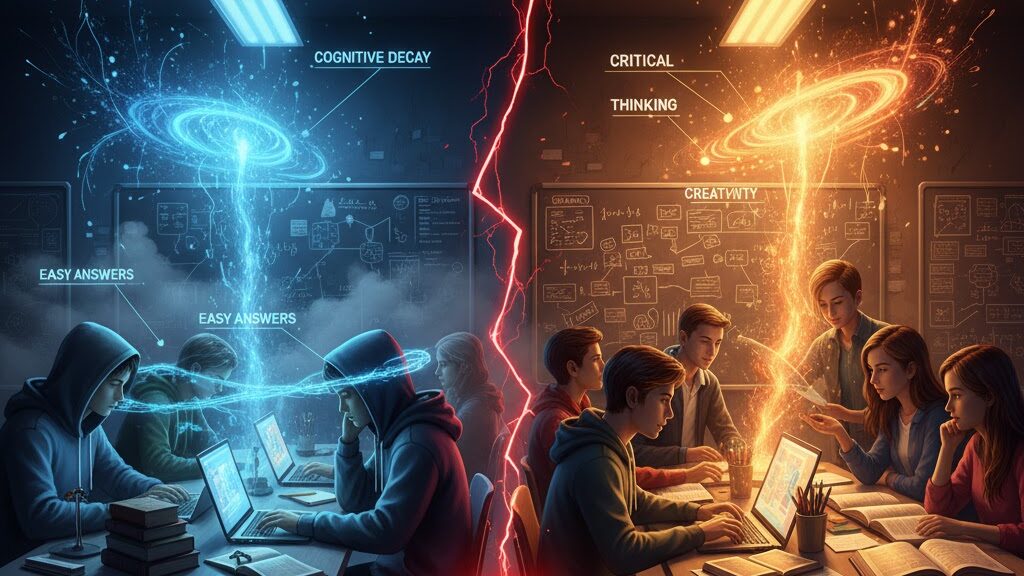
A split image contrasting two groups of students in a classroom. On the left, a blue-lit side represents "COGNITIVE DECAY" with students passively looking at laptops receiving "EASY ANSWERS." On the right, an orange-lit side represents "CRITICAL THINKING" and "CREATIVITY" with students actively collaborating and working. Image (and typos) generated by Nano Banana.
A critical question posed: Does the growing reliance on AI lead to cognitive decay, or can it be harnessed to foster critical thinking and creativity in students? Image (and typos) generated by Nano Banana.

Source

Radio New Zealand (RNZ) – Nine to Noon

Summary

University of Auckland professor Alex Sims examines whether the growing integration of artificial intelligence in classrooms and lecture halls enhances or impedes student learning. Drawing on findings from an MIT neuroscience study and an Oxford University report, Sims highlights both the cognitive effects of AI use and students’ own accounts of its impact on motivation and understanding. The research suggests that while AI tools can aid efficiency, overreliance may disrupt the brain processes central to deep learning and independent reasoning. The discussion raises questions about how to balance technological innovation with the preservation of critical thinking and sustained attention.

Key Points

  • AI use in education is expanding rapidly across levels and disciplines.
  • MIT research explores how AI affects neural activity linked to learning.
  • Oxford report includes students’ perceptions of AI’s influence on study habits.
  • Benefits include efficiency; risks include reduced cognitive engagement.
  • Experts urge educators to maintain a balance between AI support and active learning.

Keywords

URL

https://www.rnz.co.nz/national/programmes/ninetonoon/audio/2019010577/is-increasing-use-of-ai-damaging-students-learning-ability

Summary generated by ChatGPT 5


English Professors Take Individual Approaches to Deterring AI Use


A triptych showing three different English professors employing distinct methods to deter AI use. The first panel shows a professor lecturing on critical thinking. The second shows a professor providing personalized feedback on a digital screen. The third shows a professor leading a discussion with creative prompts. Image (and typos) generated by Nano Banana.
Diverse strategies in action: English professors are developing unique and personalised methods to encourage original thought and deter the misuse of AI in their classrooms. Image (and typos) generated by Nano Banana.

Source

Yale Daily News

Summary

Without a unified departmental policy, Yale University’s English professors are independently addressing the challenge of generative AI in student writing. While all interviewed faculty agree that AI undermines critical thinking and originality, their responses vary from outright bans to guided experimentation. Professors Stefanie Markovits and David Bromwich warn that AI shortcuts obstruct the process of learning to think and write independently, while Rasheed Tazudeen enforces a no-tech classroom to preserve student engagement. Playwriting professor Deborah Margolin insists that AI cannot replicate authentic human voice and creativity. Across approaches, faculty emphasise trust, creativity, and the irreplaceable role of struggle in developing genuine thought.

Key Points

  • Yale English Department lacks a central AI policy, favouring academic freedom.
  • Faculty agree AI use hinders original thinking and creative voice.
  • Some, like Tazudeen, impose no-tech classrooms to deter reliance on AI.
  • Others allow limited exploration under clear guidelines and reflection.
  • Consensus: authentic learning requires human engagement and intellectual struggle.

Keywords

URL

https://yaledailynews.com/blog/2025/10/29/english-professors-take-individual-approaches-to-deterring-ai-use/

Summary generated by ChatGPT 5


The Case Against AI Disclosure Statements


A large tablet displaying an "AI Disclosure Statement" document with a prominent red "X" over it sits on a wooden desk in a courtroom setting. A gavel lies next to the tablet, and a judge's bench with scales of justice is visible in the background. Image (and typos) generated by Nano Banana.
Challenging transparency: A visual argument against mandatory AI disclosure statements, set against the backdrop of legal scrutiny. Image (and typos) generated by Nano Banana.

Source

Inside Higher Ed

Summary

Julie McCown, an associate professor of English at Southern Utah University, argues that mandatory AI disclosure statements in higher education are counterproductive. Initially designed to promote transparency and responsible use, these statements have instead reinforced a culture of guilt, distrust, and surveillance. McCown contends that disclosure requirements stigmatise ethical AI use and inhibit open dialogue between students and educators. Rather than policing AI use, she advocates normalising it within learning environments, rethinking assessment design, and fostering trust. Transparency, she suggests, emerges from safety and shared experimentation, not coercion.

Key Points

  • Mandatory AI disclosure creates a culture of confession and distrust.
  • Research shows disclosure reduces perceived trustworthiness regardless of context.
  • Anti-AI bias drives use underground and suppresses AI literacy.
  • Assignments should focus on quality and integrity of writing, not AI detection.
  • Normalising AI through reflective practice and open discussion builds genuine transparency.

Keywords

URL

https://www.insidehighered.com/opinion/views/2025/10/28/case-against-ai-disclosure-statements-opinion

Summary generated by ChatGPT 5


Homework Is Facing an Existential Crisis: Has AI Made It Pointless?


A split image contrasting traditional homework with AI-influenced study. The left side shows a frustrated teenage boy sitting at a cluttered desk under a lamp, struggling with a textbook and papers, with a large red 'X' overlaid on him, signifying the traditional struggle. The background features a messy bulletin board and bookshelves. The right side shows the same boy relaxed in a modern, blue-lit setting, calmly using a tablet. Above his tablet, a friendly, glowing holographic AI tutor figure appears, surrounded by flowing data, equations, and digital interfaces, representing effortless, AI-assisted learning. Image (and typos) generated by Nano Banana.
As AI revolutionizes learning, traditional homework faces an existential crisis. This image dramatically contrasts the classic struggle with assignments against the ease of AI-assisted learning, raising a fundamental question: has artificial intelligence rendered conventional homework pointless, or simply redefined its purpose? Image (and typos) generated by Nano Banana.

Source

Los Angeles Times

Summary

Howard Blume explores how the rise of artificial intelligence is forcing educators to reconsider the value of homework. According to the College Board, 84 per cent of U.S. high school students now use AI for schoolwork, leading some teachers to abandon homework entirely while others redesign tasks to make AI misuse harder. Educators such as Alyssa Bolden in Inglewood now require handwritten essays to limit AI reliance, while others emphasise in-class mastery over at-home repetition. Experts warn that poorly designed homework, amplified by AI, risks undermining learning and widening inequality. Yet research suggests students still benefit from meaningful, creative assignments that foster independence, time management, and deeper understanding. The article concludes that AI hasn’t made homework obsolete—it has exposed the need for better, more purposeful learning design.

Key Points

  • 84 per cent of U.S. high school students use AI for schoolwork, up from 79 per cent earlier in 2025.
  • Teachers are divided: some have scrapped homework, while others are redesigning it to resist AI shortcuts.
  • AI challenges traditional measures of academic effort and authenticity.
  • Experts urge teachers to create engaging, meaningful assignments that deepen understanding.
  • Poorly designed homework can increase stress and widen learning gaps, particularly across socioeconomic lines.
  • The consensus: students don’t need more homework—they need better homework.

Keywords

URL

https://www.latimes.com/california/story/2025-10-25/homework-useless-existential-crisis-ai

Summary generated by ChatGPT 5


Most Teachers Rethinking How They Set Assignments Due to AI


A diverse group of eight teachers or educators are gathered around a conference table in a modern library or academic setting, engaged in a discussion. Two male teachers stand and point at a large, glowing holographic display above the table, which is split into two sections: "TRADITIONAL ASSIGNMENT DESIGN" and "AI-INTEGRATED PROJECTS." Each section contains pie charts, diagrams, and keywords like "CRITICAL THINKING," "HUMAN-AI COLLABORATION," and "ETHICS," illustrating a shift in pedagogical approaches. A large red bracket and arrow point from the traditional to the AI-integrated section, symbolizing the transition. Other teachers at the table are working on laptops with glowing interfaces. Image (and typos) generated by Nano Banana.
A significant majority of teachers—8 out of 10—are actively re-evaluating their assignment design strategies in response to the rise of AI. This shift reflects a crucial effort to adapt educational methods, ensuring assignments remain relevant, promote critical thinking, and address the capabilities and challenges presented by artificial intelligence. Image (and typos) generated by Nano Banana.

Source

Tes

Summary

A British Council survey of 1,000 UK secondary teachers reveals that 79 per cent have changed how they design assignments because of artificial intelligence. The rapid integration of AI tools into student learning is reshaping assessment practices and communication skills in classrooms. While 59 per cent of teachers are creating assignments that incorporate AI responsibly, 38 per cent are designing tasks to prevent its use entirely. Teachers report declines in writing quality, originality, and vocabulary, as well as shorter attention spans among students. Education leaders, including Amy Lightfoot of the British Council and Sarah Hannafin of the NAHT, call for guidance, training, and proportional expectations to help schools manage AI’s growing influence while maintaining academic integrity and creativity.

Key Points

  • 79 per cent of teachers have altered assignment design due to AI.
  • 59 per cent integrate AI intentionally, while 38 per cent design tasks to exclude it.
  • Teachers report reduced writing quality, narrower vocabulary, and shorter attention spans.
  • 60 per cent worry AI is changing how students communicate and express ideas.
  • Education unions call for clearer national guidance and funded teacher training on AI use.
  • Experts highlight the need to balance innovation with safeguarding originality and ethics.

Keywords

URL

https://www.tes.com/magazine/news/secondary/teachers-rethinking-assignments-artificial-intelligence

Summary generated by ChatGPT 5