A Way to Save the Essay


A stylized visual showing a classic, handwritten essay page being protected by a glowing, modern digital shield or frame, symbolizing the integration of new methods to preserve the integrity of traditional writing assignments against AI interference. Image (and typos) generated by Nano Banana.
Rescuing the written word: Exploring innovative teaching and assessment strategies designed to preserve the value and necessity of the traditional essay in the age of generative AI. Image (and typos) generated by Nano Banana.

Source

Inside Higher Ed

Summary

Philosophy instructor Lily Abadal argues that the traditional take-home essay has long been failing as a measure of critical thinking—an issue made undeniable by the rise of generative AI. Instead of abandoning essays altogether, she advocates for “slow-thinking pedagogy”: a semester-long, structured, in-class writing process that replaces rushed, last-minute submissions with deliberate research, annotation, outlining, drafting and revision. Her scaffolded model prioritises depth over content coverage and cultivates intellectual virtues such as patience, humility and resilience. Abadal contends that meaningful writing requires time, struggle and independence—conditions incompatible with AI shortcuts—and calls for designated AI-free spaces where students can practise genuine thinking and writing.

Key Points

  • Traditional take-home essays often reward superficial synthesis rather than deep reasoning.
  • AI exposes existing weaknesses by enabling polished but shallow student work.
  • “Slow-thinking pedagogy” uses structured, in-class writing to rebuild genuine engagement.
  • Scaffolded steps—research, annotation, thesis development, outlining, drafting—promote real understanding.
  • Protecting AI-free spaces supports intellectual virtues essential for authentic learning.

Keywords

URL

https://www.insidehighered.com/opinion/career-advice/teaching/2025/11/07/way-save-essay-opinion

Summary generated by ChatGPT 5


Student Success Leaders Worry About Affordability, AI and Diversity


A composite visual showing three distinct, stylized icons representing major challenges: A padlock with dollar signs (Affordability), a swirling digital vortex or chatbot logo (AI), and a group of varied silhouettes (Diversity). All three are converging on a single, glowing student figure, symbolizing the multiple pressures on student success leaders. Image (and typos) generated by Nano Banana.
Triple threat to student success: Leaders in higher education are currently grappling with the complex and intertwined challenges of making college affordable, integrating AI responsibly, and ensuring robust diversity and inclusion across their institutions. Image (and typos) generated by Nano Banana.

Source

Inside Higher Ed

Summary

This article examines the concerns expressed by student-success leaders across U.S. higher education institutions, reflecting a convergence of affordability challenges, diversity commitments and the accelerating influence of generative AI. While administrators generally maintain confidence in institutional missions, they report increasing difficulty in evaluating authentic student engagement and learning outcomes due to widespread AI use. AI-assisted work can obscure students’ actual competencies, making early intervention and personalised support more complex. Leaders warn that inequitable access to advanced AI tools and differences in digital literacy may widen existing gaps for underrepresented groups. These concerns extend beyond teaching and assessment policies to broader institutional planning, prompting calls for staff training, student guidance frameworks and integrated AI governance strategies. The article suggests that institutions must adopt more holistic responses that acknowledge AI’s influence on retention, equity, affordability and long-term student success. AI is no longer a marginal pedagogical issue but an influential variable in strategic decision-making.

Key Points

  • AI seen as major pressure alongside affordability and DEI.
  • AI affects measurement of engagement and outcomes.
  • Risks of widening equity gaps.
  • Need for proactive policy.
  • AI now strategic issue, not just pedagogical.

Keywords

URL

https://www.insidehighered.com/news/students/academics/2025/11/06/student-success-leaders-worry-about-affordability-ai-dei

Summary generated by ChatGPT 5.1


How AI Is Challenging the Credibility of Some Online Courses


A digital illustration of a diploma or certificate with a prominent "CERTIFIED" seal, but the document is visibly fraying and breaking apart into digital code and pixels. A small, glowing AI chatbot icon hovers near the broken area, symbolizing the erosion of credibility. Image (and typos) generated by Nano Banana.
Questioning the digital degree: AI-generated work is forcing educators to reassess the integrity and perceived value of completion certificates for online courses. Image (and typos) generated by Nano Banana.

Source

The Conversation

Summary

Mohammed Estaiteyeh argues that generative AI has exposed fundamental weaknesses in asynchronous online learning, where instructors cannot observe students’ thinking or verify authorship. Traditional assessments—discussion boards, reflective posts, essays, and multimedia assignments—are now easily replaced or augmented by AI tools capable of producing personalised, citation-matched work indistinguishable from human output. Detection tools and remote proctoring offer little protection and raise serious equity and ethical issues. Estaiteyeh warns that without systemic redesign, institutions risk issuing credentials that no longer guarantee genuine learning. He advocates integrating oral exams, experiential learning with external verification, and programme-level redesign to maintain authenticity and uphold academic integrity in the AI era.

Key Points

  • Asynchronous online courses face the highest risk of undetectable AI substitution.
  • Discussion boards, reflections, essays, and even citations can be convincingly AI-generated.
  • AI detectors and remote proctoring are unreliable, inequitable, and ethically problematic.
  • Oral exams and experiential assessments offer partial safeguards but require major redesign.
  • Institutions must invest in structural change or risk turning asynchronous programmes into “credential mills.”

Keywords

URL

https://theconversation.com/how-ai-is-challenging-the-credibility-of-some-online-courses-264851

Summary generated by ChatGPT 5


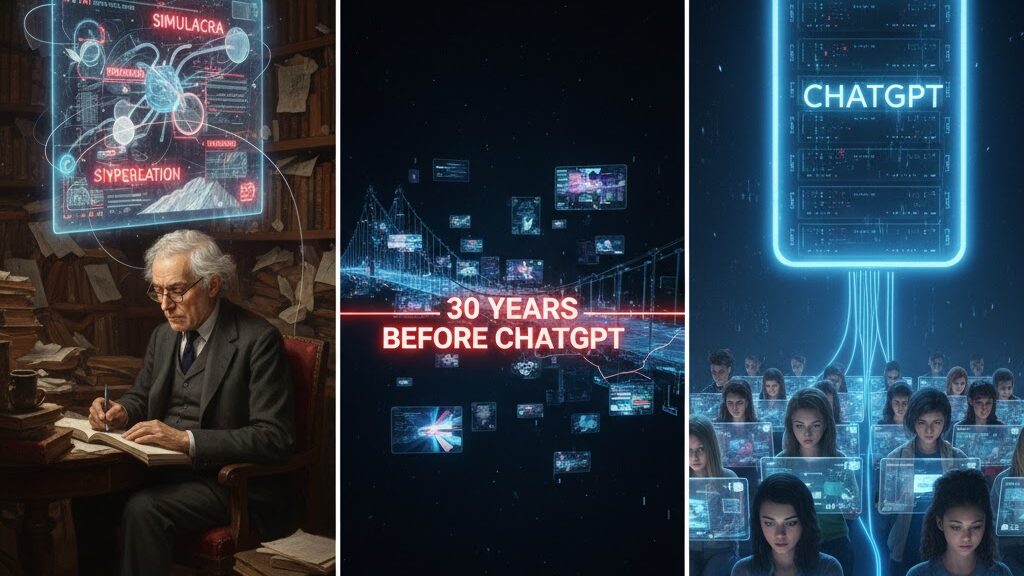
How the French Philosopher Jean Baudrillard Predicted Today’s AI 30 Years Before ChatGPT


A stylized, sepia-toned image of French philosopher Jean Baudrillard seated in a classic setting, holding a book, with a faint, modern, glowing digital projection of AI code and chat bubbles superimposed subtly in the background and foreground, merging the past and the hyperreal present. Image (and typos) generated by Nano Banana.
Philosophy meets the future: Examining the enduring relevance of Jean Baudrillard’s concepts of the hyperreal and simulacra, and how they eerily foreshadow the rise and impact of modern generative AI. Image (and typos) generated by Nano Banana.

Source

The Conversation

Summary

Bran Nicol argues that Jean Baudrillard’s cultural theory anticipated the logic and impact of today’s AI decades before its emergence. Through concepts such as simulacra, hyperreality and the disappearance of the real, Baudrillard foresaw a world in which screens, networks and digital proxies would replace direct human experience. He framed AI as a cognitive prosthetic: a device that simulates thought while encouraging humans to outsource thinking itself. Nicol highlights Baudrillard’s belief that such reliance risks eroding human autonomy and “exorcising” our humanness, not through machine domination but through our willingness to surrender judgement. Contemporary developments—AI actors, algorithmic companions and blurred boundaries between human and machine—demonstrate the uncanny accuracy of his predictions.

Key Points

  • Baudrillard predicted smartphone culture, hyperreality and AI-mediated life decades early.
  • He viewed AI as a prosthetic that produces the appearance of thought, not thought itself.
  • Outsourcing cognition risks diminishing human autonomy and “disappearing” the real.
  • Modern AI phenomena—deepfakes, AI influencers, chatbots—align with his theories.
  • He believed only human pleasure and embodied experience distinguished us from machines.

Keywords

URL

https://theconversation.com/how-the-french-philosopher-jean-baudrillard-predicted-todays-ai-30-years-before-chatgpt-267372

Summary generated by ChatGPT 5


Students using ChatGPT beware: Real learning takes legwork, study finds


split image illustrating two contrasting study methods. On the left, a student in a blue-lit setting uses a laptop for "SHORT-CUT LEARNING" with "EASY ANSWERS" floating around. On the right, a student in a warm, orange-lit setting is engaged in "REAL LEGWORK LEARNING," writing in a notebook with open books and calculations. A large question mark divides the two scenes. Image (and typos) generated by Nano Banana.
The learning divide: A visual comparison highlights the potential pitfalls of relying on AI for “easy answers” versus the proven benefits of diligent study and engagement, as a new study suggests. Image (and typos) generated by Nano Banana.

Source

The Register

Summary

A new study published in PNAS Nexus finds that people who rely on ChatGPT or similar AI tools for research develop shallower understanding compared with those who gather information manually. Conducted by researchers from the University of Pennsylvania’s Wharton School and New Mexico State University, the study involved over 10,000 participants. Those using AI-generated summaries retained fewer facts, demonstrated less engagement, and produced advice that was shorter, less original, and less trustworthy. The findings reinforce concerns that overreliance on AI can “deskill” learners by replacing active effort with passive consumption. The researchers conclude that AI should support—not replace—critical thinking and independent study.

Key Points

  • Study of 10,000 participants compared AI-assisted and traditional research.
  • AI users showed shallower understanding and less factual recall.
  • AI summaries led to homogenised, less trustworthy responses.
  • Overreliance on AI risks reducing active learning and cognitive engagement.
  • Researchers recommend using AI as a support tool, not a substitute.

Keywords

URL

https://www.theregister.com/2025/11/03/chatgpt_real_understanding/

Summary generated by ChatGPT 5