The cognitive shift: Experts are weighing the potential impact of AI reliance—is it a tool for enhancement, or are we outsourcing the very processes that keep our brains sharp? Image (and typos) generated by Nano Banana.
Source
RTÉ Prime Time
Summary
RTÉ explores emerging concerns about how widespread AI use may alter human cognition. With almost 800 million ChatGPT users globally and Ireland among the world’s heaviest users, scientists warn that convenience may carry hidden cognitive costs. An MIT study using brain-imaging found reduced neural activity when participants relied on ChatGPT, suggesting diminished critical evaluation. Irish neuroscientist Paul Dockree cautions that outsourcing tasks like writing and problem-solving could erode core cognitive skills, similar to over-dependency on GPS. Others draw parallels with aviation, where automation has weakened pilots’ manual skills. While some users praise AI’s benefits, experts warn of a potential “two-tier society” of empowered critical thinkers and those who grow dependent on automated reasoning.
Key Points
AI adoption is extremely rapid; Ireland has one of the highest global usage rates.
MIT research indicates reduced brain activity when using ChatGPT for problem-solving.
Cognitive scientists warn of long-term skill decline if AI replaces active thinking.
Automation parallels in aviation show how skills can erode without practice.
Public reactions are mixed, reflecting broader uncertainty about AI’s cognitive impact.
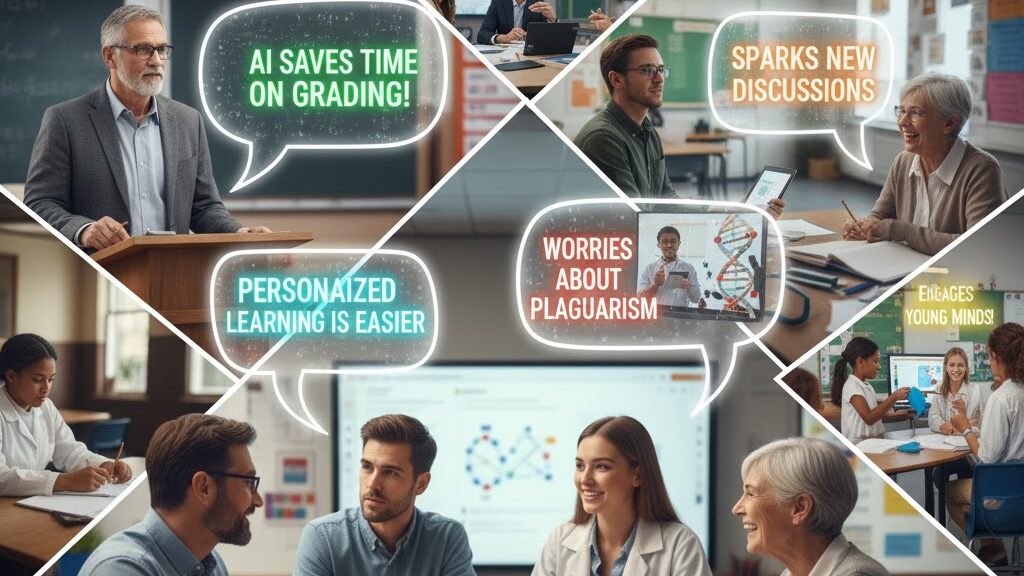
Diverse perspectives on the digital frontier: Capturing the wide range of experiences and opinions shared by educators as they navigate the benefits and challenges of integrating AI into their classrooms. Image (and typos) generated by Nano Banana.
Source
The Conversation
Summary
Researcher Nadia Delanoy interviewed ten Canadian teachers to explore how generative AI is reshaping K–12 classrooms. The teachers, spanning grades 5–12 across multiple provinces, described mounting pressures to adapt amid ethical uncertainty and emotional strain. Common concerns included the fragility of traditional assessment, inequitable access to AI tools, and rising workloads compounded by inadequate policy support. Many expressed fear that AI could erode the artistry and relational nature of teaching, turning it into a compliance exercise. While acknowledging AI’s potential to enhance workflow, teachers emphasised the need for slower, teacher-led, and ethically grounded implementation that centres humanity and professional judgment.
Key Points
Teachers report anxiety over authenticity and fairness in assessment.
Equity gaps widen as some students have greater AI access than others.
Educators feel policies treat them as implementers, not professionals.
AI integration adds to burnout, threatening teacher autonomy.
Responsible policy must involve teachers, ethics, and slower adoption.
by Brian Mulligan – e-learning consultant with Universal Learning Systems (ulsystems.com)
Estimated reading time: 5 minutes
Artificial intelligence is poised to unleash a revolution in higher education, not in the ways we’ve conventionally imagined, but through unexpected and profound transformations. This image visualises AI as a central, dynamic force reshaping academic landscapes, curriculum delivery, and the very nature of learning in universities. Image (and typos) generated by Nano Banana.
The current conversation about Artificial Intelligence (AI) in higher education primarily focuses on efficiency and impact. People talk about how AI can personalise learning, streamline administrative tasks, and help colleges “do more with less.” For decades, every new technology, from online training to MOOCs, promised a similar transformation. Generative AI certainly offers powerful tools to enhance existing processes.
However, perhaps the revolutionary potential of AI in higher education may come from a more critical and urgent pressure: its significant challenge to the integrity of academic credentials and the learning processes they are supposed to represent.
Historically, colleges haven’t had a strong incentive to completely overhaul their teaching models just because new technology arrived. Traditional lectures, established assessment methods, and the value of a physical campus have remained largely entrenched. Technology usually just served to augment existing practices, not to transform the underlying structures of teaching, learning, and accreditation.
AI, however, may be a different kind of catalyst for change.
The Integrity Challenge
AI’s ability to create human-quality text, solve complex problems, and produce creative outputs has presented a serious challenge to academic integrity. Reports show a significant rise in AI-driven cheating, with many students now routinely using these tools to complete their coursework. For a growing number of students, offloading cognitive labour, from summarising readings to generating entire essays, to AI is becoming the new norm.
This widespread and mostly undetectable cheating compromises the entire purpose of assessment: to verify genuine learning and award credible qualifications. Even students committed to authentic learning feel compromised, forced to compete against peers using AI for an unfair advantage.
Crucially, even when AI use is approved, there’s a legitimate concern that it can undermine the learning process itself. If students rely on AI for foundational tasks like summarisation and idea generation, they may bypass the essential cognitive engagement and critical thinking development. This reliance can lead to intellectual laziness, meaning the credentials universities bestow may no longer reliably signify genuine knowledge and skills. This creates an urgent imperative for institutions to act.
The Shift to Authentic Learning
While many believe we can address this just by redesigning assignments, the challenge offers, and may even require, a structural shift towards more radical educational models. These new approaches,which have been emerging to address the challenges of quality, access and cost, may also prove to be the most effective ways of addressing academic integrity challenges.
To illustrate the point, let’s look at three examples of such emerging models:
Flipped Learning: Students engage with core content independently online. Valuable in-person time is then dedicated to active learning like problem-solving, discussions, and collaborative projects. Educators can directly observe the application of knowledge, allowing for a more authentic assessment of understanding.
Project-Based Learning (PBL): Often seen as an integrated flipped model, PBL immerses students in complex, integrated projects over extended periods. The focus is on applying knowledge from multiple modules and independent research to solve real-world problems. These projects demand sustained, supervised engagement, creative synthesis, and complex problem-solving, capabilities that are very hard to simply outsource to AI.
Work-Based Learning (WBL): A significant part of the student’s journey takes place in authentic workplace settings. The emphasis shifts entirely to the demonstrable application of skills and knowledge in genuine professional contexts, a feat AI alone cannot achieve. Assessment moves to evaluating how a student performs and reflects in their role, including how they effectively and ethically integrate AI tools professionally.
AI as the Enabler of Change
Shifting to these models isn’t easy. Can institutions afford the resources to develop rich content, intricate project designs, and robust supervisory frameworks? Creating and assessing numerous, varied, and authentic tasks requires significant time and financial investment.
This is where technology, now including AI itself, becomes the key enabler for the feasibility of these new pedagogical approaches. Learning technologies, intelligently deployed, can help by:
Affordably Creating Content: AI tools rapidly develop diverse learning materials, including texts, videos and formative quizzes as well as more sophisticated assessment designs.
Providing Automated Learning Support: AI-powered tutors and chatbots offer 24/7 support, guiding students through challenging material, which personalises the learning journey.
Monitoring Independent Work: Learning analytics, enhanced by AI, track student engagement and flag struggling individuals. This allows educators to provide timely, targeted human intervention.
Easing the Assessment Burden: Technology can streamline the heavy workload associated with more varied assignments. Simple digital tools like structured rubrics and templated feedback systems free up educator time for nuanced, human guidance.
In summary, the most significant impact of AI isn’t the familiar promise of doing things better or faster. By undermining traditional methods of learning verification through the ease of academic dishonesty, AI has created an unavoidable pressure for systemic change. It forces colleges to reconsider what they are assessing and what value their degrees truly represent.
It’s that AI, by challenging the old system so thoroughly, makes the redesign of higher education a critical necessity.
Brian Mulligan
E-learning Consultant Universal Learning Systems (ulsystems.com)
Brian Mulligan is an e-learning consultant with Universal Learning Systems (ulsystems.com) having retired as Head of Online Learning Innovation at Atlantic Technological University in Sligo in 2022. His current interests include innovative models of higher education and the strategic use of learning technologies in higher education.
Rescuing the written word: Exploring innovative teaching and assessment strategies designed to preserve the value and necessity of the traditional essay in the age of generative AI. Image (and typos) generated by Nano Banana.
Source
Inside Higher Ed
Summary
Philosophy instructor Lily Abadal argues that the traditional take-home essay has long been failing as a measure of critical thinking—an issue made undeniable by the rise of generative AI. Instead of abandoning essays altogether, she advocates for “slow-thinking pedagogy”: a semester-long, structured, in-class writing process that replaces rushed, last-minute submissions with deliberate research, annotation, outlining, drafting and revision. Her scaffolded model prioritises depth over content coverage and cultivates intellectual virtues such as patience, humility and resilience. Abadal contends that meaningful writing requires time, struggle and independence—conditions incompatible with AI shortcuts—and calls for designated AI-free spaces where students can practise genuine thinking and writing.
Key Points
Traditional take-home essays often reward superficial synthesis rather than deep reasoning.
AI exposes existing weaknesses by enabling polished but shallow student work.
“Slow-thinking pedagogy” uses structured, in-class writing to rebuild genuine engagement.
Scaffolded steps—research, annotation, thesis development, outlining, drafting—promote real understanding.
Protecting AI-free spaces supports intellectual virtues essential for authentic learning.
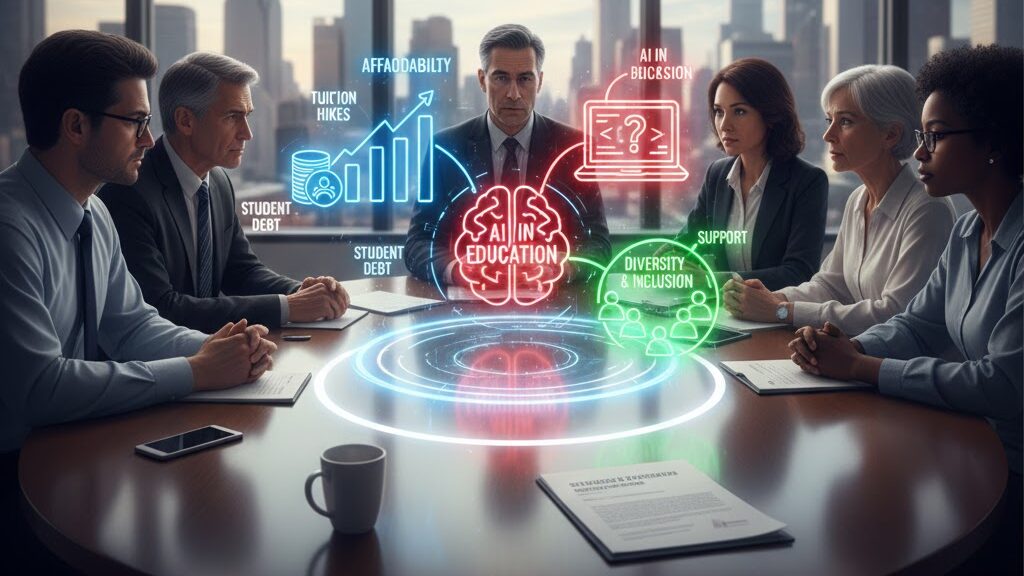
Triple threat to student success: Leaders in higher education are currently grappling with the complex and intertwined challenges of making college affordable, integrating AI responsibly, and ensuring robust diversity and inclusion across their institutions. Image (and typos) generated by Nano Banana.
Source
Inside Higher Ed
Summary
This article examines the concerns expressed by student-success leaders across U.S. higher education institutions, reflecting a convergence of affordability challenges, diversity commitments and the accelerating influence of generative AI. While administrators generally maintain confidence in institutional missions, they report increasing difficulty in evaluating authentic student engagement and learning outcomes due to widespread AI use. AI-assisted work can obscure students’ actual competencies, making early intervention and personalised support more complex. Leaders warn that inequitable access to advanced AI tools and differences in digital literacy may widen existing gaps for underrepresented groups. These concerns extend beyond teaching and assessment policies to broader institutional planning, prompting calls for staff training, student guidance frameworks and integrated AI governance strategies. The article suggests that institutions must adopt more holistic responses that acknowledge AI’s influence on retention, equity, affordability and long-term student success. AI is no longer a marginal pedagogical issue but an influential variable in strategic decision-making.
Key Points
AI seen as major pressure alongside affordability and DEI.
AI affects measurement of engagement and outcomes.