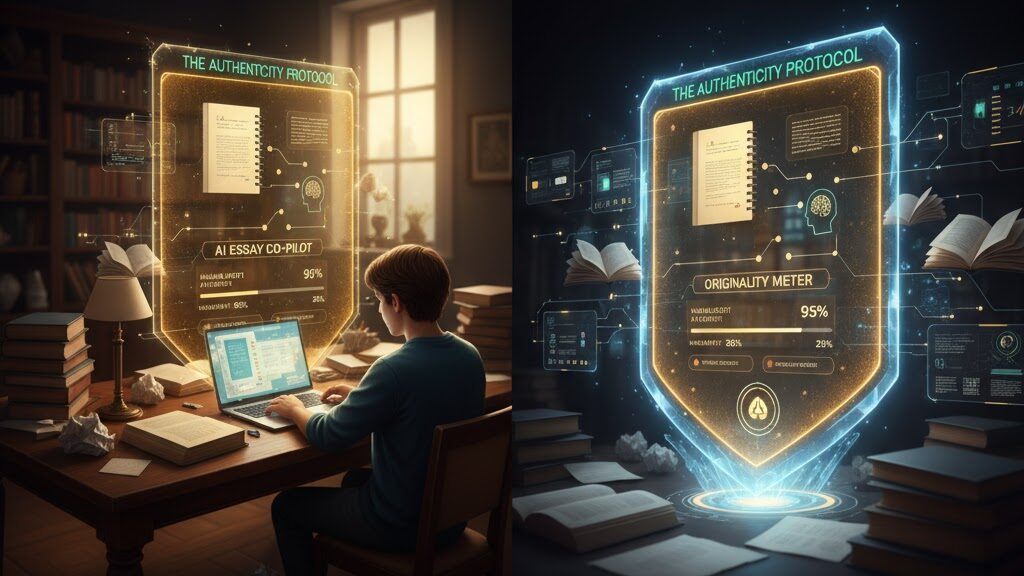
A Way to Save the Essay


A stylized visual showing a classic, handwritten essay page being protected by a glowing, modern digital shield or frame, symbolizing the integration of new methods to preserve the integrity of traditional writing assignments against AI interference. Image (and typos) generated by Nano Banana.
Rescuing the written word: Exploring innovative teaching and assessment strategies designed to preserve the value and necessity of the traditional essay in the age of generative AI. Image (and typos) generated by Nano Banana.

Source

Inside Higher Ed

Summary

Philosophy instructor Lily Abadal argues that the traditional take-home essay has long been failing as a measure of critical thinking—an issue made undeniable by the rise of generative AI. Instead of abandoning essays altogether, she advocates for “slow-thinking pedagogy”: a semester-long, structured, in-class writing process that replaces rushed, last-minute submissions with deliberate research, annotation, outlining, drafting and revision. Her scaffolded model prioritises depth over content coverage and cultivates intellectual virtues such as patience, humility and resilience. Abadal contends that meaningful writing requires time, struggle and independence—conditions incompatible with AI shortcuts—and calls for designated AI-free spaces where students can practise genuine thinking and writing.

Key Points

  • Traditional take-home essays often reward superficial synthesis rather than deep reasoning.
  • AI exposes existing weaknesses by enabling polished but shallow student work.
  • “Slow-thinking pedagogy” uses structured, in-class writing to rebuild genuine engagement.
  • Scaffolded steps—research, annotation, thesis development, outlining, drafting—promote real understanding.
  • Protecting AI-free spaces supports intellectual virtues essential for authentic learning.

Keywords

URL

https://www.insidehighered.com/opinion/career-advice/teaching/2025/11/07/way-save-essay-opinion

Summary generated by ChatGPT 5


Teachers Share More Ways to Engage AI in the Classroom


In a modern, technology-rich classroom, a diverse group of students works on laptops at individual desks. A female teacher stands at the front, gesturing towards a large interactive screen that displays "ENGAGING AI IN THE CLASSROOM: NEW STRATEGIES," along with various visual examples of AI tools and learning scenarios. Other teachers are visible on side screens, illustrating collaborative strategies. Image (and typos) generated by Nano Banana.
Educators are continuously innovating and discovering new methods to effectively integrate AI into classroom learning. This image showcases a vibrant educational setting where teachers are actively sharing and implementing a range of strategies to engage AI, transforming teaching methodologies and enriching student experiences. Image (and typos) generated by Nano Banana.

Source

Education Week (Opinion)

Summary

In this opinion blog, several K-12 English teachers describe practical strategies they use to integrate AI as a learning tool rather than letting it replace student thinking. They treat AI as a brainstorming assistant, prompt critic, or discussion partner rather than writer. Techniques include prompting AI to argue counterpoints, using it to surface alternative interpretations in literature, and setting roles (AI user, evaluator, synthesiser) in group tasks. Districts are also forming AI steering committees, piloting tools, and developing consistent guidelines to guide equitable, transparent adoption.

Key Points

  • AI is used as brainstorming / idea generation support, but students still revise and contextualise its output.
  • Teachers use AI in debate, persuasive writing, literary analysis, historical inquiry, science discussions, and Socratic questioning to deepen engagement.
  • Role assignments (AI user, evaluator, gatherer) help distribute responsibilities and prevent overreliance.
  • Districts should establish AI steering committees, pilot thoughtfully, and build shared understanding and policies.
  • AI should be scaffolded, not standalone; teachers emphasise transparency, critical review, and prompting skills.

Keywords

URL

https://www.edweek.org/technology/opinion-teachers-share-more-ways-to-engage-ai-in-the-classroom/2025/10

Summary generated by ChatGPT 5