According to a student’s observation, AI technology is alarmingly “replacing critical thinking in university lectures,” transforming the learning environment into one focused solely on information delivery. This dystopian image visualizes a future where traditional human instruction is minimized, and AI automates the lecture process, raising serious questions about the impact on students’ cognitive development and the very essence of higher education. Image (and typos) generated by Nano Banana.
Source
Waikato Times
Summary
A University of Waikato student has voiced concern that widespread use of AI in lectures is eroding students’ ability to think critically. Speaking anonymously, the fourth-year student said many peers now use ChatGPT to generate lecture notes, discussion questions, and ideas—essentially outsourcing thinking itself. While she acknowledged that AI has benefits when used judiciously, she worries it encourages intellectual passivity and dependence. The student warned that such habits could eventually harm employability, as employers increasingly seek graduates with strong analytical and critical-thinking skills.
Key Points
Students are using ChatGPT to generate lecture notes and workshop discussion prompts.
The student fears this practice undermines the purpose of higher education—to cultivate independent thinking.
She admits AI has value when used responsibly but sees overreliance as damaging to learning.
The trend risks producing graduates who lack the analytical abilities employers prize most.
The concern reflects wider tensions in universities over balancing AI’s benefits and harms.
This collection of essays explores how artificial intelligence—particularly generative AI (GenAI)—is reshaping the university sector across teaching, research, and administration. Contributors, including Dame Wendy Hall, Vinton Cerf, Rose Luckin, and others, argue that AI represents a profound structural shift rather than a passing technological wave. The report emphasises that universities must respond strategically, ethically, and holistically: developing AI literacy among staff and students, redesigning assessment, and embedding responsible innovation into governance and institutional strategy.
AI is portrayed as both a disruptive and creative force. It automates administrative processes, accelerates research, and transforms strategy-making, while simultaneously challenging ideas of authorship, assessment, and academic integrity. Luckin and others call for universities to foster uniquely human capacities—critical thinking, creativity, emotional intelligence, and metacognition—so that AI augments rather than replaces human intellect. Across the essays, there is strong consensus that AI literacy, ethical governance, and institutional agility are vital if universities are to remain credible and relevant in the AI era.
Key Points
GenAI is reshaping all aspects of higher education teaching and learning.
AI literacy must be built into curricula, staff training, and institutional culture.
Faculty should use GenAI to enhance creativity and connection, not replace teaching.
Clear, flexible policies are needed for responsible and ethical AI use.
Institutions must prioritise equity, inclusion, and closing digital divides.
Ongoing professional development in AI is essential for staff and administrators.
Collaboration across institutions and with industry accelerates responsible adoption.
Assessment and pedagogy must evolve to reflect AI’s role in learning.
GenAI governance should balance innovation with accountability and transparency.
Shared toolkits and global practice networks can scale learning and implementation.
Conclusion
The Action Plan positions GenAI as both a challenge and a catalyst for renewal in higher education. Institutions that foster literacy, ethics, and innovation will not only adapt but thrive. Teaching with AI is framed as a collective, values-led enterprise—one that keeps human connection, creativity, and critical thinking at the centre of the learning experience.
by Jim O’Mahony, SFHEA – Munster Technological University
Estimated reading time: 5 minutes
The true test of a professor’s intelligence: finding the lost remote control. Image generated by Nano Banana
I remember as a 7-year-old having to hop off the couch at home to change the TV channel. Shortly afterwards, a futuristic-looking device called a remote control was placed in my hand, and since then I have chosen its wizardry over my own physical ability to operate the TV. Why wouldn’t I? It’s reliable, instant, multifunctional, compliant and most importantly… less effort.
The Seduction of Less Effort
Less effort……….as humans, we’re biologically wired for it. Our bodies will always choose energy saving over energy-consuming, whether that’s a physical instance or a cognitive one. It’s an evolutionary aid to conserve energy.
Now, my life hasn’t been impaired by the introduction of a remote control, but imagine for a minute if that remote control replaced my thinking as a 7-year-old rather than my ability to operate a TV. Sounds fanciful, but in reality, this is exactly the world in which our students are now living in.
Within their grasp is a seductive all-knowing technological advancement called Gen AI, with the ability to replace thinking, reflection, metacognition, creativity, evaluative judgement, interpersonal relationships and other richly valued attributes that make us uniquely human.
Now, don’t get me wrong, I’m a staunch flag bearer for this new age of Gen AI and can see the unlimited potential it holds for enhanced learning. Who knows? Someday, it may even solve Bloom’s 2 sigma problem through its promise of personalised learning?
Guardrails for a New Age
However, I also realise that as the adults in the room, we have a very narrow window to put sufficient guardrails in place for our students around its use, and urgent considered governance is needed from University executives.
Gen AI literacy isn’t the most glamorous term (it may not even be the most appropriate term), but it encapsulates what our priority as educators should be. Learn what these tools are, how they work, what are the limitations, problems, challenges, pitfalls, etc, and how can we use them positively within our professional practice to support rather than replace learning?
Isn’t that what we all strive for? To have the right digital tools matched with the best pedagogical practices so that our students enter the workforce as well-rounded, fully prepared graduates – a workforce by the way, that is rapidly changing, with more than 71% of employers routinely adopting Gen AI 12 months ago (we can only imagine what it is now).
Shouldn’t our teaching practices change then, to reflect the new Gen AI-rich graduate attributes required by employers? Surely, the answer is YES… or is it? There is no easy answer – and perhaps no right answer. Maybe we’ve been presented with a wicked problem – an unsolvable situation where some crusade to resist AI, and others introduce policies to ‘ban the banning’ of AI! Confused anyone?
Rethinking Assessment in a GenAI World
I believe a common-sense approach is best and would have us reimagine our educational programmes with valid, secure and authentic assessments that reward learning both with and without the use of Gen AI.
Achieving this is far from easy, but as a starting point, consider a recent paper from Deakin University, which advocates for structural changes to assessment design along with clearly communicated instructions to students around Gen AI use.
To facilitate a more discursive approach regarding reimagined assessment protocols, some universities are adopting ‘traffic light systems’ such as the AI Assessment scale, which, although not perfect (or the whole solution), at least promotes open and transparent dialogue with students about assessment integrity – and that’s never a bad thing.
The challenge will come from those academics who resist the adoption of Gen AI in education. Whether their reasons relate to privacy, environmental issues, ethics, inherent bias, AGI, autonomous AI or cognitive offloading concerns (all well-intentioned and entirely valid by the way), Higher Ed debates and decision making around this topic in the coming months will be robust and energetic.
Accommodating the fearful or ‘traditionalist educators’ who feel unprepared or unwilling to road-test Gen AI should be a key part of any educational strategy or initiative. Their voices should be heard and their opinions considered – but in return, they also need to understand how Gen AI works.
From Resistance to Fluency
Within each department, faculty, staffroom, T&L department – even among the rows of your students, you will find early adopters and digital champions who are a little further along this dimly lit path to Gen AI enlightenment. Seek them out, have coffee with them, reflect on their wisdom and commit to trialling at least one new Gen AI tool or application each week – here’s a list of 100 to get you started. Slowly build your confidence, take an open course, learn about AI fluency, and benefit from the expertise of others.
I’m not encouraging you to be an AI evangelist, but improving your knowledge and general AI capabilities will make you better able to make more informed decisions for you and your students.
Now, did anyone see where I left the remote control?
Jim O’Mahony
University Professor | Biotechnologist | Teaching & Learning Specialist Munster Technological University
I am a passionate and enthusiastic University lecturer with over 20 years experience of designing, delivering and assessing undergraduate and postgraduate programmes. My primary focus as an academic is to empower students to achieve their full potential through innovative educational strategies and carefully designed curricula. I embrace the strategic and well-intentioned use of digital tools as part of my learning ethos, and I have been an early adopter and enthusiastic advocate of Artificial Intelligence (AI) as an educational tool.
Tertiary Education Quality and Standards Agency (TEQSA), Australian Government
Summary
This resource addresses how Australian higher education can reform assessment in response to the rise of generative AI. Building on earlier work (Assessment Reform for the Age of Artificial Intelligence), it sets out strategies that align with the Higher Education Standards Framework while acknowledging that gen AI is now ubiquitous in student learning and professional practice. The central message is that detection alone is insufficient; instead, assessment must be redesigned to assure learning authentically, ethically, and sustainably.
The report outlines three main pathways: (1) program-wide assessment reform, which integrates assessment as a coherent system across degrees; (2) unit/subject-level assurance of learning, where each subject includes at least one secure assessment task; and (3) a hybrid approach combining both. Each pathway carries distinct advantages and challenges, from institutional resourcing and staff coordination to maintaining program coherence and addressing integrity risks. Critical across all approaches is the need to balance immediate integrity concerns with long-term goals of preparing students for an AI-integrated future.
Key Points
Generative AI necessitates structural assessment reform, not reliance on detection.
Assessments must equip students to participate ethically and critically in an AI-enabled society.
Assurance of learning requires multiple, inclusive, and contextualised approaches.
Program-level reform provides coherence and alignment but demands significant institutional commitment.
Unit-level assurance offers quick implementation but risks fragmentation.
Hybrid approaches balance flexibility with systemic assurance.
Over-reliance on traditional supervised exams risks reducing authenticity and equity.
Critical questions must guide reform: alignment across units, disciplinary variation, and student experience.
Assessment must reflect authentic professional practices where gen AI is legitimately used.
Ongoing collaboration and evidence-sharing across the sector are vital for sustainable reform.
Conclusion
The report concludes that assessment reform in the age of AI is not optional but essential. Institutions must move beyond short-term fixes and design assessment systems that assure learning, uphold integrity, and prepare students for future professional contexts. This requires thoughtful strategy, collaboration, and a willingness to reimagine assessment as a developmental, systemic, and values-driven practice.
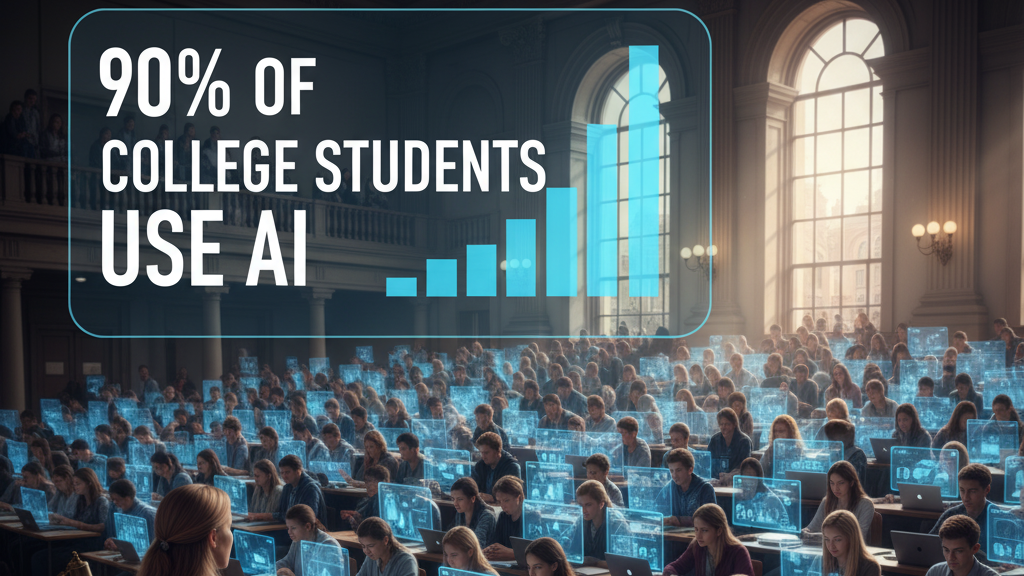
With a staggering 90% of college students now integrating AI tools into their academic lives, the demand for robust AI fluency support in higher education has never been more critical. This image underscores the widespread adoption of AI by students, signalling an urgent need for institutions to adapt their curricula and resources to equip learners for an AI-driven future. Image generated by Nano Banana.
Source
Forbes
Summary
AI is now deeply embedded in student life: roughly 90 % of college students report using AI tools, and the evidence suggests institutions are lagging in supporting this shift. Many students use AI for learning support—brainstorming, drafting, reviewing—but worry about its limitations, risks, and policy clarity. Educators argue that AI fluency should be integrated into curricula so students can use it responsibly, distinguish strong from weak output, and avoid over-reliance. The piece calls for higher education to embed AI ethics and practical AI skills to prepare students for a changing work environment.
Key Points
About 90 % of college students now use AI tools in their academic work.
Students use AI for brainstorming, feedback, editing, drafting—not necessarily to cheat—but feel under-prepared in distinguishing good versus bad AI output.
There is a gap between student usage and institutional support; many students believe their universities aren’t keeping pace.
AI fluency (understanding how AI works, its limitations, ethical issues) is increasingly seen as a necessary component of modern education.
Clear policy, guidance, and curricular integration are needed to ensure AI is a help, not a crutch.