OECD (2026), OECD Digital Education Outlook 2026: Exploring Effective Uses of Generative AI in Education, OECD Publishing, Paris, https://doi.org/10.1787/062a7394-en..
Summary
This flagship OECD report examines how generative artificial intelligence (GenAI) is reshaping education systems, with a strong emphasis on evidence-based uses that enhance learning, teaching, assessment, and system capacity. Drawing on international research, policy analysis, and design experiments, the report moves beyond hype to identify where GenAI adds genuine educational value and where it introduces risks. It highlights GenAI’s potential to support personalised learning, high-quality feedback, teacher productivity, and system-level efficiency, while cautioning against uses that displace cognitive effort or undermine deep learning.
A central theme is the need for hybrid human–AI approaches that preserve teacher autonomy, learner agency, and professional judgement. The report shows that GenAI can be effective when embedded in pedagogically grounded designs, such as intelligent tutoring, formative feedback, and collaborative learning, but harmful when used as a shortcut to answers. It also reviews national policy responses, noting a global shift towards targeted guidance, AI literacy frameworks, and proportionate regulation aligned with ethical principles, transparency, and accountability. The report calls for coordinated strategies that integrate curriculum reform, assessment redesign, professional development, and governance to ensure GenAI strengthens, rather than substitutes, human learning and expertise.
Key Points
GenAI can enhance personalised learning and feedback at scale when pedagogically designed.
Overreliance on GenAI risks reducing cognitive engagement and deep learning.
Hybrid human–AI models are essential to preserve teacher and learner agency.
Generative AI should support formative assessment rather than replace judgement.
AI literacy is a foundational skill for students, teachers, and leaders.
Teacher autonomy and professional expertise must be protected in AI integration.
Evidence-informed design is critical to avoid unintended learning harms.
National policies increasingly favour guidance over blanket bans.
Ethical principles, transparency, and accountability underpin responsible use.
Cross-system collaboration strengthens sustainable AI adoption.
Conclusion
The OECD Digital Education Outlook 2026 positions generative AI as a powerful but conditional force in education. Its impact depends not on the technology itself, but on how thoughtfully it is designed, governed, and integrated into learning ecosystems. By prioritising human-centred, evidence-based, and ethically grounded approaches, education systems can harness GenAI to improve quality and equity while safeguarding the core purposes of education.
By Dr Hazel Farrell & Ken McCarthy, South East Technological University & GenAI:N3
Estimated reading time: 7 minutes
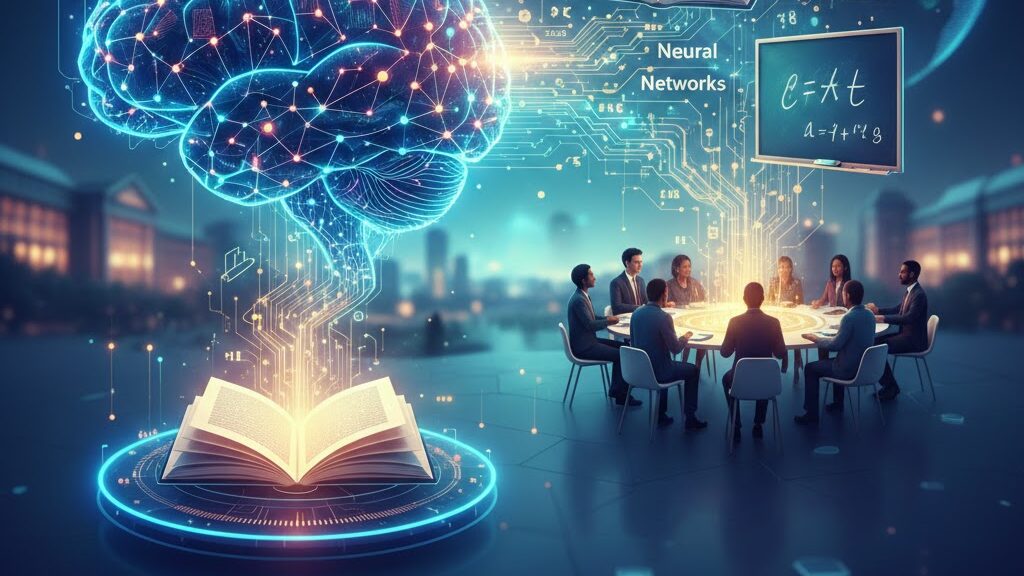
Moving from reaction to intentional practice: Exploring the collaborative future of Generative AI in higher education through human-led dialogue and pedagogical reflection. Image (and typos) generated by Nano Banana.
Generative AI has become part of higher education with remarkable speed.
In a short period of time, it has entered classrooms, assessment design, academic writing, feedback processes, and professional workflows. For many educators, its arrival felt sudden and difficult to make sense of, leaving little space to pause and consider what this shift means for learning, teaching, and academic practice.
Initial responses across the sector have often focused on risk, regulation, and control. These concerns are understandable. Yet they only tell part of the story. Alongside uncertainty and anxiety, there is also curiosity, experimentation, and a growing recognition that GenAI raises questions that are fundamentally pedagogical rather than purely technical.
On 21 January, we are delighted to host #LTHEchat to explore these questions together and to move the conversation from reaction towards more intentional, reflective practice.
The discussion will be grounded in the Manifesto for Generative AI in Higher Education, and informed by the wider work of GenAI:N3, a national initiative in Ireland supporting collaborative engagement with generative AI across higher education.
GenAI:N3: A Collaborative Project for the Sector
GenAI:N3 is a national network that was established in Ireland as part of the N-TUTORR programme, to support technological higher education institutions as they responded to the rapid emergence of generative AI. Rather than focusing on tools or technical solutions, the project centres on people, practice, and shared learning.
At its core, GenAI:N3 aims to build institutional and sectoral capacity by creating spaces where educators, professional staff, and leaders can explore GenAI together. Its work is grounded in collaboration across institutions and disciplines, recognising that no single university or role has all the answers.
The project focuses on several interconnected areas:
Supporting communities of practice where staff can share experiences, challenges, and emerging approaches
Encouraging critical and reflective engagement with GenAI in teaching, learning, assessment, and professional practice
Exploring the ethical, social, and institutional implications of GenAI, including questions of power, inclusion, sustainability, and academic judgement
Developing shared resources, events, and conversations that help the sector learn collectively rather than in isolation
GenAI:N3 is not about accelerating adoption for its own sake. It is about helping institutions and individuals make informed, values-led decisions that are aligned with the purposes of higher education.
The Manifesto as a Shared Thinking Space
The Manifesto for Generative AI in Higher Education emerged from this collaborative context. It did not begin as a formal deliverable or a policy exercise. Instead, it took shape gradually through workshops, conversations, reflections, and recurring questions raised by staff and students across the sector.
What became clear was a need for a shared language. Not a framework that closed down debate, but a set of statements that could hold complexity, uncertainty, and difference.
The Manifesto brings together 30 short statements organised across three themes:
Rethinking teaching and learning
Responsibility, ethics, and power
Imagination, humanity, and the future
It is intentionally concise and deliberately open. It does not offer instructions or compliance rules. Instead, it invites educators and institutions to pause, reflect, and ask what kind of learning we are designing for in a world where generative tools are readily available.
One of its central ideas is that GenAI does not replace thinking. Rather, it reveals the cost of not thinking. In doing so, it challenges us to look beyond surface solutions and to engage more deeply with questions of purpose, judgement, and educational values.
Why These Conversations Matter Now
Much of the early discourse around GenAI has centred on assessment integrity and detection. While these issues matter, they risk narrowing the conversation too quickly.
GenAI does not operate uniformly across disciplines, contexts, or learning designs. What is productive in one setting may be inappropriate in another. Students experience this inconsistency acutely, particularly when institutional policies feel disconnected from everyday teaching practice.
The work of GenAI:N3, and the thinking captured in the Manifesto, keeps this complexity in view. It foregrounds ideas such as transparency as a foundation for trust, academic judgement as something that can be supported but not automated, and ethical leadership as an institutional responsibility rather than an individual burden.
These ideas play out in very practical ways, in curriculum design, in assessment briefs, in conversations with students, and in decisions about which tools are used and why.
Why #LTHEchat?
#LTHEchat has long been a space for thoughtful, practice-led discussion across higher education. That makes it an ideal forum to explore generative AI not simply as a technology, but as a catalyst for deeper pedagogical and institutional reflection.
This chat is not about promoting a single position or reaching neat conclusions. Instead, it is an opportunity to surface experiences, tensions, and emerging practices from across the sector.
The questions we will pose are designed to open up dialogue around issues such as abundance, transparency, disciplinary difference, and what it means to keep learning human in a GenAI-rich environment.
An Invitation to Join the Conversation
Whether you are actively experimenting with generative AI, approaching it with caution, or still forming your views, your perspective is welcome.
Bring examples from your own context. Bring uncertainties and unfinished thinking. The Manifesto itself is open to use, adapt, and challenge, and GenAI:N3 continues to evolve through the contributions of those engaging with its work.
As the Manifesto suggests, the future classroom is a conversation. On 21 January, we hope you will join that conversation with us through #LTHEchat.
Hazel Farrell has been immersed in the AI narrative since 2023 both through practice-based research and the development of guidelines, frameworks, tools, and training to support educators and learners throughout the HE sector. She led the national N-TUTORR GenAI:N3 project which was included in the EDUCAUSE 2025 Horizon Report as an exemplar of good practice. She is the SETU Academic Lead for GenAI and Chair of the university’s GenAI Steering Committee. The practical application of GenAI provides a strong foundation for her research, with student engagement initiatives for creative disciplines at the forefront of her work. Hazel recently won DEC24 Digital Educator Award for her GenAI contributions to the HE sector. She has presented extensively on a variety of GenAI related topics and has several publications in this space.
Ken McCarthy
Head of Centre for Academic Practice SETU
Ken McCarthy is the Head of the Centre for Academic Practice at SETU, Ken leads strategic initiatives to enhance teaching, learning, and assessment across the university. He works with academic staff, professional teams, and students to promote inclusive, research-informed, and digitally enriched education. He is the current vice-president of ILTA (Irish Learning Technology Association) and was previously the university lead for the N-TUTORR programme. He has a lifelong interest in technology and education and combines this in his professional role. He has written and presented on technology enhanced learning in general and in GenAI in particular over the past number of years.
European Digital Education Hub (EDEH), European Commission, 2025
Summary
This foresight report explores four plausible futures for digital education in 2040, emphasising how generative and intelligent technologies could redefine learning, teaching, and human connection. Developed by the EDEH “Future Learner” squad, the study uses scenario planning to imagine how trends such as the rise of generative AI (GenAI), virtual assistance, lifelong learning, and responsible technology use might shape the education landscape. The report identifies 16 major drivers of change, highlighting GenAI’s central role in personalising learning, automating administration, and transforming the balance between human and machine intelligence.
In the most optimistic scenario – Empowered Learning – AI-powered personal assistants, immersive technologies, and data-driven systems make education highly adaptive, equitable, and learner-centred. In contrast, the Constrained Education scenario imagines over-regulated, energy-limited systems where AI use is tightly controlled, while The End of Human Knowledge portrays an AI-saturated collapse where truth, trust, and human expertise dissolve. The final Transformative Vision outlines a balanced, ethical future in which AI enhances – not replaces – human intelligence, fostering empathy, sustainability, and lifelong learning. Across all futures, the report calls for human oversight, explainability, and shared responsibility to ensure that AI in education remains ethical, inclusive, and transparent.
Key Points
Generative AI and intelligent systems are central to all future learning scenarios.
AI personal assistants, XR, and data analytics drive personalised, lifelong education.
Responsible use and ethical frameworks are essential to maintain human agency.
Overreliance on AI risks misinformation, cognitive overload, and social fragmentation.
Sustainability and carbon-neutral AI systems are core to educational innovation.
Data privacy and explainability remain critical for trust in AI-driven learning.
Equity and inclusion depend on access to AI-enhanced tools and digital literacy.
The line between human and artificial authorship will blur without strong governance.
Teachers evolve into mentors and facilitators supported by AI co-workers.
The most resilient future balances technology with human values and social purpose.
Conclusion
The Future Learner envisions 2040 as a pivotal point for digital education, where the success or failure of AI integration depends on ethical design, equitable access, and sustained human oversight. Generative AI can create unprecedented opportunities for personalisation and engagement, but only if education systems preserve their human essence – empathy, creativity, and community – amid the accelerating digital transformation.