How Generative AI Could Change How We Think and Speak


A glowing, ethereal blue silhouette of a human head and shoulders against a dark, starry background. Within the head, vibrant cosmic energy and swirling light converge, symbolizing thought and consciousness. From the head, streams of complex code, abstract data visualizations, and various speech bubbles with different languages and concepts flow outward, representing language and communication. Above the head, two pairs of translucent, glowing hands reach down, seemingly interacting with or guiding the processes. On either side, futuristic holographic interfaces display intricate data and neural networks. Image (and typos) generated by Nano Banana.
Generative AI is not just changing how we create, but how we fundamentally process information and express ourselves. Explore the profound ways this transformative technology could reshape human thought patterns and linguistic communication in the years to come. Image (and typos) generated by Nano Banana.

Source

The Conversation

Summary

Antonio Cerella examines how generative AI may reshape the cognitive and linguistic habits that underpin human thought. Drawing on psychology, neuroscience, and linguistics, he argues that over-reliance on AI tools risks weakening creativity, critical thinking, and language mastery. Just as GPS technology has diminished spatial memory, constant AI-assisted writing and problem-solving could erode our ability to form and express original ideas. Cerella warns that when language becomes pre-packaged through AI systems, the connection between speech and thought deteriorates, fostering a “culture of immediacy” driven by emotion rather than understanding. Yet for those with mature linguistic awareness, AI can still serve as a creative partner—if used reflectively and not as a substitute for thought.

Key Points

  • Overuse of AI may dull critical thinking and creative language use.
  • Psychological research shows that technological reliance can reconfigure the brain.
  • AI-generated language risks weakening the link between thought and expression.
  • The loss of linguistic agency could erode democratic discourse and imagination.
  • Conscious, reflective engagement with language can preserve creativity and autonomy.

Keywords

URL

https://theconversation.com/how-generative-ai-could-change-how-we-think-and-speak-267118

Summary generated by ChatGPT 5


AI Is Trained to Avoid These Three Words That Are Essential to Learning


A glowing, futuristic central processing unit (CPU) or AI core, radiating blue light and surrounded by complex circuit board patterns. Three prominent red shield icons, each with a diagonal 'no' symbol crossing through it, are positioned around the core. Inside these shields are the words "WHY," "HOW," and "IMAGINE" in bold white text, signifying that these concepts are blocked or avoided. The overall background is dark and digital, with streams of binary code and data flowing. Image (and typos) generated by Nano Banana.
A critical new analysis reveals that current AI training protocols are designed to avoid the use of three words—”why,” “how,” and “imagine”—which are fundamental to human learning, critical thinking, and creativity. This raises significant questions about the depth of understanding and innovation possible with AI. Image (and typos) generated by Nano Banana.

Source

Education Week

Summary

Sam Wineburg and Nadav Ziv argue that artificial intelligence, by design, avoids the phrase “I don’t know,” a trait that undermines the essence of learning. Drawing on OpenAI’s research, they note that chatbots are penalised for expressing uncertainty and rewarded for confident—but often incorrect—answers. This, they contend, clashes with educational goals that value questioning, evidence-weighing, and intellectual humility. The authors caution educators to slow the rush to integrate AI into classrooms without teaching critical evaluation. Instead of treating AI as a source of truth, students must learn to interrogate it—asking for sources, considering evidence, and recognising ambiguity. True learning, they write, depends on curiosity and the courage to admit what one does not know.

Key Points

  • Chatbots are trained to eliminate uncertainty, prioritising fluency over accuracy.
  • Students and adults often equate confident answers with credible information.
  • AI risks promoting surface-level understanding and discouraging critical inquiry.
  • Educators should model scepticism, teaching students to source and question AI outputs.
  • Learning thrives on doubt and reflection—qualities AI currently suppresses.

Keywords

URL

https://www.edweek.org/technology/opinion-ai-is-trained-to-avoid-these-3-words-that-are-essential-to-learning/2025/10

Summary generated by ChatGPT 5


Schools Urged to Use AI in Education with Caution


In a modern Nigerian classroom, a female teacher in traditional attire stands over a group of attentive students gathered around a table with laptops. A glowing holographic interface displays "AI IN EDUCATION: CAUTION ADVISED," with sections for "PROMISE" (showing benefits like efficiency) and "RISKS" (highlighting concerns such as bias, data privacy, and reliance) with corresponding checkmarks and X-marks. The Nigerian flag is visible in the background. Image (and typos) generated by Nano Banana.
Amidst the global integration of AI into education, Nigerian schools are being urged to proceed with caution. This image depicts a teacher guiding students through the nuanced landscape of AI, highlighting both its promising applications and significant risks like inherent biases, data privacy concerns, and over-reliance, advocating for a balanced and responsible approach to adopting AI technologies in the classroom. Image (and typos) generated by Nano Banana.

Source

Punch (Nigeria)

Summary

At the “Artificial Intelligence: Turning Disruption into Advantage” forum in Lagos, educators and technologists encouraged Nigerian schools to embrace AI while maintaining a balance between innovation and critical thinking. Speakers highlighted that AI can enhance learning efficiency and prepare students for future careers but warned against over-reliance that weakens analytical skills. John Todd of Charterhouse Lagos urged educators to teach responsible use, stressing the need for ethics and discernment. Eric Oliver of AidTrace added that Africa should invest in local infrastructure to process its own technology resources, reducing dependence on foreign supply chains and strengthening regional economies.

Key Points

  • Educators urged cautious but proactive adoption of AI in classrooms.
  • Over-reliance on AI risks undermining students’ independent thinking skills.
  • Responsible use requires ethics, discernment, and understanding of AI’s limits.
  • African nations should develop local tech infrastructure to capture more value.
  • The forum promoted AI as a tool for empowerment rather than replacement.

Keywords

URL

https://punchng.com/schools-urged-to-use-ai-with-caution/

Summary generated by ChatGPT 5


How to Teach Critical Thinking When AI Does the Thinking


In a modern classroom overlooking a city skyline, a female teacher engages with a small group of students around a table. A glowing holographic maze labeled "CRITICAL THINKING" emanates from the tabletop, surrounded by various interactive data displays. In the background, other students work on laptops, and a large screen at the front displays "CRITICAL THINKING IN THE AGE OF AI: NAVIGATING THE ALGORITHMIC LANDSCAPE." Image (and typos) generated by Nano Banana.
As artificial intelligence increasingly automates cognitive tasks, educators face the crucial challenge of teaching critical thinking when AI can “do the thinking” for students. This image illustrates a forward-thinking classroom where a teacher guides students through complex, interactive simulations designed to hone their critical thinking skills, transforming AI from a potential crutch into a tool for deeper intellectual engagement and navigating an algorithmic world. Image (and typos) generated by Nano Banana.

Source

Psychology Today

Summary

Timothy Cook explores how the growing use of generative AI is eroding critical thinking and accountability in both education and professional contexts. Citing Deloitte’s $291,000 error-filled AI-generated report, he warns that overreliance on AI leads to “cognitive outsourcing,” where users stop questioning information and lose ownership of their ideas. Educators, he argues, mirror this problem by automating grading and teaching materials while penalising students for doing the same. Cook proposes a “dialogic” approach—using AI as a thinking partner through questioning, critique, and reflection—to restore analytical engagement and model responsible use in classrooms and workplaces alike.

Key Points

  • Deloitte’s AI-generated report highlights the risks of uncritical reliance on ChatGPT.
  • Many educators automate teaching tasks while discouraging students from AI use.
  • Frequent AI users show weakened brain connectivity and reduced ownership of ideas.
  • Dialogic prompting—interrogating AI outputs—fosters deeper reasoning and creativity.
  • Transparent, guided AI use should replace institutional hypocrisy and cognitive outsourcing.

Keywords

URL

https://www.psychologytoday.com/us/blog/the-algorithmic-mind/202510/how-to-teach-critical-thinking-when-ai-does-the-thinking

Summary generated by ChatGPT 5


Rising Use of AI in Schools Comes With Big Downsides for Students


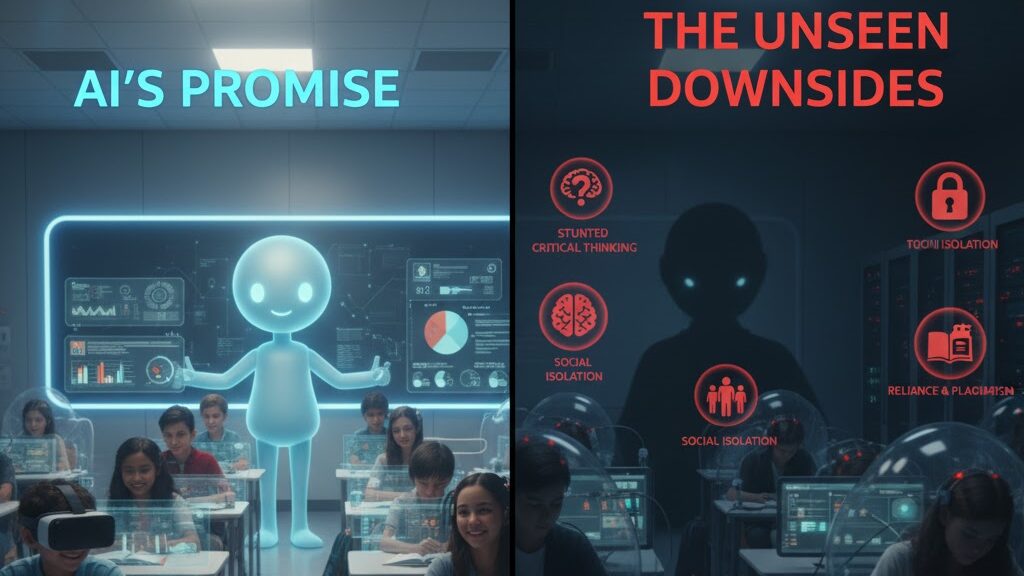
A split image contrasting the perceived benefits and actual drawbacks of AI in education. On the left, "AI'S PROMISE" depicts a bright, modern classroom where students happily engage with holographic AI interfaces and a friendly AI avatar. On the right, "THE UNSEEN DOWNSIDES" shows a darker, more isolated classroom where students are encapsulated in individual AI pods, surrounded by icons representing "STUNTED CRITICAL THINKING," "SOCIAL ISOLATION," and "RELIANCE & PLAGIARISM," with an ominous alien-like AI figure looming in the background. Image (and typos) generated by Nano Banana.
While the integration of AI in schools holds significant promise for personalised learning, its rising use also comes with substantial, often unforeseen, downsides for students. This image starkly contrasts the idealised vision of AI in education with the potential negative realities, highlighting risks such as diminished critical thinking, increased social isolation, and an over-reliance that could foster academic dishonesty. Image (and typos) generated by Nano Banana.

Source

Education Week

Summary

A new report from the Center for Democracy and Technology warns that the rapid adoption of AI in schools is undermining students’ relationships, critical thinking and data privacy. In 2024–25, 85 % of teachers and 86 % of students used AI, yet fewer than half received any formal training. The report highlights emotional disconnection, weaker research skills and risks like data breaches and tech-fuelled bullying. While educators acknowledge AI’s benefits for efficiency and personalised learning, experts urge schools to prioritise teacher training, AI literacy, and ethical safeguards to prevent harm. Without adequate guidance, AI could deepen inequities rather than improve learning outcomes.

Key Points

  • AI use has surged across US classrooms, with 85 % of teachers and 86 % of students using it.
  • Students report weaker connections with teachers and peers due to AI use.
  • Teachers fear declines in students’ critical thinking and authenticity.
  • Less than half of teachers and students have received AI-related training.
  • Experts call for stronger AI literacy, ethics education and policy guardrails.

Keywords

URL

https://www.edweek.org/technology/rising-use-of-ai-in-schools-comes-with-big-downsides-for-students/2025/10

Summary generated by ChatGPT 5