How AI Adoption May Erode Key Skills US Students Need in an Automated World


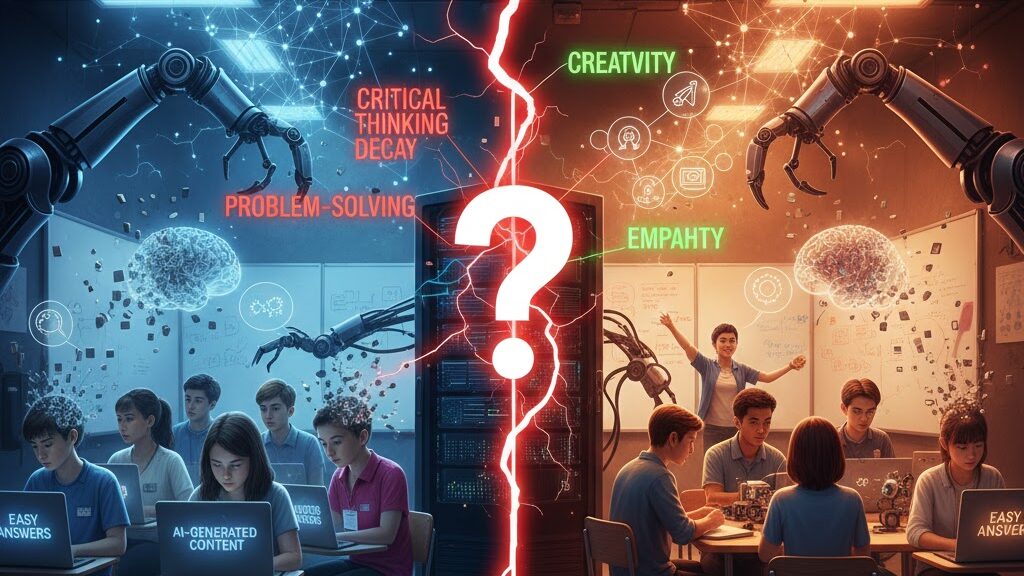
A highly conceptual visual of a digital circuit board with key areas representing skills like "Critical Thinking," "Problem Solving," and "Originality" fading and becoming obscured by an overwhelming cloud of generic, high-speed AI data. Image (and typos) generated by Nano Banana.
The automation paradox: Experts warn that while AI drives efficiency, its widespread adoption in education may inadvertently erode the crucial cognitive and creative skills US students need to thrive in a future dominated by technology. Image (and typos) generated by Nano Banana.

Source

Times of India (Education International Desk)

Summary

This article explores concerns that widespread adoption of AI tools in education may undermine essential skills that students require for long-term success in an increasingly automated world. Educators and analysts interviewed argue that easy access to generative AI for writing, problem solving and research may weaken students’ capacity for critical thinking, creativity and independent judgement. They note that while AI can accelerate tasks, it may also reduce opportunities for deep learning and cognitive struggle, both of which are crucial for intellectual development. The article raises concerns that students who rely heavily on AI may experience diminished confidence in producing original work and solving complex problems without technological support. Experts recommend curriculum renewal that blends responsible AI literacy with explicit instruction in foundational skills, ensuring that students can use AI effectively without sacrificing their broader intellectual growth. The discussion reflects a recurring theme in the global AI-in-education debate: the need to preserve human expertise and cognitive resilience in an era of pervasive automation. The article calls for educators, policymakers and institutions to strike a balance between embracing AI and safeguarding human capabilities.

Key Points

  • Widespread AI use may weaken foundational cognitive skills
  • Risks include reduced independent thinking and reduced confidence
  • Educators call for curriculum redesign with balanced AI integration
  • Highlights need for responsible AI literacy
  • Addresses long-term workforce preparation concerns

Keywords

URL

https://timesofindia.indiatimes.com/education/news/how-ai-adoption-may-erode-key-skills-us-students-need-in-an-automated-world/articleshow/125672541.cms

Summary generated by ChatGPT 5.1


Students Who Lack Academic Confidence More Likely to Use AI


In a modern university library setting, a young female student with a concerned expression is intently focused on her laptop. A glowing holographic interface floats above her keyboard, displaying "ESSAY ASSIST," "RESEARCH BOT," and "CONFIDENCE BOOST!" with an encouraging smiley face. In the background, other students are also working on laptops. Image (and typos) generated by Nano Banana.
Research suggests a correlation between a lack of academic confidence in students and an increased likelihood of turning to AI tools for assistance. This image depicts a student utilising an AI interface offering “confidence boost” and “essay assist,” illustrating how AI can become a crutch for those feeling insecure about their abilities in the academic environment. Image (and typos) generated by Nano Banana.

Source

Inside Higher Ed

Summary

A survey by Inside Higher Ed and Generation Lab finds that 85 % of students claim they’ve used generative AI for coursework in the past year. Among the habits observed, students with lower self-perceived academic competence or low confidence are more likely to lean on AI tools, especially when unsure or reluctant to ask peers or instructors for help. The study distinguishes between instrumental help-seeking (clarification, explanations) and executive help-seeking (using AI to complete work). Students who trust AI more are also more likely to use it. The authors argue that universities need clearer AI policies and stronger support structures so that students don’t feel forced into overreliance.

Key Points

  • 85 % of surveyed students reported using generative AI for coursework in the past year.
  • Students with lower academic confidence or discomfort asking peers tend to rely more on AI.
  • AI use splits into two modes: instrumental (asking questions, clarifying) vs executive (using the AI to generate or complete work).
  • Trust in AI correlates with higher usage, even controlling for other variables.
  • Many students call for clear, standardised institutional policies on AI use to reduce ambiguity.

Keywords

URL

https://www.insidehighered.com/news/student-success/academic-life/2025/09/30/students-who-lack-academic-confidence-more-likely-use

Summary generated by ChatGPT 5