Latest Posts

‘It’s going to be a life skill’: educators discuss the impact of AI on university education


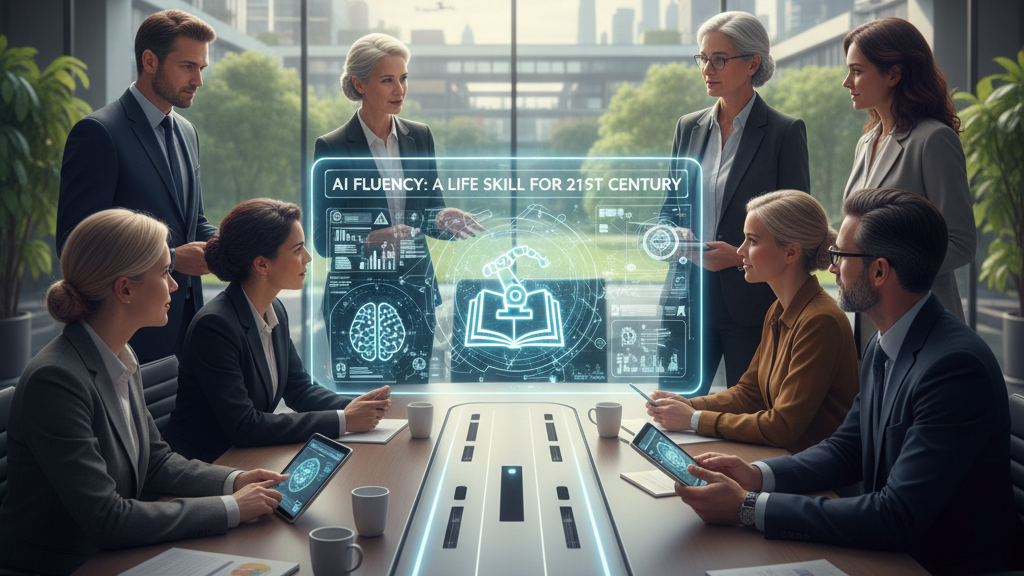
In a modern, sunlit conference room with a city view, a diverse group of seven educators in business attire are gathered around a sleek table. They are looking at a central holographic display that reads 'AI FLUENCY: A LIFE SKILL FOR 21ST CENTURY' and shows icons related to AI and learning. The scene depicts a discussion among professionals about the transformative impact of AI on university education. Generated by Nano Banana.
As AI reshapes industries and daily life, educators are converging to discuss its profound impact on university education, recognising AI fluency not merely as a technical skill but as an essential ‘life skill’ for the 21st century. This image captures a pivotal conversation among academic leaders focused on integrating AI into curricula to prepare students for the future. Image generated by Nano Banana.

Source

The Guardian

Summary

Educators argue that generative AI is swiftly moving from a novelty to a necessary skill, and universities must catch up. Students are often more advanced in AI usage than academic institutions, which are playing catch‑up with policy, curriculum adaptation, and support services. The piece emphasises that being able to use AI tools (and understand their limits) should be as fundamental as reading and writing. Universities are urged to incorporate AI literacy broadly—across disciplines—ensure equitable access, and ensure that teaching still reinforces enduring human skills like critical thinking, creativity, and communication.

Key Points

  • AI proficiency is becoming a life skill; many students already use AI tools, often more adeptly than institutions can respond.
  • Important for students to evaluate what AI can and can’t do, not just how to use it.
  • Universities should show leadership: clear AI strategy, support across all courses.
  • Equity matters: ensuring all students have access and skills to use AI.
  • Human skills (creativity, communication, thinking) retain their value even as AI tools become common.

Keywords

URL

https://www.theguardian.com/education/2025/sep/13/its-going-to-be-a-life-skill-educators-discuss-the-impact-of-ai-on-university-education

Summary generated by ChatGPT 5


Education report calling for ethical AI use contains over 15 fake sources


In the foreground, a robotic hand holds a red pen, poised over documents labeled 'THE FUTURE OF ETHICAL AI'. A glowing red holographic screen above the desk displays 'FAKE SOURCE DETECTED' and 'OVER 15 FABRICATED ENTRIES', showing snippets of text and data. The scene powerfully illustrates the irony of an ethics report containing fake sources, highlighting the challenges of AI and misinformation. Generated by Nano Banana.
In a striking testament to the complex challenges of the AI era, a recent education report advocating for ethical AI use has itself been found to contain over 15 fabricated sources. This image captures the alarming irony and the critical need for vigilance in an information landscape increasingly blurred by AI-generated content and potential misinformation. Image generated by Nano Banana.

Source

Ars Technica

Summary

An influential Canadian government report advocating ethical AI in education was found to include over 15 fake or misattributed sources upon scrutiny. Experts examining the document flagged that many citations led to dead links, non-existent works, or outlets that had no record of publication. The revelations raise serious concerns about how “evidence” is constructed in policy advisories and may undermine the credibility of calls for AI ethics in education. The incident stands as a caution: even reports calling for rigour must themselves be rigorous.

Key Points

  • The Canadian report included more than 15 citations that appear to be fabricated or misattributed.
  • Some sources could not be found in public databases, and some journal names were incorrect or non-existent.
  • The errors weaken the report’s authority and open it to claims of hypocrisy in calls for ethical use of AI.
  • Experts argue that policy documents must adhere to the same standards they demand of educational AI tools.
  • This case underscores how vulnerable institutional narratives are to “junk citations” and sloppy vetting.

Keywords

URL

https://arstechnica.com/ai/2025/09/education-report-calling-for-ethical-ai-use-contains-over-15-fake-sources/

Summary generated by ChatGPT 5


Google’s top AI scientist says ‘learning how to learn’ will be next generation’s most needed skill


Four diverse young individuals (three female, one male) are seated around a futuristic round table in a high-rise room overlooking a city. In the center of the table, glowing holographic icons emanate from a central lightbulb, representing concepts like 'METACOGNITION,' 'CRITICAL THINKING,' 'PROBLEM SOLVING,' and 'ADAPTABILITY.' The scene symbolises the importance of fundamental learning skills for the next generation. Generated by Nano Banana.
In an era of rapid technological change and readily available information, the ability to ‘learn how to learn’ is emerging as the paramount skill for the next generation. This image illustrates a collaborative, future-focused environment where metacognition, critical thinking, and continuous adaptation are the core competencies being cultivated to thrive in an unpredictable world. Image generated by Nano Banana.

Source

AP News

Summary

At a public talk in Athens, Demis Hassabis, CEO of DeepMind and 2024 Nobel laureate, stressed that rapid advances in AI demand the human meta-skill of “learning how to learn.” He argued that traditional education (math, science, humanities) will remain important, but people must develop adaptability and the capacity to continuously upskill. Hassabis warned that artificial general intelligence (AGI) might arrive within a decade, making continuous learning essential. He also warned of inequality risks if AI’s benefits remain in the hands of a few, urging both societal awareness and human agency.

Key Points

  • Hassabis proposes that meta-learning (knowing how to learn) will become a critical human skill as AI rises.
  • He predicts AGI could emerge in ~10 years, accelerating the need to adapt.
  • Traditional knowledge (math, humanities) will remain relevant, but must be complemented by agility.
  • He cautions against inequality: if gains flow only to a few, social mistrust may grow.
  • The pace of AI change is so fast that fixed curricula risk becoming obsolete.

Keywords

URL

https://www.apnews.com/article/greece-google-artificial-intelligence-hassabis-85bff114c30cbea4b951ab93dcc1e6d1

Summary generated by ChatGPT 5


As AI tools reshape education, schools struggle with how to draw the line on cheating


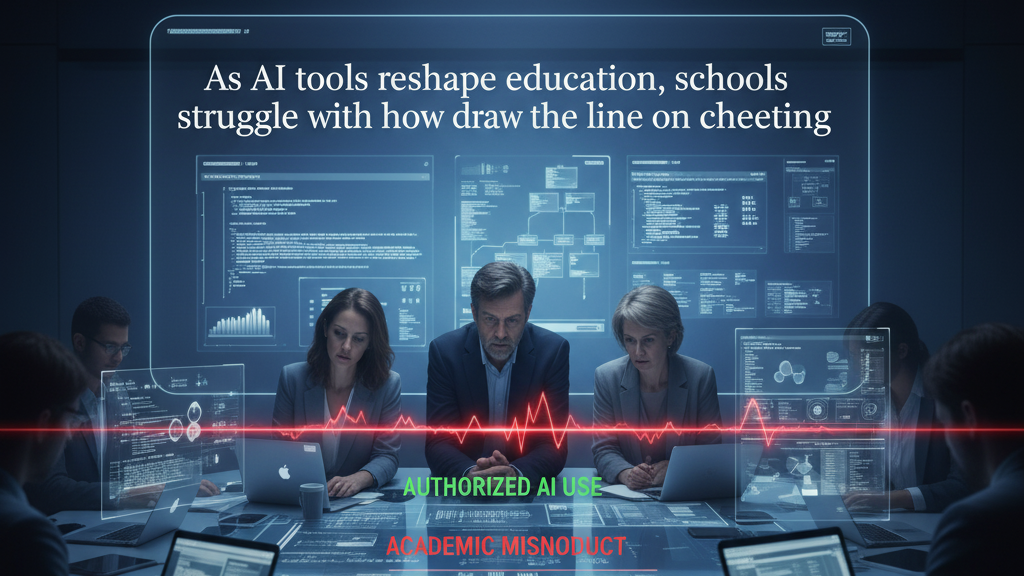
A group of educators and administrators in business attire are seated around a modern conference table, intensely focused on laptops. A glowing red line, fluctuating like a waveform, runs down the center of the table, separating 'AUTHORIZED AI USE' from 'ACADEMIC MISCONDUCT'. A large holographic screen above displays the headline 'As AI tools reshape education, schools struggle with how to how to draw the line on cheeting'. The scene visualizes the challenge of defining ethical boundaries for AI in academia. Generated by Nano Banana.
As AI tools become ubiquitous in education, schools are grappling with the complex and often ambiguous task of defining the line between legitimate AI assistance and academic misconduct. This image captures the intensity of discussions among educators striving to establish clear policies and maintain academic integrity in an evolving technological landscape. Image (and typos) generated by Nano Banana.

Source

ABC News

Summary

AI is now so widespread among students that traditional assessments (take‑home essays, homework) are often considered invitations to ‘cheat.’ Teachers are responding by shifting to in‑class writing, using lockdown browsers, blocking device access, redesigning assignments, and clarifying AI policies. But confusion remains: students don’t always have clarity on what’s allowed, and teaching methods lag behind the technology. There’s growing consensus that blanket bans are not enough — what matters more is teaching students how to use AI responsibly, with transparent guidelines that protect academic integrity without stifling learning.

Key Points

  • High prevalence of student use of AI is challenging existing norms around homework & take‑home essays.
  • Teachers increasingly require in‑class work, verbal assessments, or technology controls (lockdown browser).
  • Students often unsure where the line is: what counts as cheating isn’t always clear.
  • Institutions & faculty are drafting clearer policies and guidelines; bans alone are unviable.
  • Equity issues emerge: AI access/use varies, raising fairness concerns.

Keywords

URL

https://abcnews.go.com/US/wireStory/ai-tools-reshape-education-schools-struggle-draw-line-125501970

Summary generated by ChatGPT 5


The Question All Colleges Should Ask Themselves About AI


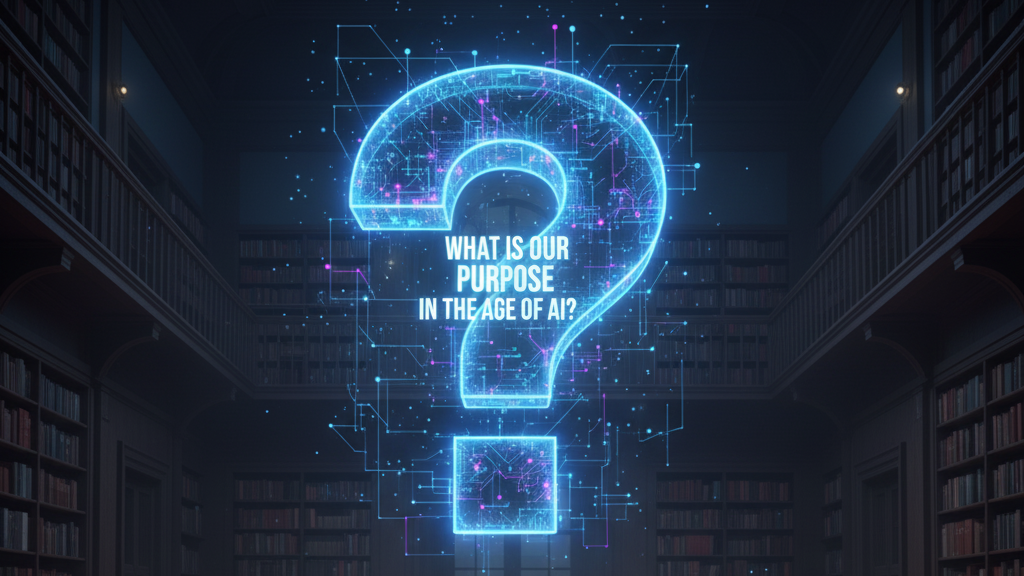
In a grand, traditional university library, a glowing holographic question mark formed from digital circuitry. Inside the question mark, the text reads "WHAT IS OUR PURPOSE IN THE AGE OF AI?". Image (and typos) generated by Nano Banana.
As Artificial Intelligence reshapes industries and societies, colleges and universities are confronted with a fundamental challenge: redefining their core purpose. This image powerfully visualises the critical question that all academic institutions must now address regarding their relevance, value, and role in an increasingly AI-driven world. Image (and typos) generated by Nano Banana.

Source

The Atlantic

Summary

AI is now deeply embedded in college life — often unauthorised — and colleges are struggling with responses. Many institutions fail to enforce coherent, system‑wide policies, risking degradation of learning, peer relationships, and integrity of scholarship. The article suggests radical measures like tech/device bans or stronger honour codes to defend educational values, while teaching responsible AI use where appropriate. Colleges must choose whether to integrate AI or resist it, guided by their core values.

Key Points

  • Unauthorised AI use undermines learning and fairness.
  • Removes opportunities for deep thinking and writing.
  • Institutional goals like originality are compromised by AI’s fabrications and IP issues.
  • Proposals: banning devices, honour codes, strict penalties.
  • Colleges must clarify values and boundaries for AI use.

Keywords

URL

https://www.theatlantic.com/culture/archive/2025/09/ai-colleges-universities-solution/684160/

Summary generated by ChatGPT 5