Latest Posts

ChatGPT can hallucinate: College dean in Dubai urges students to verify data


In a modern, high-tech lecture hall with a striking view of the Dubai skyline at night, a female college dean stands at a podium, gesturing emphatically towards a large holographic screen. The screen prominently displays the ChatGPT logo surrounded by numerous warning signs and error messages such as "ERROR: FACTUAL INACCURACY" and "DATA HALLUCINATION DETECTED," with a bold command at the bottom: "VERIFY YOUR DATA!". Students in traditional Middle Eastern attire are seated, working on laptops. Image (and typos) generated by Nano Banana.
Following concerns over ChatGPT’s tendency to “hallucinate” or generate factually incorrect information, a college dean in Dubai is issuing a crucial directive to students: always verify data provided by AI. This image powerfully visualises the critical importance of scrutinising AI-generated content, emphasising that while AI can be a powerful tool, human verification remains indispensable for academic integrity and accurate knowledge acquisition. Image (and typos) generated by Nano Banana.

Source

Gulf News

Summary

Dr Wafaa Al Johani, Dean of Batterjee Medical College in Dubai, cautioned students against over-reliance on generative AI tools like ChatGPT during the Gulf News Edufair Dubai 2025. Speaking on the panel “From White Coats to Smart Care: Adapting to a New Era in Medicine,” she emphasised that while AI is transforming medical education, it can also produce false or outdated information—known as “AI hallucination.” Al Johani urged students to verify all AI-generated content, practise ethical use, and develop AI literacy. She stressed that AI will not replace humans but will replace those who fail to learn how to use it effectively.

Key Points

  • AI is now integral to medical education but poses risks through misinformation.
  • ChatGPT and similar tools can generate false or outdated medical data.
  • Students must verify AI outputs and prioritise ethical use of technology.
  • AI literacy, integrity, and continuous learning are essential for future doctors.
  • Simulation-based and hybrid training models support responsible tech adoption.

Keywords

URL

https://gulfnews.com/uae/chatgpt-can-hallucinate-college-dean-in-dubai-urges-students-to-verify-data-1.500298569

Summary generated by ChatGPT 5


University wrongly accuses students of using artificial intelligence to cheat


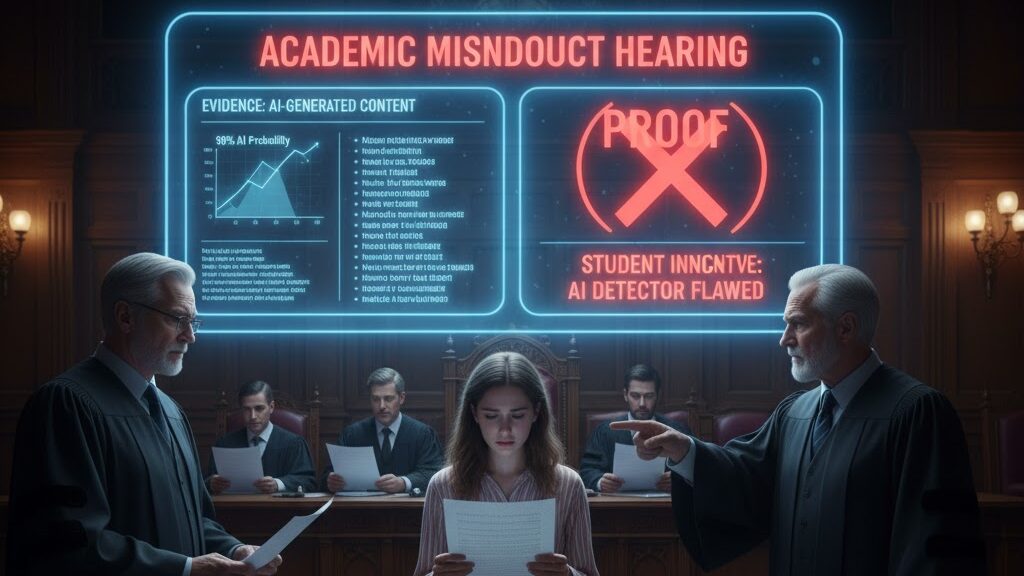
In a solemn academic hearing room, reminiscent of a courtroom, a distressed female student stands before a panel of university officials in robes, holding a document. A large holographic screen above displays "ACADEMIC MISCONDUCT HEARING." On the left, "EVIDENCE: AI-GENERATED CONTENT" shows a graph of AI probability, while on the right, a large red 'X' over "PROOF" is accompanied by text stating "STUDENT INNOCENT: AI DETECTOR FLAWED," highlighting a wrongful accusation. Image (and typos) generated by Nano Banana.
The burgeoning reliance on AI detection software has led to a disturbing trend: universities wrongly accusing students of using artificial intelligence to cheat. This dramatic image captures the devastating moment a student is cleared after an AI detector malfunctioned, highlighting the serious ethical challenges and immense distress caused by flawed technology in academic integrity processes. Image (and typos) generated by Nano Banana.

Source

ABC News (Australia)

Summary

The Australian Catholic University (ACU) has come under fire after wrongly accusing hundreds of students of using AI to cheat on assignments. Internal records showed nearly 6,000 academic misconduct cases in 2024, around 90 % linked to AI use. Many were based solely on Turnitin’s unreliable AI detection tool, later scrapped for inaccuracy. Students said they faced withheld results, job losses and reputational damage while proving their innocence. Academics reported low AI literacy, inconsistent policies and heavy workloads. Experts, including Sydney’s Professor Danny Liu, argue that banning AI is misguided and that universities should instead teach students responsible and transparent use.

Key Points

  • ACU recorded nearly 6,000 misconduct cases, most tied to alleged AI use.
  • Many accusations were based only on Turnitin’s flawed AI detector.
  • Students bore the burden of proof, with long investigation delays.
  • ACU has since abandoned the AI tool and introduced training on ethical AI use.
  • Experts urge universities to move from policing AI to teaching it responsibly.

Keywords

URL

https://www.abc.net.au/news/2025-10-09/artificial-intelligence-cheating-australian-catholic-university/105863524

Summary generated by ChatGPT 5


Leaving Cert changes won’t stand up to AI, says Colm O’Rourke


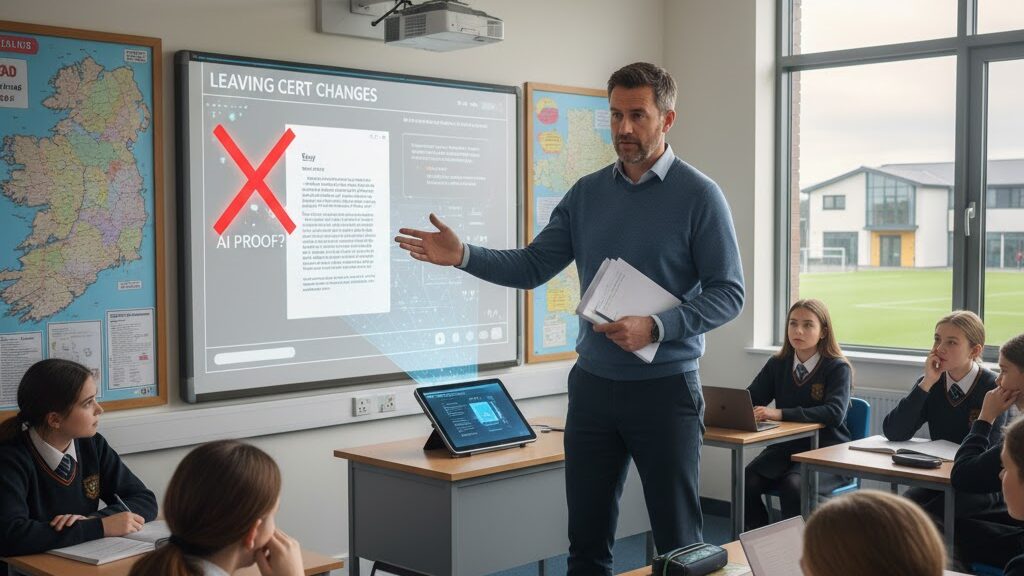
In a modern secondary school classroom, a male teacher stands at the front, holding papers and gesturing towards a large interactive screen. The screen displays "LEAVING CERT CHANGES" with a big red 'X' over a document and the question "AI PROOF?", indicating concerns about the new exam structure's vulnerability to AI. Students in school uniforms are seated at desks, attentively listening. Image (and typos) generated by Nano Banana.
Concerns are mounting that recent changes to the Leaving Certificate examination system may not be robust enough to withstand the challenges posed by artificial intelligence. This image depicts a teacher discussing the new exam structure in a classroom, highlighting anxieties that the updated assessment methods might be susceptible to AI-driven academic dishonesty, compromising the integrity of the crucial final exams. Image (and typos) generated by Nano Banana.

Source

BreakingNews.ie

Summary

Former school principal and columnist Colm O’Rourke has criticised Ireland’s revised Leaving Certificate curriculum, warning that new assessment methods are ill-equipped to withstand the influence of generative AI. The updated curriculum, which allocates 40 % of marks to classroom-based work, was designed to promote continuous assessment but, according to O’Rourke, is now “too easy to cheat.” He argues that the reforms—developed years ago—have already been overtaken by technological change. O’Rourke calls for more in-person, practical, and oral-style assessments to ensure authenticity and to distinguish between genuine learning and AI-assisted shortcuts.

Key Points

  • The new Leaving Cert curriculum allocates 40 % of marks to class-based assessments.
  • O’Rourke warns these assessments are highly vulnerable to AI-assisted cheating.
  • He advocates for oral, practical, and supervised assessment formats instead.
  • The reforms were designed a decade ago and are now outdated by AI’s rapid rise.
  • He argues that genuine knowledge acquisition cannot be replicated by AI tools.

Keywords

URL

https://www.breakingnews.ie/ireland/leaving-cert-changes-wont-stand-up-to-ai-says-colm-orourke-1816115.html

Summary generated by ChatGPT 5


ChatGPT Has Been My Tutor for the Last Year. I Still Have Concerns.


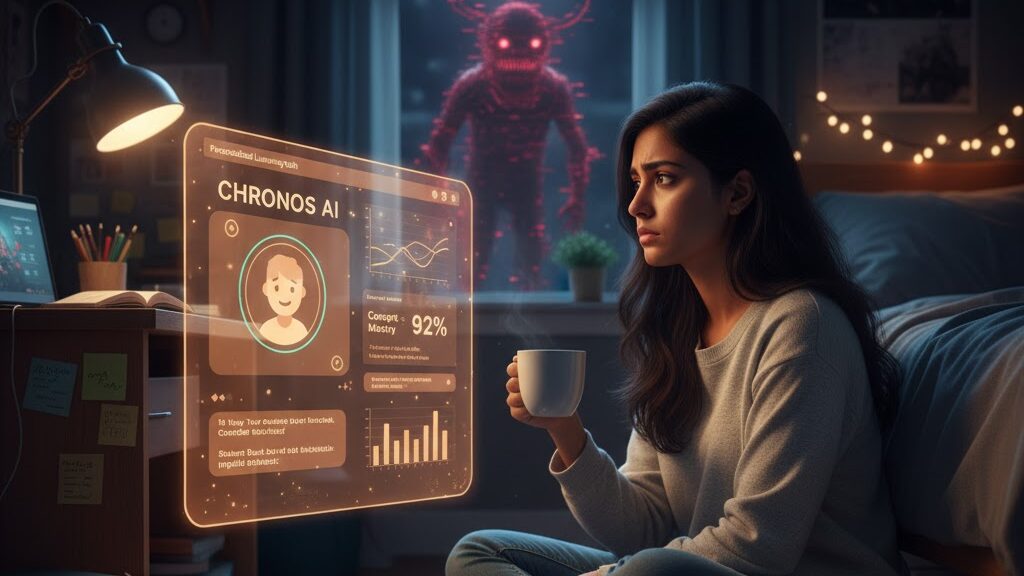
In a cozy, slightly cluttered student bedroom at night, a young female student sits on the floor with her laptop and books, looking pensively at a glowing holographic interface displaying "CHRONOS AI - Your Personal Learning Hub," showing a tutor avatar, progress, and various metrics. In the window behind her, a shadowy, horned monster with red eyes ominously peers in, symbolizing underlying concerns despite the AI's utility. Image (and typos) generated by Nano Banana.
While ChatGPT has served as a personal tutor for many students over the past year, its pervasive integration into learning also brings forth lingering concerns. This image captures a student’s thoughtful yet wary engagement with an AI tutor, visually juxtaposing its apparent utility with an ominous background figure, representing the unresolved anxieties about AI’s deeper implications for education and personal development. Image (and typos) generated by Nano Banana.

Source

The Harvard Crimson

Summary

Harvard student Sandhya Kumar reflects on a year of using ChatGPT as a learning companion, noting both its benefits and the university’s inconsistent response to generative AI. While ChatGPT has become a common study aid for debugging, essay support, and brainstorming, unclear academic guidelines have led to confusion about acceptable use. Some professors ban AI entirely, while others encourage it, leaving students without a shared framework for responsible integration. Kumar argues that rather than restricting AI, universities should teach AI literacy—helping students understand when and how to use these tools thoughtfully to enhance learning, not replace it.

Key Points

  • AI tools like ChatGPT are now embedded in student life and coursework.
  • Harvard’s response to AI use remains fragmented across departments.
  • Students face unclear ethical and authorship boundaries when using AI.
  • The author calls for structured AI literacy education rather than bans.
  • Thoughtful engagement with AI requires defined boundaries and shared guidance.

Keywords

URL

https://www.thecrimson.com/article/2025/10/7/kumar-harvard-chatgpt-tutor/

Summary generated by ChatGPT 5


Today’s AI hype has echoes of a devastating technology boom and bust 100 years ago


A split image contrasting two eras. On the left, a sepia-toned scene from 100 years ago shows a crowd enthusiastically gathered around industrial machinery and towering power lines, with a banner proclaiming "THE FUTURE OF EVERYTHING!" On the right, a vibrant, futuristic cityscape glows under a digital sky, where a diverse crowd looks up at a holographic brain symbol and text announcing "AI REVOLUTION! UNLIMITED POTENTIAL!". In the foreground, people interact with digital news showing "AI CRASHES" and "TECH LAYOFFS." Image (and typos) generated by Nano Banana.
The intense fervor surrounding today’s AI technology mirrors the intense hype and subsequent devastating bust of a technological revolution a century ago. This side-by-side comparison starkly portrays the recurring cycle of technological innovation and speculation, prompting a cautionary reflection on whether the current AI gold rush could face a similar fate to past booms and busts. Image (and typos) generated by Nano Banana.

Source

The Conversation

Summary

Cameron Shackell draws parallels between today’s AI boom and the electrification craze of the 1920s. Just as electricity fuelled massive innovation, speculation and eventual collapse, AI is showing similar patterns of overinvestment, market concentration and loose regulation. The 1929 stock market crash revealed the dangers of unregulated “high-tech” exuberance, leading to reforms that transformed electricity into stable infrastructure. Shackell warns that AI could follow the same path—booming unsustainably before a painful correction—unless governments implement thoughtful regulation. The question, he suggests, is whether we can integrate AI safely into daily life before a comparable bust forces reform.

Key Points

  • The 1920s electricity boom mirrors today’s AI surge in hype and speculation.
  • Both technologies reshaped industries and drove market concentration.
  • Lack of oversight in the 1920s helped trigger the Great Depression.
  • AI’s rapid expansion faces similarly weak global regulation.
  • The author urges proactive governance to avoid another tech-driven collapse.

Keywords

URL

https://theconversation.com/todays-ai-hype-has-echoes-of-a-devastating-technology-boom-and-bust-100-years-ago-265492

Summary generated by ChatGPT 5