Latest Posts

OpenAI’s newly launched Sora 2 makes AI’s environmental impact impossible to ignore


A dark, dystopian cityscape at night is dominated by towering data centers and skyscrapers, one of which prominently displays "OPENAI SORA 2" in glowing blue. Massive plumes of black and fiery red smoke billow from multiple buildings, symbolizing extreme environmental impact. A crowd of people looks on, while a holographic graph in the foreground shows "GLOBAL ENERGY CONSUMPTION: CRITICAL" and "CO2 EMISSIONS: EXTREME," with an icon of a distressed Earth. Image (and typos) generated by Nano Banana.
The recent launch of OpenAI’s Sora 2, a highly advanced AI model, unequivocally brings the environmental impact of artificial intelligence to the forefront, making it impossible to overlook. This dramatic image visually represents the significant energy consumption and CO2 emissions associated with powerful AI systems, urging a critical examination of the ecological footprint of cutting-edge technological advancements. Image (and typos) generated by Nano Banana.

Source

The Conversation

Summary

Robert Diab argues that the release of OpenAI’s Sora 2—a text-to-video model capable of generating ultra-realistic footage—has reignited urgent debate about AI’s environmental costs. While Sora 2’s creative potential is striking, its vast energy and water demands highlight the ecological footprint of large-scale AI. Data centres already consume around 1.5 % of global electricity, projected to double by 2030, with AI accounting for much of that growth. Competing narratives frame AI as either an ecological threat or a manageable risk, but Diab calls for transparency, regulation, and responsible scaling to ensure technological progress does not deepen environmental strain.

Key Points

  • Sora 2 showcases AI’s creative power but underscores its huge energy demands.
  • AI training and usage are accelerating global electricity and water consumption.
  • The “Jevons paradox” means efficiency gains can still drive higher total energy use.
  • Experts urge standardised, transparent reporting of AI’s environmental footprint.
  • Policymakers must balance innovation with sustainable data-centre expansion.

Keywords

URL

https://theconversation.com/openais-newly-launched-sora-2-makes-ais-environmental-impact-impossible-to-ignore-266867

Summary generated by ChatGPT 5


Schools in Wales ‘excited but wary’ as teacher workloads cut


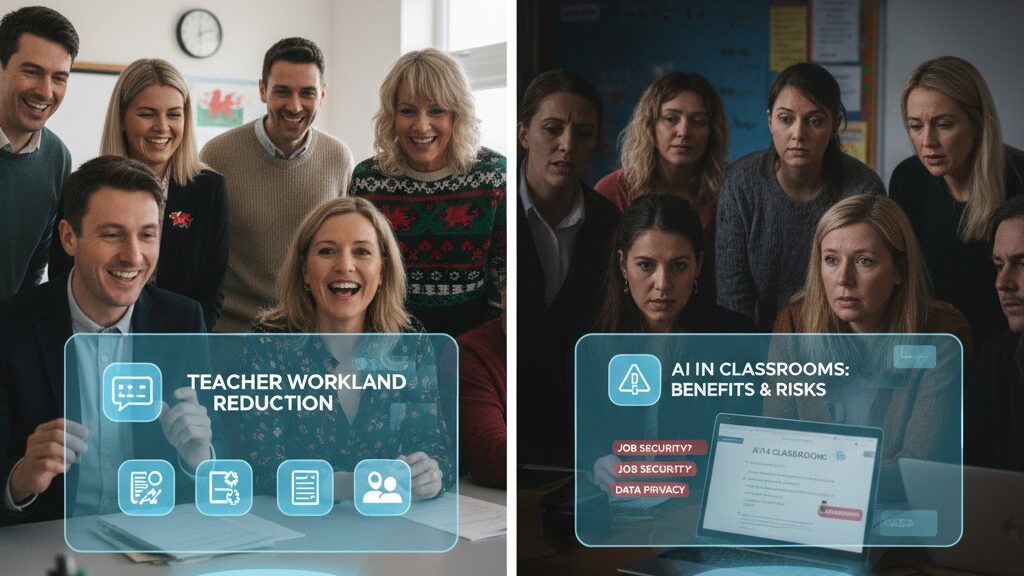
A split image contrasting two emotional responses to AI in Welsh schools. On the left, a group of smiling, happy teachers stands around a table with a glowing holographic display showing "TEACHER WORKLOAD REDUCTION" and icons representing administrative tasks, symbolizing excitement. On the right, a group of wary, concerned teachers huddle around a laptop displaying "AI IN CLASSROOMS: BENEFITS & RISKS," with text highlighting "JOB SECURITY?" and "DATA PRIVACY," reflecting their apprehension. The Welsh flag is visible in the background on the left. Image (and typos) generated by Nano Banana.
As artificial intelligence begins to reduce teacher workloads in schools across Wales, educators are experiencing a mix of excitement for the potential benefits and apprehension about the unseen challenges. This image vividly contrasts the initial relief of reduced administrative burdens with the underlying worries about job security, data privacy, and the broader impact of AI on the educational landscape. Image (and typos) generated by Nano Banana.

Source

BBC News

Summary

A new report by Estyn, Wales’s education watchdog, finds that while artificial intelligence is helping teachers save time and reduce administrative workloads, schools remain cautious about its classroom use. Many Welsh teachers now use AI for lesson planning, report writing and tailoring resources for students with additional needs. However, concerns persist around plagiarism, over-reliance, and data ethics. At Birchgrove Comprehensive School in Swansea, staff are teaching pupils to use AI responsibly, balancing innovation with digital literacy. Estyn and the Welsh government both emphasise the need for national guidance and training to ensure AI enhances learning without undermining skills or safety.

Key Points

  • AI is reducing teacher workloads by automating planning and reporting tasks.
  • Estyn warns that schools need clearer guidance for ethical and safe AI use.
  • Pupils are using AI for revision and learning support, often with teacher oversight.
  • Staff report excitement about AI’s potential but remain wary of bias and misuse.
  • The Welsh government has committed to training and national policy development.

Keywords

URL

https://www.bbc.com/news/articles/c0lkdxpz0dyo

Summary generated by ChatGPT 5


How to Teach Critical Thinking When AI Does the Thinking


In a modern classroom overlooking a city skyline, a female teacher engages with a small group of students around a table. A glowing holographic maze labeled "CRITICAL THINKING" emanates from the tabletop, surrounded by various interactive data displays. In the background, other students work on laptops, and a large screen at the front displays "CRITICAL THINKING IN THE AGE OF AI: NAVIGATING THE ALGORITHMIC LANDSCAPE." Image (and typos) generated by Nano Banana.
As artificial intelligence increasingly automates cognitive tasks, educators face the crucial challenge of teaching critical thinking when AI can “do the thinking” for students. This image illustrates a forward-thinking classroom where a teacher guides students through complex, interactive simulations designed to hone their critical thinking skills, transforming AI from a potential crutch into a tool for deeper intellectual engagement and navigating an algorithmic world. Image (and typos) generated by Nano Banana.

Source

Psychology Today

Summary

Timothy Cook explores how the growing use of generative AI is eroding critical thinking and accountability in both education and professional contexts. Citing Deloitte’s $291,000 error-filled AI-generated report, he warns that overreliance on AI leads to “cognitive outsourcing,” where users stop questioning information and lose ownership of their ideas. Educators, he argues, mirror this problem by automating grading and teaching materials while penalising students for doing the same. Cook proposes a “dialogic” approach—using AI as a thinking partner through questioning, critique, and reflection—to restore analytical engagement and model responsible use in classrooms and workplaces alike.

Key Points

  • Deloitte’s AI-generated report highlights the risks of uncritical reliance on ChatGPT.
  • Many educators automate teaching tasks while discouraging students from AI use.
  • Frequent AI users show weakened brain connectivity and reduced ownership of ideas.
  • Dialogic prompting—interrogating AI outputs—fosters deeper reasoning and creativity.
  • Transparent, guided AI use should replace institutional hypocrisy and cognitive outsourcing.

Keywords

URL

https://www.psychologytoday.com/us/blog/the-algorithmic-mind/202510/how-to-teach-critical-thinking-when-ai-does-the-thinking

Summary generated by ChatGPT 5


Smarter Classrooms, Real Results: How AI is Rewriting the Rules of Education


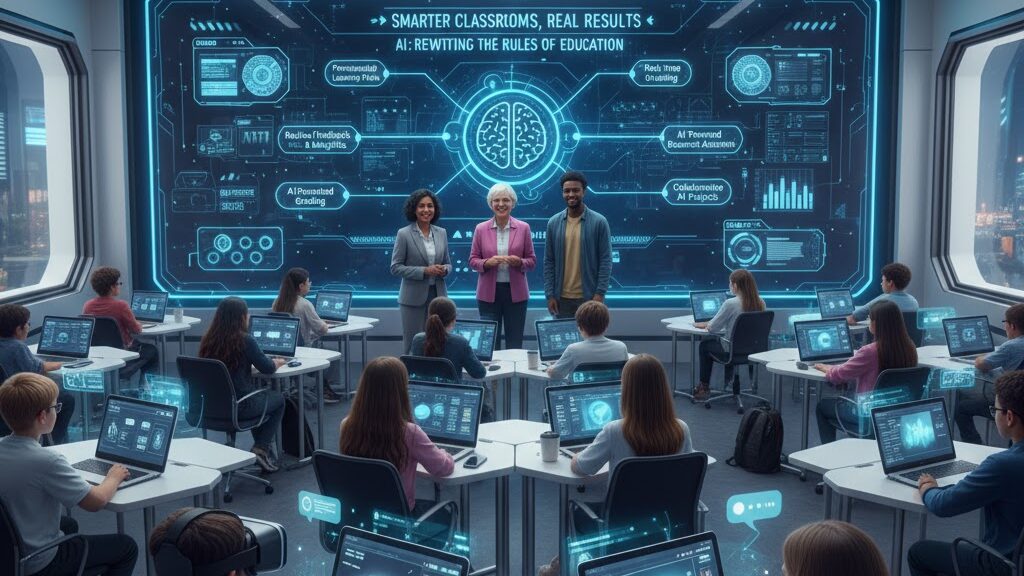
In a sleek, futuristic classroom filled with students using laptops and holographic interfaces, three educators (two female, one male) stand at the front, presenting to the class. A large, interactive screen prominently displays "SMARTER CLASSROOMS, REAL RESULTS: AI IS REWRITING THE RULES OF EDUCATION," featuring a central glowing brain icon surrounded by various AI applications like personalized learning paths, automated grading, and AI-powered assessment. Image (and typos) generated by Nano Banana.
Artificial intelligence is fundamentally “rewriting the rules of education,” ushering in an era of smarter classrooms and demonstrating tangible improvements in learning outcomes. This image envisions a dynamic, technologically advanced educational environment where AI tools enhance every aspect of teaching and learning, from personalised instruction and automated feedback to collaborative projects, ultimately delivering real and measurable results for students. Image (and typos) generated by Nano Banana.

Source

WTOP News

Summary

Will Vitka reports that artificial intelligence is transforming classrooms by saving teachers time, improving accessibility, and offering real-time personalised learning. University of Maryland professor Charles Harry describes AI as a “huge net positive” when used thoughtfully, helping educators create complex, adaptive assignments and enabling students to learn coding and data analysis more quickly. AI tools are also levelling the field for learners with disabilities and multilingual needs. However, privacy, ethical use, and over-reliance remain major concerns. Surveys show one in four teachers believe AI causes more harm than good, underscoring the need for balance between innovation and integrity.

Key Points

  • AI personalises learning and provides real-time academic feedback for students.
  • Educators using AI save up to six hours per week on administrative tasks.
  • Accessibility improves through tools like translation and voice-to-text.
  • Ethical concerns persist around cheating and student data privacy.
  • The global AI-in-education market could reach $90 billion by 2032.

Keywords

URL

https://wtop.com/education/2025/10/smarter-classrooms-real-results-how-ai-is-rewriting-the-rules-of-education/

Summary generated by ChatGPT 5


Why Higher Ed’s AI Rush Could Put Corporate Interests Over Public Service and Independence


In a grand, traditional university meeting room with stained-glass windows, a group of academic leaders in robes and corporate figures in suits are gathered around a long table. Above them, a large holographic display illustrates a stark contrast: "PUBLIC SERVICE & INDEPENDENCE" on the left (glowing blue) versus "CORPORATE AI DOMINATION" on the right (glowing red), with glowing digital pathways showing the potential flow of influence from academic values towards corporate control, symbolized by locked icons and data clouds. Image (and typos) generated by Nano Banana.
The rapid embrace of AI in higher education, often driven by external pressures and vast resources, raises critical concerns that corporate interests could overshadow the foundational values of public service and academic independence. This image visually depicts the tension between these two forces, suggesting that universities risk compromising their core mission if the “AI rush” prioritises commercial gains over their commitment to unbiased research, equitable access, and intellectual autonomy. Image (and typos) generated by Nano Banana.

Source

The Conversation

Summary

Chris Wegemer warns that universities’ accelerating embrace of AI through corporate partnerships may erode academic independence and their public service mission. High-profile collaborations—such as those between Nvidia and the University of Florida, Microsoft and Princeton, and OpenAI with the California State University system—illustrate a growing trend toward “corporatisation.” Wegemer argues that financial pressures, prestige-seeking, and the decline in enrolment are driving institutions to adopt market-driven governance, aligning higher education with private-sector priorities. Without transparent oversight and faculty involvement, he cautions, universities risk sacrificing democratic values and intellectual freedom for commercial gain.

Key Points

  • Universities are partnering with tech giants to build AI infrastructure and credentials.
  • These partnerships deepen higher education’s dependence on corporate capital.
  • Market and prestige pressures are displacing public-interest research priorities.
  • Faculty governance and academic freedom are being sidelined in AI decision-making.
  • The author urges renewed focus on transparency, democracy, and public accountability.

Keywords

URL

https://theconversation.com/why-higher-eds-ai-rush-could-put-corporate-interests-over-public-service-and-independence-260902

Summary generated by ChatGPT 5