Latest Posts

Preparing Students for the World of Work Means Embracing an AI-Positive Culture


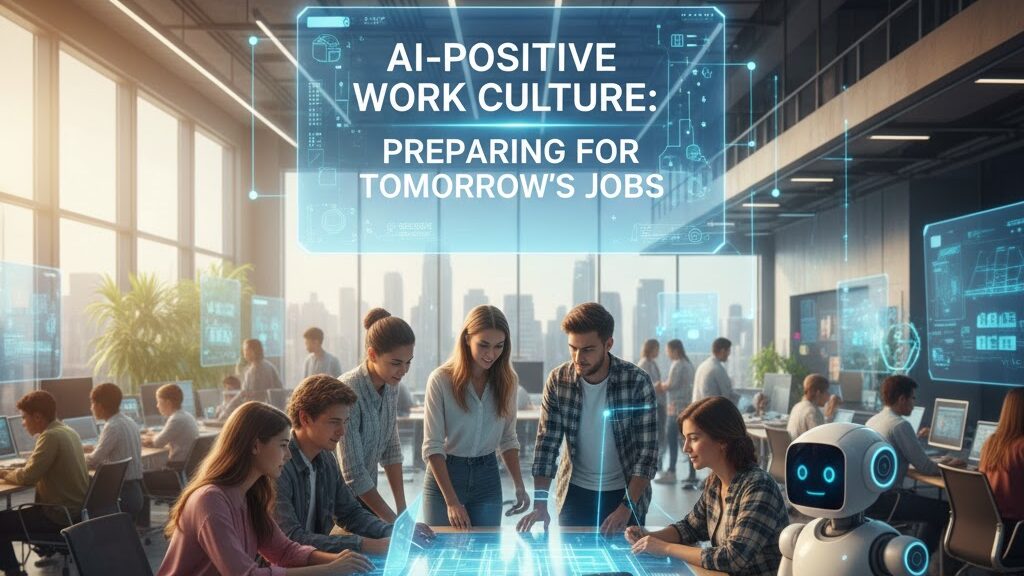
A vibrant, modern open-plan office setting, bustling with young professionals and students collaborating. In the foreground, a diverse group of five young adults is gathered around a table, intensely focused on glowing, interactive holographic projections emanating from the table surface, displaying data and digital interfaces. A friendly, white humanoid robot stands nearby, observing or assisting. In the background, other individuals are working at desks with computers, and various screens display data. Overlaid text reads "AI-POSITIVE WORK CULTURE: PREPARING FOR TOMORROW'S JOBS." Image (and typos) generated by Nano Banana.
To truly prepare students for tomorrow’s workforce, higher education must foster an AI-positive culture. This involves embracing artificial intelligence not as a threat, but as a transformative tool that enhances skills and creates new opportunities in the evolving world of work. Image (and typos) generated by Nano Banana.

Source

Wonkhe

Summary

Alastair Robertson argues that higher education must move beyond piecemeal experimentation with generative AI and instead embed an “AI-positive culture” across teaching, learning, and institutional practice. While universities have made progress through policies such as the Russell Group’s principles on generative AI, most remain in an exploratory phase lacking strategic coherence. Robertson highlights the growing industry demand for AI literacy—especially foundational skills like prompting and evaluating outputs—contrasting this with limited student support in universities. He advocates co-creation among students, educators, and AI, where generative tools enhance learning personalisation, assessment, and data-driven insights. To succeed, universities must invest in technology, staff development, and policy frameworks that align AI with institutional values and foster innovation through strategic leadership and partnership with industry.

Key Points

  • Industry demand for AI literacy far outpaces current higher education provision.
  • Universities remain at an early stage of AI adoption, lacking coherent strategic approaches.
  • Co-creation between students, educators, and AI can deepen engagement and improve outcomes.
  • Embedding AI requires investment in infrastructure, training, and ethical policy alignment.
  • An AI-positive culture depends on leadership, collaboration, and flexibility to adapt as technology evolves.

Keywords

URL

https://wonkhe.com/blogs/preparing-students-for-the-world-of-work-means-embracing-an-ai-positive-culture/

Summary generated by ChatGPT 5


AI is the flying car of the mind: An irresistible idea nobody knows how to land or manage


A retro-futuristic flying car, adorned with intricate circuit board patterns, soars through a starry night sky filled with clouds. A person with glowing eyes is at the wheel, looking forward with a determined expression. Below, numerous smaller flying cars navigate around a landscape of floating islands, each supporting miniature, dense cityscapes with landing pads. Question marks and subtle digital elements are scattered throughout the scene, symbolizing uncertainty and the challenge of managing this technology. Image (and typos) generated by Nano Banana.
Much like the elusive flying car, AI represents an exhilarating vision for the future—a powerful innovation for the mind. Yet, the question remains: how do we effectively land and manage this revolutionary technology, ensuring its safe and beneficial integration into our world? Image (and typos) generated by Nano Banana.

Source

The Register

Summary

Mark Pesce likens artificial intelligence to the “flying car of the mind”—an alluring concept that few know how to operate safely. Drawing parallels with early computing, he argues that despite AI’s apparent intuitiveness, effective use requires deep understanding of workflow, data, and design. Pesce criticises tech companies for distributing powerful AI tools to untrained users, fuelling unrealistic expectations and inevitable failures. Without proper guidance and structured learning, most AI projects—like unpiloted flying cars—end in “flaming wrecks.” He concludes that meaningful productivity gains come only when users invest the effort to learn how to “fly” AI systems responsibly.

Key Points

  • AI, like the personal computer once was, demands training before productivity is possible.
  • The “flying car” metaphor captures AI’s mix of allure, danger, and complexity.
  • Vendors overstate AI’s accessibility while underestimating the need for user expertise.
  • Most AI projects fail because of poor planning, lack of data management, or user naïveté.
  • Pesce calls for humility, discipline, and education in how AI tools are adopted and applied.

Keywords

URL

https://www.theregister.com/2025/10/15/ai_vs_flying_cars/

Summary generated by ChatGPT 5


How Generative AI Could Change How We Think and Speak


A glowing, ethereal blue silhouette of a human head and shoulders against a dark, starry background. Within the head, vibrant cosmic energy and swirling light converge, symbolizing thought and consciousness. From the head, streams of complex code, abstract data visualizations, and various speech bubbles with different languages and concepts flow outward, representing language and communication. Above the head, two pairs of translucent, glowing hands reach down, seemingly interacting with or guiding the processes. On either side, futuristic holographic interfaces display intricate data and neural networks. Image (and typos) generated by Nano Banana.
Generative AI is not just changing how we create, but how we fundamentally process information and express ourselves. Explore the profound ways this transformative technology could reshape human thought patterns and linguistic communication in the years to come. Image (and typos) generated by Nano Banana.

Source

The Conversation

Summary

Antonio Cerella examines how generative AI may reshape the cognitive and linguistic habits that underpin human thought. Drawing on psychology, neuroscience, and linguistics, he argues that over-reliance on AI tools risks weakening creativity, critical thinking, and language mastery. Just as GPS technology has diminished spatial memory, constant AI-assisted writing and problem-solving could erode our ability to form and express original ideas. Cerella warns that when language becomes pre-packaged through AI systems, the connection between speech and thought deteriorates, fostering a “culture of immediacy” driven by emotion rather than understanding. Yet for those with mature linguistic awareness, AI can still serve as a creative partner—if used reflectively and not as a substitute for thought.

Key Points

  • Overuse of AI may dull critical thinking and creative language use.
  • Psychological research shows that technological reliance can reconfigure the brain.
  • AI-generated language risks weakening the link between thought and expression.
  • The loss of linguistic agency could erode democratic discourse and imagination.
  • Conscious, reflective engagement with language can preserve creativity and autonomy.

Keywords

URL

https://theconversation.com/how-generative-ai-could-change-how-we-think-and-speak-267118

Summary generated by ChatGPT 5


Dartmouth Builds Its Own AI Chatbot for Student Well-Being


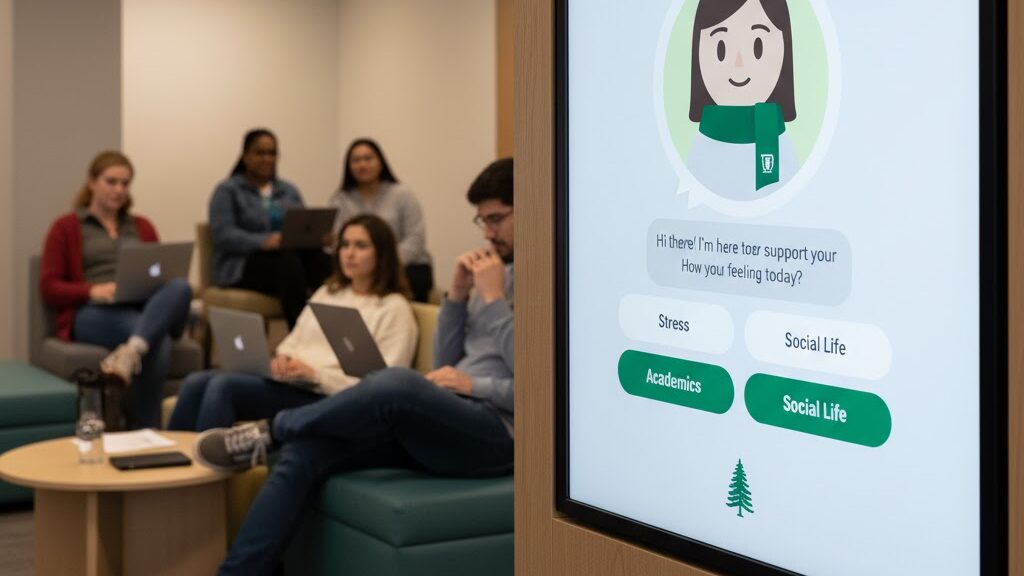
A close-up of a digital display screen showing a friendly AI chatbot interface titled "DARTMOUTH COMPANION." The chatbot has an avatar of a friendly character wearing a green scarf with the Dartmouth shield. Text bubbles read "Hi there! I'm here to support you. How you feeling today?" with clickable options like "Stress," "Social Life," and "Academics." In the blurred background, several college students are visible in a modern, comfortable common area, working on laptops and chatting, suggesting a campus environment. The Dartmouth logo (pine tree) is visible at the bottom of the screen. Image (and typos) generated by Nano Banana.
Dartmouth College takes a proactive step in student support by developing its own AI chatbot, “Dartmouth Companion.” This innovative tool aims to provide accessible assistance and resources for student well-being, addressing concerns from academics to social life. Image (and typos) generated by Nano Banana.

Source

Inside Higher Ed

Summary

Dartmouth College is developing Evergreen, a student-designed AI chatbot aimed at improving mental health and well-being on campus. Led by Professor Nicholas Jacobson, the project involves more than 130 undergraduates contributing research, dialogue, and content creation to make the chatbot conversational and evidence-based. Evergreen offers tailored guidance on health topics such as exercise, sleep, and time management, using opt-in data from wearables and campus systems. Unlike third-party wellness apps, it is student-built, privacy-focused, and designed to intervene early when students show signs of distress. A trial launch is planned for autumn 2026, with potential for wider adoption across universities.

Key Points

  • Evergreen is a Dartmouth-built AI chatbot designed to support student well-being.
  • Over 130 undergraduate researchers are developing its conversational features.
  • The app personalises feedback using student-approved data such as sleep and activity.
  • Safety features alert a self-identified support team if a user is in crisis.
  • The first controlled trial is set for 2026, with plans to share the model with other colleges.

Keywords

URL

https://www.insidehighered.com/news/student-success/health-wellness/2025/10/14/dartmouth-builds-its-own-ai-chatbot-student-well

Summary generated by ChatGPT 5


AI and Assessment Training Initiative Empowers Lecturers


A group of diverse lecturers and educators in a modern meeting room, actively participating in a training session. A male presenter stands in front of a large, interactive screen displaying "AI-POWERED ASSESSMENT STRATEGIES" and various glowing data visualizations, charts, and a central brain icon representing AI. Participants around a large table are engaged with laptops and tablets, with some looking towards the screen and others discussing amongst themselves. The overall atmosphere is collaborative and focused on learning new technologies.  Image (and typos) generated by Nano Banana.
Empowering educators for the future: A new AI and assessment training initiative is equipping lecturers with the knowledge and tools to effectively integrate artificial intelligence into their evaluation strategies, enhancing teaching and learning outcomes. Image (and typos) generated by Nano Banana.

Source

North-West University News (South Africa)

Summary

North-West University (NWU) has launched a large-scale professional development initiative to promote responsible use of artificial intelligence in teaching, learning, and assessment. The AI and Assessment course, supported by the Senior Deputy Vice-Chancellor for Teaching and Learning, the AI Hub, and the Centre for Teaching and Learning, awarded R500 Takealot vouchers to the first 800 lecturers who completed all eleven modules. Participants earned fifteen digital badges by achieving over 80 per cent in assessments and submitting a portfolio of evidence. The initiative underscores NWU’s commitment to digital transformation and capacity building. Lecturers praised the programme for strengthening their understanding of ethical and effective AI integration in higher education.

Key Points

  • 800 NWU lecturers were incentivised to complete the AI and Assessment training course.
  • The programme awarded fifteen digital badges for verified completion and assessment success.
  • Leadership highlighted AI’s transformative role in teaching and learning innovation.
  • Participants reported improved confidence in using AI tools responsibly and ethically.
  • The initiative reinforces NWU’s institutional focus on digital capability and staff development.

Keywords

URL

https://news.nwu.ac.za/ai-and-assessment-training-initiative-empowers-lecturers

Summary generated by ChatGPT 5