Professors experiment as AI becomes part of student life


In a modern university lecture hall, three professors (two female, one male) stand at a glowing, interactive holographic table, actively demonstrating or discussing AI concepts. Students are seated at desks, some using laptops with glowing AI interfaces, and one student wears a VR headset. A large holographic screen in the background displays 'AI Integration Lab: Fall 2024'. The scene depicts educators experimenting with AI in a learning environment. Generated by Nano Banana.
As AI increasingly integrates into daily student life, professors are actively experimenting with new pedagogical approaches and tools to harness its potential. This image captures a dynamic classroom setting where educators are at the forefront of exploring how AI can enrich learning, adapt teaching methods, and prepare students for an AI-driven future. Image generated by Nano Banana.

Source

The Globe and Mail

Summary

AI has shifted from novelty to necessity in Canadian higher education, with almost 60% of students now using it. Professors are experimenting with different approaches: some resist, others regulate, and many actively integrate AI into assessments. Concerns remain about diminished critical thinking, but educators like those at the University of Toronto and University of Guelph argue that ignoring AI leaves graduates unprepared. Strategies include teaching students to refine AI-generated drafts, redesigning assignments to require human input, and adopting oral assessments. The consensus is that policies alone cannot keep pace; practical, ethical, and reflective engagement is essential for preparing students to use AI responsibly.

Key Points

  • Nearly 60% of Canadian students use AI for coursework, rising globally to over 90%.
  • Professors face a choice: resist, regulate, or embrace AI; ignoring it is seen as untenable.
  • Innovative teaching methods include refining AI drafts, training prompt skills, and oral assessments.
  • Concerns persist about weakening critical thinking and creativity.
  • Preparing students for AI-rich workplaces requires embedding literacy, ethics, and adaptability.

Keywords

URL

https://www.theglobeandmail.com/business/article-professors-experiment-as-ai-becomes-part-of-student-life/

Summary generated by ChatGPT 5


How are UK students really using AI?


A five-panel mosaic shows diverse UK students interacting with AI. Top row: a Black female student drinks coffee while using a laptop with glowing AI interfaces in a library; a male student studies a book with AI visuals; a male student in a lab coat uses a holographic AI screen with a UK university building in the background. Bottom row: a female student writes while looking at AI data; another male student explains a holographic AI model to a small group of students. The overall image depicts widespread AI integration in student life. Generated by Nano Banana.
From research assistance to code generation and personalised study aids, AI is subtly and overtly reshaping how UK students approach their academic work. This mosaic illustrates the multifaceted ways technology is being integrated into learning, posing questions about its true impact and future trajectory in higher education. Image generated by Nano Banana.

Source

Times Higher Education

Summary

About two-thirds (66 %) of UK undergraduate students report using AI for work or study, with one in three doing so at least weekly. ChatGPT is by far the most popular tool. Universities vary in how they regulate or guide AI use: some discourage it, others provide boundaries but little training, few actively teach ethical AI practice. Most students use AI for understanding concepts, summarising content, or identifying sources, while a smaller but significant share admits to using AI to create or partially create graded work. Many believe AI has helped their grades, though others see little or negative impact. Clearer guidance and teaching around ethical, effective AI use are needed.

Key Points

  • 66% of UK undergrads use AI for degree-related work; 33% use it weekly.
  • The most common applications: explaining difficult concepts (81%), summarising sources (69%), finding sources, and improving existing work.
  • About 14% of AI-using students confess to using AI in graded work in ways that could be cheating (creating or heavily editing), which is ~9% of all students.
  • 47% of AI-using students report frequently encountering “hallucinations” (incorrect or false information) from AI tools.
  • Universities’ policies are mixed: some actively discourage use; many simply warn; only a minority proactively teach students how to use AI well and ethically.

Keywords

URL

https://yougov.co.uk/society/articles/52855-how-are-uk-students-really-using-ai

Summary generated by ChatGPT 5


How to use ChatGPT at university without cheating: ‘Now it’s more like a study partner’


Three university students (two male, one female) are seated at a table with laptops and books, smiling and engaged in discussion. Behind them, a large transparent screen displays a glowing blue humanoid AI figure pointing to various academic data and charts. The setting is a modern library, conveying a collaborative study environment where AI acts as a helpful, non-cheating resource. Generated by Nano Banana.
Moving beyond fears of academic dishonesty, many students are now leveraging ChatGPT as an ethical ‘study partner’ to enhance their learning experience at university. This image illustrates a collaborative approach where AI supports understanding and exploration, rather than providing shortcuts, thereby fostering a new era of academic assistance. Image generated by Nano Banana.

Source

The Guardian

Summary

Many students now treat ChatGPT less like a cheating shortcut and more like a study partner: for grammar checks, revision, practice questions, and organising notes. Usage jumped from 66% to 92% in a year. Universities are clarifying rules: AI can support study but not generate assignment content. Educators stress AI literacy, awareness of risks (hallucinations, fake references), and critical thinking to ensure AI complements rather than replaces learning.

Key Points

  • Student AI use rose from ~66% to ~92% in a year; viewed more as a partner than a cheat tool.
  • Valid uses: organising notes, summarising, and generating practice questions.
  • Risks: overreliance, hallucinations, using AI to write assignments still banned.
  • Some universities track AI usage or require logs; policies clearer.
  • Message: AI should be supplemental, not a substitute; build literacy and critical skills.

Keywords

URL

https://www.theguardian.com/education/2025/sep/14/how-to-use-chatgpt-at-university-without-cheating-now-its-more-like-a-study-partner

Summary generated by ChatGPT 5


‘It’s going to be a life skill’: educators discuss the impact of AI on university education


In a modern, sunlit conference room with a city view, a diverse group of seven educators in business attire are gathered around a sleek table. They are looking at a central holographic display that reads 'AI FLUENCY: A LIFE SKILL FOR 21ST CENTURY' and shows icons related to AI and learning. The scene depicts a discussion among professionals about the transformative impact of AI on university education. Generated by Nano Banana.
As AI reshapes industries and daily life, educators are converging to discuss its profound impact on university education, recognising AI fluency not merely as a technical skill but as an essential ‘life skill’ for the 21st century. This image captures a pivotal conversation among academic leaders focused on integrating AI into curricula to prepare students for the future. Image generated by Nano Banana.

Source

The Guardian

Summary

Educators argue that generative AI is swiftly moving from a novelty to a necessary skill, and universities must catch up. Students are often more advanced in AI usage than academic institutions, which are playing catch‑up with policy, curriculum adaptation, and support services. The piece emphasises that being able to use AI tools (and understand their limits) should be as fundamental as reading and writing. Universities are urged to incorporate AI literacy broadly—across disciplines—ensure equitable access, and ensure that teaching still reinforces enduring human skills like critical thinking, creativity, and communication.

Key Points

  • AI proficiency is becoming a life skill; many students already use AI tools, often more adeptly than institutions can respond.
  • Important for students to evaluate what AI can and can’t do, not just how to use it.
  • Universities should show leadership: clear AI strategy, support across all courses.
  • Equity matters: ensuring all students have access and skills to use AI.
  • Human skills (creativity, communication, thinking) retain their value even as AI tools become common.

Keywords

URL

https://www.theguardian.com/education/2025/sep/13/its-going-to-be-a-life-skill-educators-discuss-the-impact-of-ai-on-university-education

Summary generated by ChatGPT 5


As AI tools reshape education, schools struggle with how to draw the line on cheating


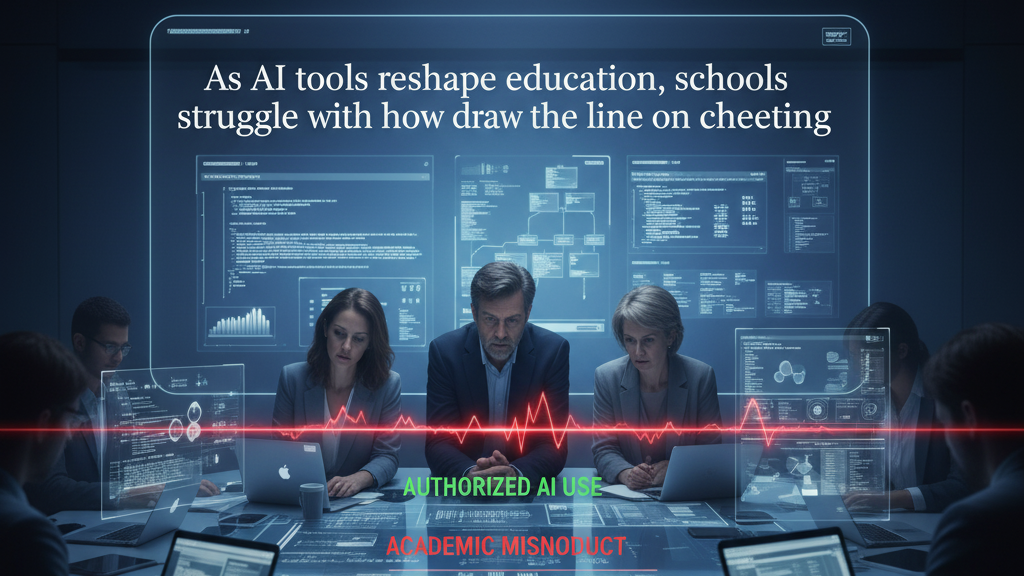
A group of educators and administrators in business attire are seated around a modern conference table, intensely focused on laptops. A glowing red line, fluctuating like a waveform, runs down the center of the table, separating 'AUTHORIZED AI USE' from 'ACADEMIC MISCONDUCT'. A large holographic screen above displays the headline 'As AI tools reshape education, schools struggle with how to how to draw the line on cheeting'. The scene visualizes the challenge of defining ethical boundaries for AI in academia. Generated by Nano Banana.
As AI tools become ubiquitous in education, schools are grappling with the complex and often ambiguous task of defining the line between legitimate AI assistance and academic misconduct. This image captures the intensity of discussions among educators striving to establish clear policies and maintain academic integrity in an evolving technological landscape. Image (and typos) generated by Nano Banana.

Source

ABC News

Summary

AI is now so widespread among students that traditional assessments (take‑home essays, homework) are often considered invitations to ‘cheat.’ Teachers are responding by shifting to in‑class writing, using lockdown browsers, blocking device access, redesigning assignments, and clarifying AI policies. But confusion remains: students don’t always have clarity on what’s allowed, and teaching methods lag behind the technology. There’s growing consensus that blanket bans are not enough — what matters more is teaching students how to use AI responsibly, with transparent guidelines that protect academic integrity without stifling learning.

Key Points

  • High prevalence of student use of AI is challenging existing norms around homework & take‑home essays.
  • Teachers increasingly require in‑class work, verbal assessments, or technology controls (lockdown browser).
  • Students often unsure where the line is: what counts as cheating isn’t always clear.
  • Institutions & faculty are drafting clearer policies and guidelines; bans alone are unviable.
  • Equity issues emerge: AI access/use varies, raising fairness concerns.

Keywords

URL

https://abcnews.go.com/US/wireStory/ai-tools-reshape-education-schools-struggle-draw-line-125501970

Summary generated by ChatGPT 5