You Can Detect AI Writing With These Tips


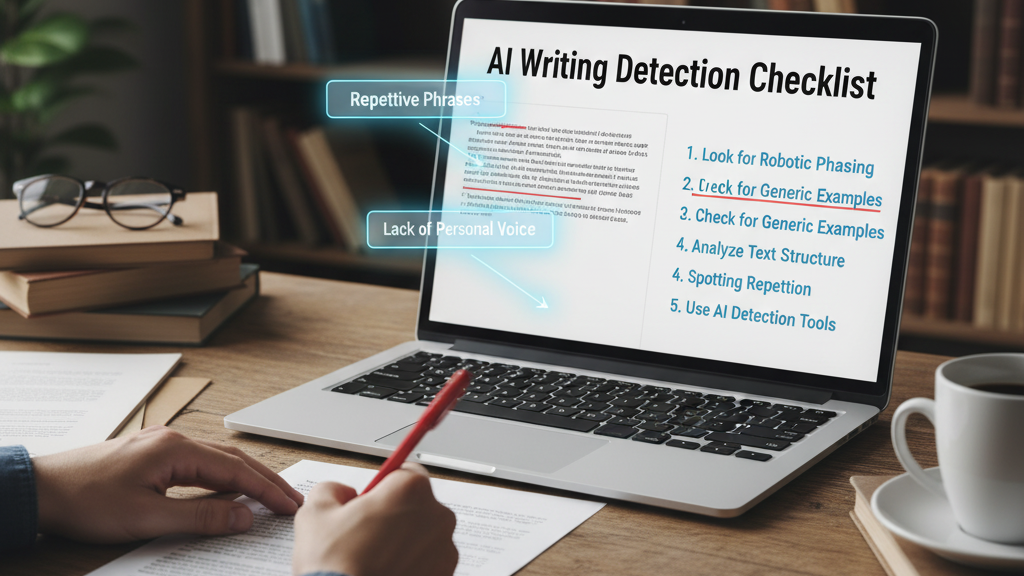
A person's hands are shown at a wooden desk, writing on a paper with a red pen. In front of them, a laptop displays an "AI Writing Detection Checklist" with tips like "Look for Robotic Phrasing," "Check for Generic Examples," and "Analyze Text Structure." Highlighted on the screen are examples of "Repetitive Phrases" and "Lack of Personal Voice," indicating common AI writing tells. A stack of books and a coffee cup are also on the desk. Image (and typos) generated by Nano Banana.
With the proliferation of AI-generated content, discerning human writing from machine-generated text has become an essential skill. This image presents practical tips and a checklist to help identify AI writing, focusing on common tells such as repetitive phrases, generic examples, and a lack of personal voice, empowering readers and educators to critically evaluate written material. Image (and typos) generated by Nano Banana.

Source

CNET

Summary

CNET offers a practical guide for spotting AI-generated writing. It highlights typical cues: prompts embedded openly in the text, overly generic or ambiguous language, unnatural transitions, repetition, and lack of depth or specificity. The article suggests that when a piece echoes the original assignment prompt too directly, that’s a red flag. While no single cue is definitive, combining several tells (tone flatness, formulaic structure, prompt residue) increases confidence that AI was involved. The aim isn’t accusation but raising readers’ critical sensitivity toward AI authorship.

Key Points

  • AI text often includes remnants of the assignment prompt verbatim.
  • It tends to use generic, vague, or ambivalent phrasing more often than human writers.
  • Repetitive patterns, smooth transitions, and “flat” tone are common signals.
  • Contextual depth, original insight, nuance, and emotional detail are often muted.
  • Use a cluster of clues rather than relying on one signal to infer AI writing.

Keywords

URL

https://www.cnet.com/tech/services-and-software/use-these-simple-tips-to-detect-ai-writing/

Summary generated by ChatGPT 5

How AI Is Rewriting the Future of Humanities Education


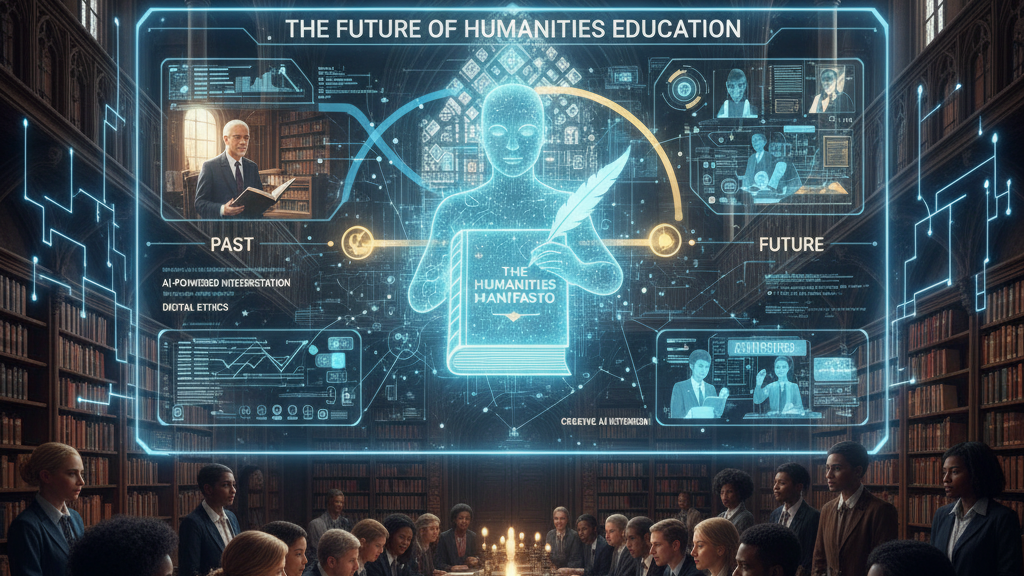
In a grand, ornate university library, a group of diverse students and professors are seated around a long, candlelit wooden table, engaged in a discussion. Above them, a large holographic display titled "THE FUTURE OF HUMANITIES EDUCATION" shows a central figure holding "THE HUMANITIES MANIFESTO" with a quill, flanked by "PAST" and "FUTURE" panels detailing AI-powered interpretation, digital ethics, and evolving roles of AI in humanities. Image (and typos) generated by Nano Banana.
Artificial intelligence is not merely influencing but actively “rewriting” the trajectory of humanities education, prompting a re-evaluation of its foundational principles and methodologies. This image captures a moment of deep academic reflection, visualizing how AI is introducing new tools for interpretation, posing ethical challenges, and ultimately shaping a dynamic new future for the study of human culture and thought. Image (and typos) generated by Nano Banana.

Source

Forbes

Summary

Mary Hemphill argues that while AI is rapidly changing technical and STEM fields, its impact on the humanities may be even more profound. She sees AI not just as a tool but a collaborator—helping students explore new interpretations, generate creative prompts, and push boundaries in writing, philosophy, or cultural critique. But this is double-edged: overreliance risks hollowing out the labour of thinking deeply, undermining the craft faculty value. Hemphill suggests humanities courses must adapt via “AI-native” pedagogy: teaching prompt literacy, interrogative reading, and critical layering. The goal: use AI to elevate human thinking, not replace it.

Key Points

  • Humanities may shift from sourcing facts to exploring deeper interpretation, guided by AI-assisted exploration.
  • Students should be taught prompt literacy—how to interrogate AI outputs, not accept them.
  • “AI-native” pedagogy: adaptation of assignments to expect AI use, layered with critical human engagement.
  • Overreliance on AI can weaken students’ capacity for independent thinking and textual craftsmanship.
  • Humanities faculty must lead design of AI integration that preserves the values of the discipline.

Keywords

URL

https://www.forbes.com/sites/maryhemphill/2025/10/01/how-ai-is-rewriting-the-future-of-humanities-education/

Summary generated by ChatGPT 5


Faculty innovate with, and avoid, AI in the classroom


A split image contrasting two distinct classroom approaches to AI. On the left, a bright, modern classroom shows faculty and students collaboratively engaging with holographic displays and laptops, demonstrating "Innovative Integration" and "Collaborative Research AI." On the right, a darker, traditional classroom features a blackboard with a large red 'X' over "AI" and "NO AI TOOLS" written below it, with faculty and students avoiding technology, symbolizing resistance to AI. Image (and typos) generated by Nano Banana.
The academic world is currently experiencing a bifurcated response to artificial intelligence: while some faculty are enthusiastically innovating with AI to transform learning, others are deliberately avoiding its integration, advocating for traditional methods. This image vividly illustrates these contrasting approaches within university classrooms, highlighting the ongoing debate and diverse strategies faculty are employing regarding AI. Image (and typos) generated by Nano Banana.

Source

Cornell Chronicle

Summary

Cornell faculty are experimenting with hybrid approaches to AI: some integrate generative AI into coursework, others push back by returning to in-person, pencil-and-paper assessments. In nutrition and disease classes, AI is used to simulate patient case studies, generating unpredictable errors that prompt students to think critically. In parallel, some professors now include short “job interview” chats or oral questions to verify understanding. A campus survey found 70% of students use GenAI weekly or more, but only 44% of faculty do. Cornell is responding via workshops, a GenAI education working group, and guidelines to preserve academic integrity while embracing AI’s pedagogical potentials.

Key Points

  • AI is used to generate case studies, simulate patients, debate AI arguments, and help faculty draft content.
  • Some faculty moved back to paper exams, in-class assessments, or short oral checks (“job interviews”) to guard learning.
  • A campus survey showed 70% of students use GenAI weekly, vs. 44% of faculty.
  • Cornell’s GenAI working group develops policies, workshops, and academic integrity guidelines around AI use.
  • The approach is not binary acceptance or rejection, but navigating where AI can support without eroding students’ reasoning and agency.

Keywords

URL

https://news.cornell.edu/stories/2025/10/faculty-innovate-and-avoid-ai-classroom

Summary generated by ChatGPT 5


6 Smart Ways I Use AI for Learning (Without Becoming Lazy)


A multi-panel image illustrating smart ways to use AI for learning. The top panel shows a large screen displaying six distinct AI applications: "Personalized Tutor," "Concept Explainer," "Creative Brainstormer," "Language Partner," "Language Partner," and "Feedback Coach." The bottom two panels show individuals actively engaging with these AI tools on their laptops in study environments, utilizing holographic interfaces for tasks like personalized tutoring and receiving feedback, all without appearing lazy. Image (and typos) generated by Nano Banana.
This image showcases six intelligent and active ways individuals can leverage AI for enhanced learning without succumbing to intellectual laziness. From personalized tutoring and concept explanation to creative brainstorming and language practice, these methods highlight how AI can be a powerful tool to augment, rather than replace, human effort in the pursuit of knowledge and skill development. Image (and typos) generated by Nano Banana.

Source

PCMag UK

Summary

Brian Westover explains how AI can enhance learning when used as an active partner, not a shortcut. Drawing on studies from MIT and Microsoft, he warns that offloading critical thinking to AI weakens understanding. Instead, Westover outlines six practical ways to use AI as a learning aid—digitising handwritten notes, organising study materials, creating flashcards, simplifying complex topics, engaging in Socratic dialogue, and practising the Feynman technique. These methods turn AI into a reflection tool that reinforces comprehension, memory, and independent reasoning rather than replacing them.

Key Points

  • AI note-taking should complement—not replace—handwriting, which improves retention and understanding.
  • Use AI to digitise notes, compile key concepts, and create flashcards for spaced repetition learning.
  • Simplify complex topics via prompts such as “Explain like I’m 5” or “In simple English”.
  • Apply Socratic dialogue and Feynman techniques to build reasoning, self-explanation, and mastery.
  • Treat AI as a study partner to deepen thinking, not as a shortcut for completing tasks.

Keywords

URL

https://uk.pcmag.com/ai/160379/6-smart-ways-i-use-ai-for-learning-without-becoming-lazy

Summary generated by ChatGPT 5


AI in the classroom is hard to detect — time to bring back oral tests


In a modern classroom or meeting room, students are seated around a table, some with laptops. Two individuals are engaged in an oral discussion, facing each other. Behind them, a large screen displays lines of code that appear to be pixelating and disappearing, symbolizing the difficulty in detecting AI. Image (and typos) generated by Nano Banana.
As the stealth of AI-generated content in written assignments increases, educators are exploring alternative assessment methods. This image highlights a return to oral examinations, where direct interaction can provide a more accurate measure of a student’s understanding and original thought, bypassing the challenges of AI detection software. Image (and typos) generated by Nano Banana.

Source

The Conversation

Summary

Because AI-written texts are relatively easy to present convincingly, detecting AI use in student work is becoming increasingly difficult. The article argues that oral assessments (discussions, interrogations, viva voce) expose a student’s reasoning in ways AI can’t mimic. Voice, hesitation, follow-up questioning and depth of thought are far harder for AI to fake in real time. The authors suggest reintroducing or strengthening oral exams and conversational assessments as a countermeasure to maintain academic integrity and ensure authentic student understanding.

Key Points

  • AI tools produce polished text, but they fail when asked to defend their reasoning under questioning.
  • Oral tests can force students to show understanding, not just output.
  • Real-time dialogue gives instructors more confidence about authenticity than text alone.
  • Reintroduction of oral assessment may help bridge the integrity gap in AI-era classrooms.
  • The method isn’t perfect, but it is a practical and historically grounded safeguard.

Keywords

URL

https://theconversation.com/ai-in-the-classroom-is-hard-to-detect-time-to-bring-back-oral-tests-265955

Summary generated by ChatGPT 5