How to Teach Critical Thinking When AI Does the Thinking


In a modern classroom overlooking a city skyline, a female teacher engages with a small group of students around a table. A glowing holographic maze labeled "CRITICAL THINKING" emanates from the tabletop, surrounded by various interactive data displays. In the background, other students work on laptops, and a large screen at the front displays "CRITICAL THINKING IN THE AGE OF AI: NAVIGATING THE ALGORITHMIC LANDSCAPE." Image (and typos) generated by Nano Banana.
As artificial intelligence increasingly automates cognitive tasks, educators face the crucial challenge of teaching critical thinking when AI can “do the thinking” for students. This image illustrates a forward-thinking classroom where a teacher guides students through complex, interactive simulations designed to hone their critical thinking skills, transforming AI from a potential crutch into a tool for deeper intellectual engagement and navigating an algorithmic world. Image (and typos) generated by Nano Banana.

Source

Psychology Today

Summary

Timothy Cook explores how the growing use of generative AI is eroding critical thinking and accountability in both education and professional contexts. Citing Deloitte’s $291,000 error-filled AI-generated report, he warns that overreliance on AI leads to “cognitive outsourcing,” where users stop questioning information and lose ownership of their ideas. Educators, he argues, mirror this problem by automating grading and teaching materials while penalising students for doing the same. Cook proposes a “dialogic” approach—using AI as a thinking partner through questioning, critique, and reflection—to restore analytical engagement and model responsible use in classrooms and workplaces alike.

Key Points

  • Deloitte’s AI-generated report highlights the risks of uncritical reliance on ChatGPT.
  • Many educators automate teaching tasks while discouraging students from AI use.
  • Frequent AI users show weakened brain connectivity and reduced ownership of ideas.
  • Dialogic prompting—interrogating AI outputs—fosters deeper reasoning and creativity.
  • Transparent, guided AI use should replace institutional hypocrisy and cognitive outsourcing.

Keywords

URL

https://www.psychologytoday.com/us/blog/the-algorithmic-mind/202510/how-to-teach-critical-thinking-when-ai-does-the-thinking

Summary generated by ChatGPT 5


Schools in Wales ‘excited but wary’ as teacher workloads cut


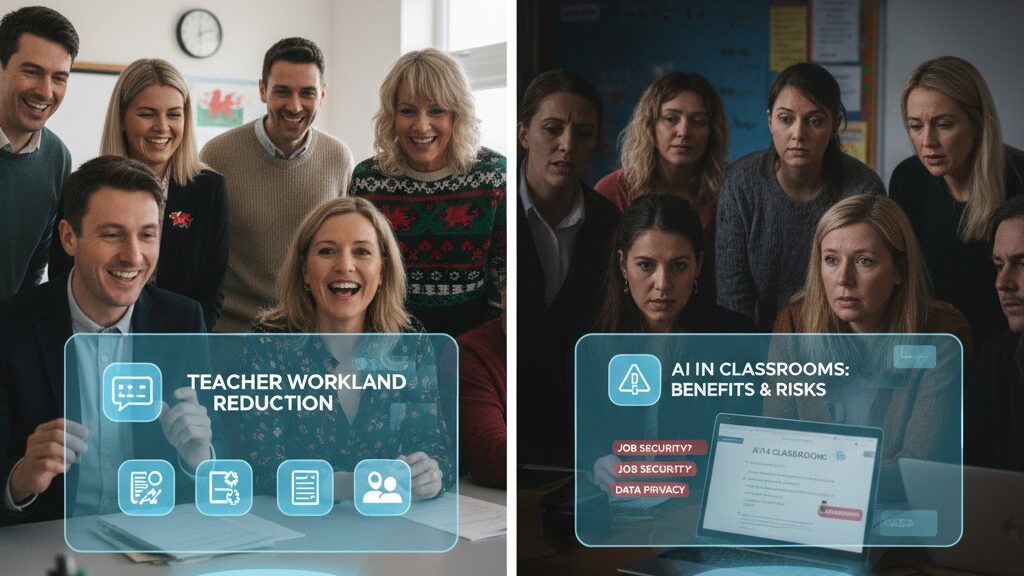
A split image contrasting two emotional responses to AI in Welsh schools. On the left, a group of smiling, happy teachers stands around a table with a glowing holographic display showing "TEACHER WORKLOAD REDUCTION" and icons representing administrative tasks, symbolizing excitement. On the right, a group of wary, concerned teachers huddle around a laptop displaying "AI IN CLASSROOMS: BENEFITS & RISKS," with text highlighting "JOB SECURITY?" and "DATA PRIVACY," reflecting their apprehension. The Welsh flag is visible in the background on the left. Image (and typos) generated by Nano Banana.
As artificial intelligence begins to reduce teacher workloads in schools across Wales, educators are experiencing a mix of excitement for the potential benefits and apprehension about the unseen challenges. This image vividly contrasts the initial relief of reduced administrative burdens with the underlying worries about job security, data privacy, and the broader impact of AI on the educational landscape. Image (and typos) generated by Nano Banana.

Source

BBC News

Summary

A new report by Estyn, Wales’s education watchdog, finds that while artificial intelligence is helping teachers save time and reduce administrative workloads, schools remain cautious about its classroom use. Many Welsh teachers now use AI for lesson planning, report writing and tailoring resources for students with additional needs. However, concerns persist around plagiarism, over-reliance, and data ethics. At Birchgrove Comprehensive School in Swansea, staff are teaching pupils to use AI responsibly, balancing innovation with digital literacy. Estyn and the Welsh government both emphasise the need for national guidance and training to ensure AI enhances learning without undermining skills or safety.

Key Points

  • AI is reducing teacher workloads by automating planning and reporting tasks.
  • Estyn warns that schools need clearer guidance for ethical and safe AI use.
  • Pupils are using AI for revision and learning support, often with teacher oversight.
  • Staff report excitement about AI’s potential but remain wary of bias and misuse.
  • The Welsh government has committed to training and national policy development.

Keywords

URL

https://www.bbc.com/news/articles/c0lkdxpz0dyo

Summary generated by ChatGPT 5


Leaving Cert changes won’t stand up to AI, says Colm O’Rourke


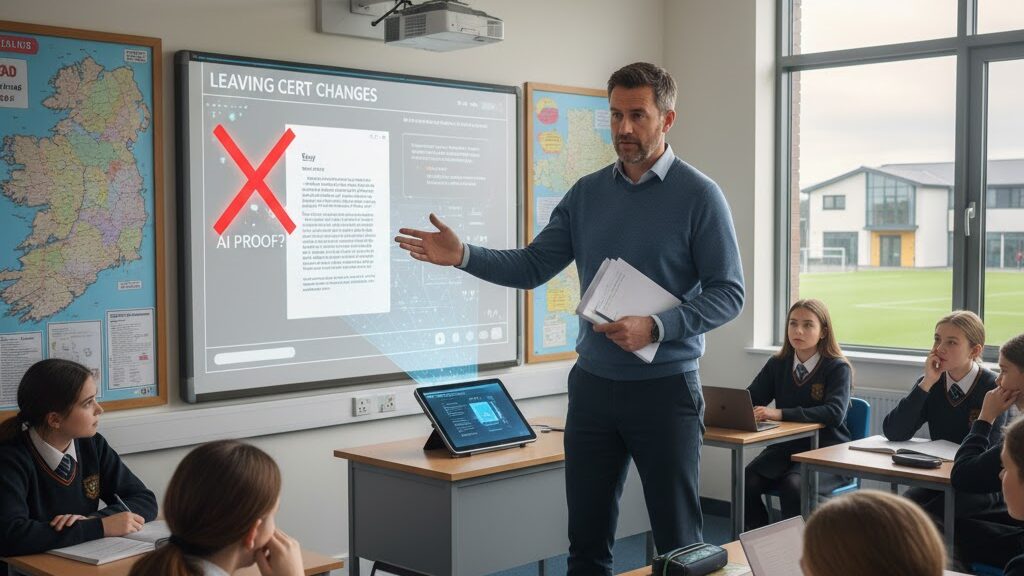
In a modern secondary school classroom, a male teacher stands at the front, holding papers and gesturing towards a large interactive screen. The screen displays "LEAVING CERT CHANGES" with a big red 'X' over a document and the question "AI PROOF?", indicating concerns about the new exam structure's vulnerability to AI. Students in school uniforms are seated at desks, attentively listening. Image (and typos) generated by Nano Banana.
Concerns are mounting that recent changes to the Leaving Certificate examination system may not be robust enough to withstand the challenges posed by artificial intelligence. This image depicts a teacher discussing the new exam structure in a classroom, highlighting anxieties that the updated assessment methods might be susceptible to AI-driven academic dishonesty, compromising the integrity of the crucial final exams. Image (and typos) generated by Nano Banana.

Source

BreakingNews.ie

Summary

Former school principal and columnist Colm O’Rourke has criticised Ireland’s revised Leaving Certificate curriculum, warning that new assessment methods are ill-equipped to withstand the influence of generative AI. The updated curriculum, which allocates 40 % of marks to classroom-based work, was designed to promote continuous assessment but, according to O’Rourke, is now “too easy to cheat.” He argues that the reforms—developed years ago—have already been overtaken by technological change. O’Rourke calls for more in-person, practical, and oral-style assessments to ensure authenticity and to distinguish between genuine learning and AI-assisted shortcuts.

Key Points

  • The new Leaving Cert curriculum allocates 40 % of marks to class-based assessments.
  • O’Rourke warns these assessments are highly vulnerable to AI-assisted cheating.
  • He advocates for oral, practical, and supervised assessment formats instead.
  • The reforms were designed a decade ago and are now outdated by AI’s rapid rise.
  • He argues that genuine knowledge acquisition cannot be replicated by AI tools.

Keywords

URL

https://www.breakingnews.ie/ireland/leaving-cert-changes-wont-stand-up-to-ai-says-colm-orourke-1816115.html

Summary generated by ChatGPT 5


ChatGPT Has Been My Tutor for the Last Year. I Still Have Concerns.


In a cozy, slightly cluttered student bedroom at night, a young female student sits on the floor with her laptop and books, looking pensively at a glowing holographic interface displaying "CHRONOS AI - Your Personal Learning Hub," showing a tutor avatar, progress, and various metrics. In the window behind her, a shadowy, horned monster with red eyes ominously peers in, symbolizing underlying concerns despite the AI's utility. Image (and typos) generated by Nano Banana.
While ChatGPT has served as a personal tutor for many students over the past year, its pervasive integration into learning also brings forth lingering concerns. This image captures a student’s thoughtful yet wary engagement with an AI tutor, visually juxtaposing its apparent utility with an ominous background figure, representing the unresolved anxieties about AI’s deeper implications for education and personal development. Image (and typos) generated by Nano Banana.

Source

The Harvard Crimson

Summary

Harvard student Sandhya Kumar reflects on a year of using ChatGPT as a learning companion, noting both its benefits and the university’s inconsistent response to generative AI. While ChatGPT has become a common study aid for debugging, essay support, and brainstorming, unclear academic guidelines have led to confusion about acceptable use. Some professors ban AI entirely, while others encourage it, leaving students without a shared framework for responsible integration. Kumar argues that rather than restricting AI, universities should teach AI literacy—helping students understand when and how to use these tools thoughtfully to enhance learning, not replace it.

Key Points

  • AI tools like ChatGPT are now embedded in student life and coursework.
  • Harvard’s response to AI use remains fragmented across departments.
  • Students face unclear ethical and authorship boundaries when using AI.
  • The author calls for structured AI literacy education rather than bans.
  • Thoughtful engagement with AI requires defined boundaries and shared guidance.

Keywords

URL

https://www.thecrimson.com/article/2025/10/7/kumar-harvard-chatgpt-tutor/

Summary generated by ChatGPT 5


Today’s AI hype has echoes of a devastating technology boom and bust 100 years ago


A split image contrasting two eras. On the left, a sepia-toned scene from 100 years ago shows a crowd enthusiastically gathered around industrial machinery and towering power lines, with a banner proclaiming "THE FUTURE OF EVERYTHING!" On the right, a vibrant, futuristic cityscape glows under a digital sky, where a diverse crowd looks up at a holographic brain symbol and text announcing "AI REVOLUTION! UNLIMITED POTENTIAL!". In the foreground, people interact with digital news showing "AI CRASHES" and "TECH LAYOFFS." Image (and typos) generated by Nano Banana.
The intense fervor surrounding today’s AI technology mirrors the intense hype and subsequent devastating bust of a technological revolution a century ago. This side-by-side comparison starkly portrays the recurring cycle of technological innovation and speculation, prompting a cautionary reflection on whether the current AI gold rush could face a similar fate to past booms and busts. Image (and typos) generated by Nano Banana.

Source

The Conversation

Summary

Cameron Shackell draws parallels between today’s AI boom and the electrification craze of the 1920s. Just as electricity fuelled massive innovation, speculation and eventual collapse, AI is showing similar patterns of overinvestment, market concentration and loose regulation. The 1929 stock market crash revealed the dangers of unregulated “high-tech” exuberance, leading to reforms that transformed electricity into stable infrastructure. Shackell warns that AI could follow the same path—booming unsustainably before a painful correction—unless governments implement thoughtful regulation. The question, he suggests, is whether we can integrate AI safely into daily life before a comparable bust forces reform.

Key Points

  • The 1920s electricity boom mirrors today’s AI surge in hype and speculation.
  • Both technologies reshaped industries and drove market concentration.
  • Lack of oversight in the 1920s helped trigger the Great Depression.
  • AI’s rapid expansion faces similarly weak global regulation.
  • The author urges proactive governance to avoid another tech-driven collapse.

Keywords

URL

https://theconversation.com/todays-ai-hype-has-echoes-of-a-devastating-technology-boom-and-bust-100-years-ago-265492

Summary generated by ChatGPT 5